 October 9, 2026
 Categories: Halacha & Hashkafa / Torah
I Didn’t Light the Fire!


Mr. Brand was working in his backyard one afternoon, using an electric compressor to inflate several tires. The machine hummed beside him as he worked.
Suddenly, the compressor sputtered. A spark shot out, followed by a burst of flame from the motor housing.
“Fire!” his wife called from the porch. “Get the extinguisher!”
Mr. Brand stepped back and watched the small flames flicker around the machine. “Don’t worry,” he replied calmly. “It’ll burn out in a moment.”
But instead, a sudden breeze swept across the yard, fanning the flames. Dry leaves nearby caught fire, and within moments the blaze spread into a patch of brush along the fence line.
“The extinguisher!” his wife urged again.
Now concerned, Mr. Brand hurried to get the fire extinguisher from the house. By the time he returned, however, the fire had already crept into the neighboring yard. His neighbor shouted in alarm as the flames reached a large tarp, which quickly ignited.
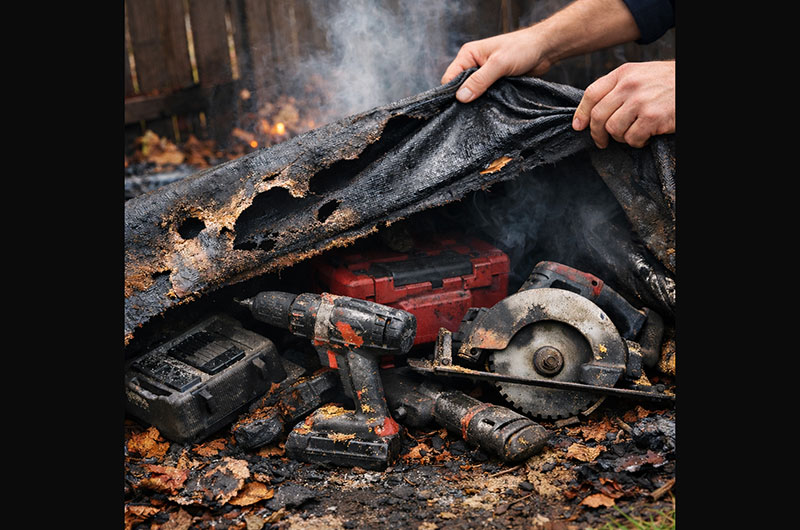
Mr. Brand sprayed the extinguisher and managed to put out the fire before it spread further. Still, the tarp had burned badly. When the neighbor pulled the burned tarp back, he stared in dismay. Underneath were several expensive power tools that he had stored there temporarily. The fire had badly damaged them.
“You’ll have to compensate me for this,” the neighbor said firmly.
Mr. Brand shook his head. “I didn’t even light the fire,” he replied. “The compressor sparked on its own. And how was I supposed to know that there were valuable tools hidden under a tarp?”
The discussion grew tense. The two came before Rabbi Dayan and asked:ראש הטופס
תחתית הטופס
“Is Mr. Brand liable for the tools under the tarp?”
“Eish (fire) is a category of damage defined as a person’s flame spread by the wind,” said Rabbi Dayan (C.M. 418:1).
“The Amoraim dispute (B.K. 22a) whether fire is like one’s property – such as an animal or pit – that caused damage (isho mishum mamono) or is considered like the person’s own actions (isho mishum chitzav), as if he himself caused the damage. The halacha is that both elements exist (C.M. 418:17; Sma 418:25).
Thus, for example, if there was a wall capable of containing the fire when it began, but the wall subsequently fell (unrelated to the fire) and the fire spread, the damage is not attributed to the person’s own actions (kalu lo chitzav), but he is still liable as to other property of his that caused damage when he neglected to contain the fire (C.M. 418:6).
One practical ramification relates to the exemption of tamun – unexpected covered or concealed items that were consumed – which applies only when the fire is not attributed to the person’s own actions (C.M. 418:13; Minchas Chinuch 56:2).
If the person did not light the fire but rather his property caught fire on its own and spread, Even Ha’azel (Hil. Nizkei Mamon 13:19) proves from the language of the Rambam and Shulchan Aruch (C.M. 418:6) that the person is still liable for it like for other property of his that he did not restrain and which subsequently caused damage.
Moreover, Minchas Chinuch (56:1) derives from Tosafos (B.K. 22a s.v. isho) that although the person did not light that fire, it is still attributed directly to him (chitzav), since he was negligent in containing a fire in his ownership. According to this opinion, the leniency of tamun (even when there was a protective wall that fell) would be limited to a case where the person lit a fire with wood that is not his, e.g. hefker wood, since otherwise the fire would be considered his action on account of his ownership of the wood or, in our case, the compressor (Giddulei Shmuel B.K. 22a).
However, Giddulei Shmuel (ibid.) concludes that when the person did not light the fire, he is liable only on account of the fire being his wood or property (mamono), so that the associated leniency of tamun does apply.
Returning to our case, according to Minchas Chinuch, Mr. Brand is liable for the tools because the fire is considered his own action – he owned the compressor that ignited and was negligent in containing the fire. According to Giddulei Shmuel, though, he is not liable, since he did not light the fire, so the leniency of tamun applies.
“Due to the dispute in the sources,” concluded Rabbi Dayan, “Mr. Brand cannot be held liable for the tools, but it is proper to compromise, since some maintain that there is a moral obligation – chiyuv latzeis yedei shamayim for tamun (Pischei Choshen, Nezikin 9:20[53]).”
Verdict: Eish is considered as both the person’s own action (chitzav) and damage caused by his property (mamono). If a person’s property caught fire and he neglected to contain it, the Acharonim dispute whether it is considered his own action. One ramification is whether the leniency of tamun (concealed items) applies. Due to the dispute on that point, Mr. Brand cannot be held liable, but it is best to come to a compromise.