 October 9, 2026
 Categories: Headline / Perspectives / Op-Eds
If You Come to Shul to Shmooze, Where Do You Go to Daven?
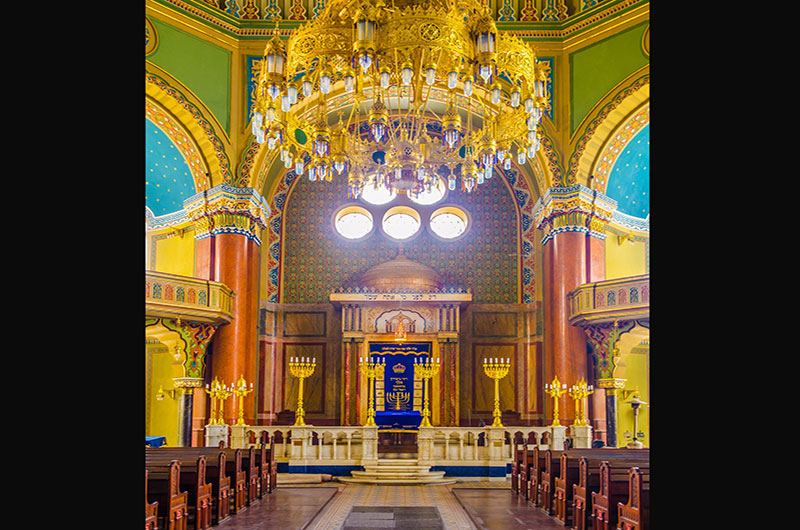


Beginning this week, and for approximately the next two months, Jews worldwide will be learning about the many detailed nuances of the Mishkan, the portable Sanctuary we constructed for G-d amidst our desert travels en route to the Holy Land. What made the Mishkan so interesting, as we will see, is that it was counterintuitive for its time (and in many ways, still is so today).
Not (Just) in Heaven
In simple terms, G-d instructed us to create a holy space in this finite realm in which His Presence could rest. But if we pay attention to the language of the verse, we see that this calling was far from simple: “V’asu Li mikdash v’shachanti b’socham” (Exodus 25:8). The standard translation is that G-d would dwell within this portable space. Before we deconstruct the Torah’s choice of wording, the reason why this task was so novel in its time was because G-d was always thought of as residing somewhere “up there.” Societies of the Ancient World couldn’t bridge spirituality and physicality together. The two realities (and experiences) were distinctly separate, and the only reason why G-d (or in their case, the gods) would interfere with this finite realm was if He had to punish us for some wrongdoing.Jews were the first to see G-d not just as the Creator of history, but also as intimately involved in history as it continued to unfold. Where others saw G-d as the Supreme Ruler of the natural world, in which time was cyclical and predicated upon order and consistency, we saw Him within – as well as beyond the confines of – nature. As much as G-d was “over there,” He was also (and continues to be) very much “right here.” The Jewish story wasn’t only about what happened, but, more so, about what was happening – because when we give meaning to the events we experience, both past and present, we share in the task of shaping that narrative for the future. This is our partnership with G-d, as Rabbi Jonathan Sacks explains in his book Future Tense.
So, our first collective building project as a newly liberated nation, beginning in this week’s parsha, was to create a space for G-d which we’d be able to bring with us wherever we traveled. And we took this message with us whenever and to wherever we were exiled from our Holy Land and forced to scatter throughout the four corners of the earth. G-d cares about our lives like a parent cares about his or her children. As Rabbi Sacks points out in Studies in Spirituality, unlike the cathedrals and temples of yesteryear, in which G-d was made to feel vastly large and unreachable, the simplicity of our shuls and batei medresh highlights how close godliness is, and how great is our potential to grow spiritually. The concept of a shul was a reminder that we didn’t have to be in the shelter of the holy city of Jerusalem to connect with G-d. He’s everywhere, Rabbi Sacks points out in Covenant and Conversation: Exodus, and if we so desire, we can form a relationship with Him from anywhere.
An Awakening from Below
Our analysis of the directive to construct the Mishkan would be amiss if we didn’t note that the preposition “b’socham,” often translated as “within it” (i.e., within the Mishkan), actually means “within them.” G-d doesn’t just reside within spaces, but godliness lives within us as well. Whether we actively sign up for the role or not, each of us is a mikdash me’at, a miniature sanctuary. We’re intrinsically holy because our Maker, in Whose image and likeness we were created, is holy – regardless of how we feel, or what we do or don’t do, in any given moment.These two aspects of holiness – the external spaces and our internal essence – have to work in partnership. Holiness is found in how we conduct our businesses and how we educate our children; it manifests in our incredible communal initiatives like bikur cholim, Chai Lifeline, and Hatzalah; it plays a role in our personal lives, such as when we refrain from speaking about others and are mindful of what we look at; and we practice holiness not just when we affix mezuzahs to our doors or wrap tefillin, but also when we exercise, when we eat, and when we interact with others.
Externally, making our spaces G-d-friendly doesn’t mean that we’re creating a new space for Him which was previously void. Rather, when we build shuls and batei medresh, we’re taking an active initiative to see the godliness already present therein – and helping it find tangible outlets. This is our “awakening from below,” and it’s very evident in the numerous donor plaques that adorn these many structures. We take care to decorate these places and maintain them through proper upkeep and security projects. And for many, shul is one of our primary modes of Jewish connectivity (regardless of whether our attendance is daily or annual).
Keeping Holiness Holy
Yet as much as we should be celebrating these moments and milestones of awakening, sometimes (or often, depending on location and community) it feels as though we have a difficult time keeping the holiness holy. Instead of creating spaces for G-d’s presence to dwell in comfort, we create spaces that scream the opposite (figuratively, and sometimes quite literally in sound volume). By and large, bluntly stated, our shuls have become arenas to catch up with our buddies on life and the latest happenings of the marketplace outside. And most recently, this has started to include gaming, scrolling, or streaming.It’s not by chance that our Sages define humanness as being a medaber, a speaking creature, in contrast to the many species of the animal kingdom. (See, for example, Onkelos on Genesis 2:7). Not only do the words we speak make a difference in shaping our realities, in the general sense – research has shown how our language affects our emotions and mental well-being – but they also transform the places in which we speak them. Indeed, socialization is an integral component of forming relationships and creating a sense of community and belonging, but certain times and places are more suitable to engage interpersonally than others.
While any formal p’sak or detailed halachic guidance is beyond the scope of this discussion, and should more appropriately be directed to one’s personal rav, some general halachos that we can be mindful of include:
- Talking is not permitted during Pesukei d’Zimra, except to answer Amen to certain blessings (Orach Chaim 51:4).
- Talking is not permitted for any reason during Kaddish (Mishnah Berurah 56:1), between Barchu and Yotzeir Ohr (O.C. 57:2), between Ga’al Yisrael and Shemoneh Esrei (O.C. 66:7), during Shemoneh Esrei itself (O.C. 104), during Kedusha (Rema, O.C. 125:1), during Birkas Kohanim (O.C. 128:26), during Kerias haTorah (O.C. 146:2) and the Haftarah (O.C. 146:3), and between Va’yachulu and Magen Avos during Maariv on Friday night (O.C. 268:12).
- Talking during the Repetition of Shemoneh Esrei is only permitted to ask a rav a specific shailah (Aruch HaShulchan 124:12).
- As well, there are also times when speaking during davening would be considered an interruption, and may require us to repeat those parts of davening, such as during Kerias Shema (M.B. 65:1, 66:1) and during Hallel (O.C. 422:4, 488:1).
Notably, halacha understands that how we spend our time in our shuls and batei medresh isn’t only about creating a personal experience between us and G-d as individuals, but also about helping to ensure that others are able to achieve an appropriate sense of connectivity as well. After finishing our personal Shemoneh Esrei, we’re supposed to remain standing in our place until the leader begins his Repetition (and then take our final three steps forward), as a way of not causing any distractions to those still davening (M.B. 123:2); we’re only allowed to sit next to someone who’s still davening if we don’t make noise (O.C. 102:2); and we’re not allowed to talk at all during the Repetition unless it’s to answer Amen to its blessings (O.C. 124:2).
Journeying Forward Together
Davening isn’t always easy, and we each have different connections to shul and reasons for attending. Some of us come to converse with our Maker; some come because we feel obligated, guilty, or want to be recognized as an individual who attends daily minyan; others come for the drasha or shiur after davening; and there are those of us who come because we hear a good kiddush is being sponsored. Regardless of our reasons, there are practical acts we can all do to ensure that we collectively maintain a sacred decorum and environment.Some examples include:
- If we find ourselves finished with certain sections of davening prior to the rest of the minyan, we can open a Tehillim, sefer, or other shul-appropriate article.
- If the silence makes us feel uncomfortable or we become jittery, we can take a break in the hall or lobby and return to the minyan after we feel calmer.
- If we’re attending a shiur that takes place in an adjacent room to the minyan, we can make sure not to talk with those who came to the shiur as we walk past (or through) the minyan. We can also make sure that the door to the shiur is closed while davening is taking place.
- For those of us blessed with children, we can model appropriate shul decorum and inspire them to participate in the davening instead of allowing (or even encouraging) them to run back and forth between the chairs in search of the best candy. We can also encourage them to attend the youth minyan or “kids’ program” if the main minyan is too mature.
- If we do have something urgent to tell someone in the minyan (including coordinating among gabbaim), both individuals can step outside to speak. Those of us who need to speak outside the minyan can ensure that the minyan door is closed before conversing (and if there’s no door, we can make sure that we speak far enough away from where the minyan is taking place).
- And finally, we must be mindful that just because the minyan is scheduled to begin, or normally ends, at a specific time, many individuals come early – to learn, recite Tehillim, say Korbanos, or are still davening once the majority of the minyan has finished. Our talking, setting up for kiddush, or other noise-making activities during these times can be immensely disruptive (even if we think we’re whispering).
Just prior to entering a new, and more elevated, relationship with G-d when He gifted us with the Torah at Mt. Sinai, He issued an eternal mission for each of us to become a kingdom of priests and a holy nation (Exodus 19:6). Priesthood is hereditary, only allotted to a few individuals. Holiness, by contrast, is applicable to, and attainable by, each of us. Our inner holiness is up to each of us as individuals to decide how to actualize, but our external, communal holiness – and the holy spaces we create together – are a collective responsibility.
There’s a time to speak and there’s a time to refrain from speaking. Let’s unite in sanctifying our holy spaces. We make them aesthetically beautiful with continuous renovation projects, and we make them accessible to those with mobility and other physical complexities. Let’s also make them accessible to the Divine, and ensure that they’re comfortable spaces for those of us who come to connect to that Source.