 September 25, 2026
 Categories: Headline / Perspectives / Op-Eds
Introducing Ematai’s Halachic Estate Shtar
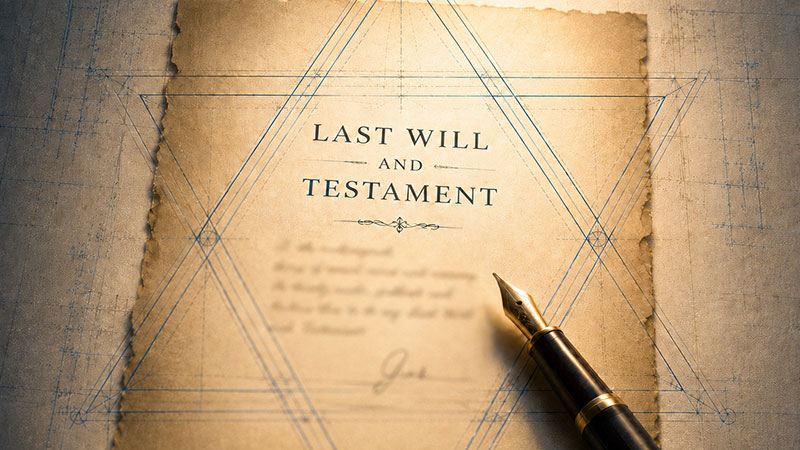


Few areas of Jewish law feel as emotionally charged and as quietly neglected as inheritance. Under formal Torah law, assets transfer upon death immediately to designated Torah heirs, most prominently sons. Yet as Rabbi Shlomo Dichovsky has noted, religious Jews commonly draft civil wills that distribute assets to spouses, daughters, stepchildren, or favored causes, reflecting their instincts about fairness, family financial security, and charitable giving. Jewish legal decisors have long confronted this challenge. For generations, halachic mechanisms have enabled assets to be distributed to “non-Torah heirs” while preserving fidelity to Jewish law. This historical practice was strongly endorsed by Jerusalem’s legendary Rabbi Yechiel Michel Tykocinski (Gesher Ha-Chayim Vol 1, p. 41), who urged parents to structure their estates in a halachically sound manner that would include all children and prevent disputes. With proper planning, one can uphold halacha while ensuring that one’s estate is distributed as intended.
The difficulty begins with a basic principle. Under halacha, inheritance is not a matter of personal choice. Ownership transfers automatically at the moment of death. A civil will, by contrast, operates after death, directing courts to distribute assets according to the testator’s wishes. By the time the will takes effect, halacha has already assigned ownership. This mismatch creates a genuine legal problem.
The concern is not merely theoretical. If a civil will distributes assets to individuals who are not halachic heirs, recipients face the possibility of receiving funds that technically belong to others. Rabbi Moshe Feinstein proposed a novel argument to validate such transfers, but many authorities have challenged this position. As a result, relying on a civil will alone remains halachically uncertain.
Some suggest distributing assets during one’s lifetime. While Jewish law permits gifts of any size, this approach is usually impractical. One can only give away what one currently owns, and most individuals need to retain control of their resources. In addition, no one can predict future needs, longevity, or the eventual size of their estate. Lifetime gifting and related planning tools may help in specific cases, but they do not resolve the core issue.
The more effective solution, endorsed by leading halachic authorities and rooted in medieval precedents, is to supplement a civil will with a halachic document known as a shtar zachar shalem. Originally developed to provide for daughters alongside sons, this mechanism allows the distribution outlined in a civil will to take effect within a halachic framework.
The structure is both simple and sophisticated. The shtar creates a substantial financial obligation, a debt owed by the testator to designated beneficiaries, which takes effect immediately before death. The amount is deliberately set far higher than the expected value of the estate. For example, someone anticipating a two million dollar estate might establish a four million dollar obligation.
This structure shapes the incentives of the Torah heirs. If they accept the distribution outlined in the civil will, the obligation is waived and the estate is divided accordingly. If they challenge the will in a rabbinical court, they must first satisfy the full debt. Faced with such a requirement, there is no incentive to pursue a claim based on formal inheritance law, which the bet din would anyway rule against because of the obligation. The practical result is that the civil will is respected.
This mechanism operates fully within halacha. The Torah heirs retain their formal rights, but the legal structure encourages them to affirm the intended distribution. It also helps prevent disputes that can fracture families at sensitive moments. By aligning legal reality with personal intent, the shtar promotes compliance and harmony.
Practically, the process is straightforward. The shtar can be signed at any point while the individual is competent, ideally soon after completing a civil will. It is then given to a beneficiary or entrusted to a rabbi or attorney. The document does not require witnesses and is only presented if a dispute arises in beit din. It remains in the background, ensuring that the estate plan functions properly.
Some have raised concerns about whether such a document could create complications under civil law. To date, such concerns have not materialized. Nonetheless, Ematai’s estate shtar addresses this explicitly by stating that it is intended solely for halachic purposes and is structured to avoid enforceability in civil court. While consultation with legal professionals is advisable, the shtar’s role remains within the halachic system alone. Ematai’s shtar has been reviewed by many lawyers and rabbis and endorsed by Rabbi Mordechai Willig.
Estate planning reflects responsibility and foresight. By making use of established halachic tools, individuals can ensure that their wishes are fulfilled in a legally effective and halachically sound manner. You can protect your loved ones not only materially, but also from conflict, leaving behind a legacy shaped by wisdom and care.
Take the initiative at ematai.org/shtar. If not now, when?