October 2, 2026
 Categories: Collecting / Arts
Jakob Edelstein, ‘The Elder of Theresienstadt’


Jakob Edelstein (1903-1944) was born in Horodenka, then part of the Austro-Hungarian Empire (today in Ukraine), into a middle-class devout Ashkenazi Jewish family whose cultural and communal identity was firmly rooted in Central European Jewry. His father, Motl, a textile merchant, and his mother, Mattil, raised their children in an environment that blended Jewish consciousness with the assimilated civic culture common among many Jews of the late Habsburg period. In 1915, during WWI, the family fled Horodenka to Brno in Moravia to avoid the Russian army that incited a pogrom against the Jews of Horodenka when nine Jews were hanged in the main street. When his family returned to Horodenka after the war, Jakob remained in Brno to finish his studies at a business school, and he left Brno for Teplitz in northern Bohemia after his graduation, where he worked as a traveling salesman.
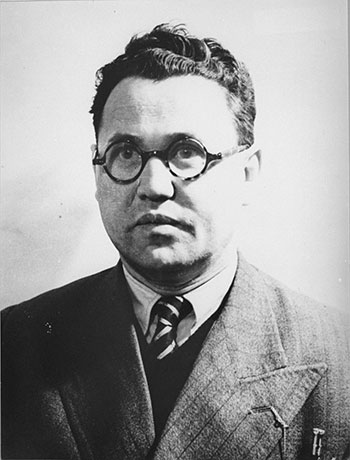
From an early age, Edelstein showed intellectual promise and organizational talent. By his late teens he had become active in Zionist circles, especially within the labor-oriented wing of the movement that sought both Jewish national revival and social reform, and his early activism coincided with the dramatic transformations following WWI and the creation of Czechoslovakia, a democratic state in which Jews initially enjoyed civil equality and relative security. He became a passionate member of the Poale Tzion movement, and from 1926, he was involved in HeChalutz, a Zionist youth organization and a resistance movement in WWII, later working at its head office. In 1929, he joined the Histadrut, an organization of trade unions.
Edelstein’s Zionism was not merely theoretical. He became associated with the Zionist Organization in Czechoslovakia and worked particularly with youth initiatives encouraging Jewish self-renewal and eventual settlement in Eretz Yisrael. During the 1920s and 1930s, he was involved in programs linked to Youth Aliyah, which aimed to prepare Jewish adolescents for agricultural and communal life in the Land of Israel. Surviving correspondence and testimonies indicate that he sincerely believed in the Zionist project as both a practical refuge and a moral renaissance for European Jewry.
He and his family held aliyah certificates before the war and had planned to join Kibbutz Givat Chaim, but he chose to remain in Czechoslovakia because of organizational responsibilities, family commitments, and a refusal to abandon his community. That choice would cost him his life and the lives of his family.
In 1931, Edelstein married Miriam (often called Mimi) Taussig, a Jewish woman from Prague, and moved with her there to work for the Palestine Office of the Zionist movement. Two years later, he was appointed director of the organization, in which capacity he was responsible for distributing British immigration certificates to Jews moving to Eretz Yisrael, a position he retained until the office was closed right before the outbreak of WWII. Their marriage was fully within the Jewish community and they raised their son, commonly identified in sources as Arieh or Ariel, in a consciously Jewish environment. Evidence from contemporaries suggests that while the Edelsteins were not strictly Orthodox, they maintained many Jewish observances, including marking major holidays, observing elements of kashrut in the home, and participating actively in communal institutions. His religious posture reflected a pattern common among Central European Zionists of his generation: a blend of cultural Judaism, selective traditional practice, and modern national consciousness. Thus, though he was not known as a rigorously halachic Jew, he consistently affirmed Jewish continuity and responsibility.
During the interwar years, Edelstein worked in commerce while devoting increasing time to Jewish communal leadership such that by the mid-1930s, he had become a prominent figure in Prague’s Jewish public life. The Nazi rise to power in neighboring Germany in 1933 and the subsequent intensification of antisemitism across Central Europe heightened his sense of urgency. When Germany annexed the Sudetenland in 1938 and proceeded to dismantle Czechoslovakia in March 1939, he immediately became involved in emergency Jewish relief and emigration efforts. Like many Zionist activists, he understood earlier than most assimilationist leaders that the situation facing European Jewry was existential.
Edelstein visited England in 1938 to help facilitate the evacuation of Jewish refugees, but his wife was ordered to stay in Czechoslovakia, which forced him to return home. In 1940, he went to Trieste to evacuate Czechoslovakian Jews but, in March 1941, the SS commanded him to instruct the chairmen of the Jewish Council in Amsterdam, Abraham Asscher and David Cohen, to establish an administrative apparatus between the council and the "Central Office for Jewish Emigration in Amsterdam.” Pursuant to the so-called Nisko-und-Lublin Plan, he and another thousand Jewish men were deported on October 18, 1939 to Nisko in the Lublin reservation, where the Nazis planned to establish a “Jewish reservation,” but after the Nisko Plan failed, Edelstein returned to Prague in November 1939.
On December 4, 1941, by order of the head of SS-Sturmbannfuhrer Hans Gunther, the "Central Office for Jewish Emigration in Prague," Edelstein and his family were deported to Theresienstadt. The Jewish community in Prague under German occupation was reorganized under strict Nazi supervision and Edelstein rose rapidly within its leadership structure because of his administrative abilities, language skills, and reputation for discipline. With the Nazi implementation of the Theresienstadt project as a hybrid ghetto-camp intended both as a transit point and a propaganda showcase, he was selected by commandant SS-Obersturmfuhrer Siegfried Seidl to serve as the first Judenältester (Jewish Elder) of the Jewish Council of Elders in the ghetto. This appointment placed him at the center of one of the most morally fraught positions in the history of the Holocaust.
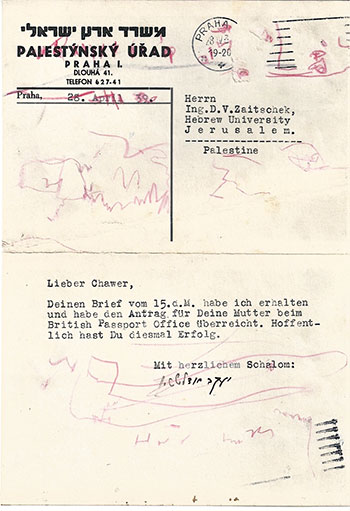
Exhibited here is a truly extreme rarity: an originally signed (in Hebrew!) April 28, 1939 rescue-related document from Edelstein as head of the Council of Elders of the Theresienstadt Ghetto to a “dear Chaver” in Jerusalem. In this letter, written on behalf of the mother of a Jew named D. V. Zaitschek who is attempting to secure a British passport for her, he writes:
I received your letter of the 15th of this month and submitted your mother’s application to the British Passport Office. I hope that this time it will succeed.
Warm regards, Jakob Edelstein.
The Theresienstadt Ghetto was established in the fortress town of Terezín in November 1941 with Nazi authorities intending it to function simultaneously as a holding camp for Czech Jews, a waystation for deportations eastward, and eventually as a “model ghetto” used to deceive international observers. Edelstein’s selection as head of the Ältestenrat (the Council of Elders) was made by the SS, but within the Jewish population he was initially regarded as a capable and relatively young leader who might mitigate German brutality.
Edelstein approached the role with a mixture of pragmatism, Zionist social planning, and desperate hope that productive labor might preserve Jewish lives, and, according to multiple testimonies preserved at Yad Vashem, he believed that if the ghetto could demonstrate economic usefulness to the German war effort, mass deportations might be slowed or reduced. This strategy, sometimes summarized as “salvation through work,” was not unique to him, but it became closely associated with his administration.
Inside Theresienstadt, Edelstein worked to create structured labor assignments, housing systems, and rudimentary welfare networks under impossible conditions of overcrowding, disease, and starvation – while also supporting cultural and educational activity among prisoners, believing that maintaining Jewish dignity and community life was essential for psychological survival. Surviving records show that religious life continued in the ghetto, often clandestinely, and that Edelstein did not suppress these activities. Although not personally Orthodox, he permitted, and at times facilitated, the functioning of prayer groups, holiday observances, and rabbinic leadership.
Accounts from fellow prisoners suggest that Edelstein himself continued to observe Jewish rituals in a modest but meaningful way, reportedly attending holiday prayers when possible and maintaining respect for dietary restrictions to the extent conditions allowed. Several testimonies note that he marked Yom Kippur and Passover in whatever limited fashion was feasible while, at the same time, the extremity of ghetto life made full observance nearly impossible, and like most prisoners, he was forced into painful compromises simply to survive. He organized collective Passover seders when possible, and he supported the continuation of children’s Jewish education.
He did not impose religious conformity, as Theresienstadt contained a wide ideological range, but he viewed Jewish continuity as central to morale and scholars generally agree that his Zionist identity remained strong even under extreme duress. At the same time, he prioritized communal survival over strict ritual compliance – an approach consistent with many rabbinic rulings that preservation of life overrides most religious prohibitions. There is no evidence that he abandoned Jewish identity; rather, his actions suggest a leader attempting to sustain Jewish collective life to the best of his ability under catastrophic conditions.
Edelstein’s tenure was marked by the most challenging ethical dilemmas. The Nazi administration required the Jewish leadership to compile deportation lists, enforce labor discipline, and maintain internal order, in response to which he repeatedly attempted to manipulate these demands to save vulnerable groups, particularly children and skilled workers. Evidence indicates that he tried to delay transports and redistribute quotas, though his actual power was sharply limited by SS oversight; some contemporaries later credited him with saving lives through bureaucratic maneuvering while others criticized the entire Judenrat system as inherently compromised.
Edelstein was forced to make a horrifying ethical choice when it became obvious that the ghetto could not survive under the existing practice of evenly distributing the severely limited food supply. Those doing heavy work had a greater need for food than those performing normal work; the latter needed more than non-workers; and children, whom he viewed as representing the Jewish future and whom he hoped would survive and go on to make aliyah, required extra rations to survive. Although this impossible-to-imagine decision to increase the rations for those classes of Jews (and, by necessity, decrease them for others) ensured the survival of the ghetto, it also consigned thousands of Jews to death by starvation. (When the camp was liberated, it had a population of about 17,000, but most of the survivors had arrived during the final months of the war.)
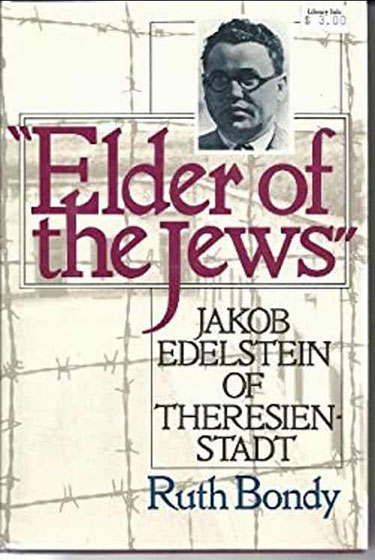
At one point, the HeChalutz organization approached Edelstein and offered to arrange his escape from Theresienstadt, but he refused out of concern for his community. The most concrete account of the proposed escape comes from Ruth Bondy’s major biography Elder of the Jews: Jakob Edelstein of Theresienstadt (Hebrew orig.; English 1989). Bondy was herself a Theresienstadt survivor who had access to extensive survivor testimony and, according to her reconstruction, the episode occurred after Edelstein came under severe pressure from the SS. According to a secondary narrative summary based on Bondy and similar sources, his supporters became fearful for his life after a confrontation in which Adolf Eichmann sharply reprimanded and threatened him. Yet again, the leaders of Hechalutz, then the largest Zionist organization in the camp, met with him and explained that they could facilitate his escape – but he refused to abandon his fellow Jews.
Bondy’s fuller interpretation emphasizes several overlapping motives rather than a single simple one. First, Edelstein had a strong ethos of collective responsibility; as a Zionist labor leader before the war, he believed leadership required personal solidarity with the community in danger, and leaving while thousands remained would, in his view, constitute moral abandonment. Second, there was a practical leadership calculation; at this stage (late 1942-1943), he still believed that maintaining a functioning, productive ghetto might help keep Czech Jews inside the Protectorate and delay transports east. (This hope, tragically mistaken in hindsight, was central to his policy throughout his tenure.) Third, several sources indicate that he feared German manipulation; escapes proposed under SS pressure could be traps and Nazi security services sometimes used fake escape offers to expose underground networks. Fourth, there was the symbolic dimension; survivor recollections reported by Bondy portray Edelstein as highly conscious that the morale of the Zionist youth, many of whom revered him, depended on his visible presence and his departure therefore might have been psychologically devastating inside the ghetto.
By early 1943, tensions with the SS intensified and Edelstein’s efforts to regulate population numbers and his occasional attempts to shield certain individuals drew suspicion. At a count in the ghetto on November 9, 1943 (the fifth anniversary of Kristallnacht), a difference of 55 Jews between the registered and the actual number of inmates appeared and Edelstein was arrested and accused of aiding the escape of inmates and he was replaced by Paul Eppstein as Jewish Elder. After interrogation and imprisonment within the ghetto, Edelstein and his family were deported in December 1943 to the so-called “family camp” at Auschwitz-Birkenau.
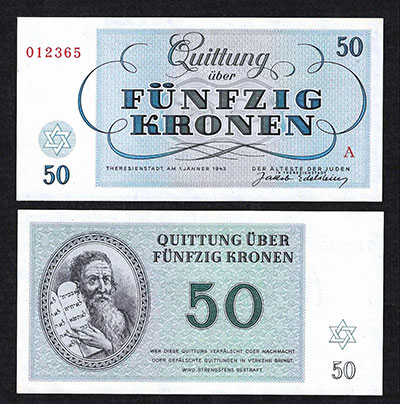
The paper money used in the Theresienstadt ghetto, commonly called “ghetto scrip,” was introduced in 1943 as part of the SS program to reorganize the camp economy and, crucially, to serve propaganda purposes. As discussed, Theresienstadt occupied a unique place in the Nazi camp system: it functioned simultaneously as a transit camp to the East and as a showcase “model ghetto” that the Germans intended to display to the outside world. Thus, the introduction of special currency was meant to create the appearance of a normal, self‑contained Jewish civic life while in reality tightening German control over prisoners’ property and movement. The notes were denominated in kroner and bore the printed signature of Edelstein as the first Jewish Elder of the ghetto even though, ironically, by the time the currency was actually issued he was no longer in that position. His arrest and deportation to Auschwitz in January 1943 did not halt the currency project; instead, when the notes were finally released later that year, the Nazis retained his printed signature because his signature was engraved into the plates in advance and, in any event, functioned symbolically, not legally. Like many aspects of the Theresienstadt façade, it reflected SS priorities rather than administrative reality, and keeping Edelstein’s name helped to present the “money” as an established, legitimate instrument of the ghetto’s “autonomous” Jewish administration, even though the entire system was controlled by the SS.
The notes were designed by Jewish artists imprisoned in the ghetto, most prominently the Czech painter and graphic artist Bedřich Fritta, who headed the Technische Abteilung (Technical Department). Under SS supervision, this department prepared the artwork, layouts, and printing plates, and the imagery, most famously Moses holding the Tablets of the Law on the higher denominations, was deliberately chosen to signal Jewish cultural life and to enhance the propaganda value of the ghetto. The printing itself was carried out inside Theresienstadt using the camp’s own printing facilities, operated by Jewish prisoners under German orders, and the process was technically competent; the notes were well engraved and printed on decent paper, though without sophisticated anti‑counterfeiting features because the currency was confined to the camp.
The circumstances of Edelstein’s final months are unusually well-documented thanks to survivor testimony. In Auschwitz he was separated from his administrative role and reduced to prisoner status, but he continued to display composure and responsibility toward fellow inmates. After a brief proceeding before a kangaroo court lacking any due process, he was executed by shooting on June 20, 1944, and multiple eyewitness accounts state that his wife and young son were forced to watch before being murdered shortly thereafter. (The exact sequence varies slightly among testimonies, but what is undisputed is that the entire immediate family perished in Auschwitz.)
The fate of his extended family reflects the broader catastrophe of Central European Jewry. Many relatives from both the Edelstein and Taussig families were deported and murdered in Nazi camps and the destruction of his wife and son in Auschwitz extinguished his direct line. After the war, however, surviving extended kin and colleagues in Israel and Europe played a significant role in preserving his memory, particularly within Zionist historiography.
Within Theresienstadt, contemporary Jewish opinion about Edelstein was complex but generally more sympathetic than critical. Numerous survivor memoirs describe him as energetic, serious, and personally courageous, and prisoners often noted his youth (he was only in his late thirties during his leadership) and his visible physical exhaustion from constant administrative pressure. Some remembered him walking the ghetto streets late at night inspecting conditions, and others emphasized his attempts to protect children and skilled workers.
Nonetheless, legitimate criticism did exist, particularly in later retrospective debates about the Judenrat system. As with other Jewish leaders under Nazi coercion, historians have wrestled with the moral ambiguities of his position, but the scholarly consensus today tends to view him as operating under extreme constraint with limited real authority. Research by historians such as Livia Rothkirchen and Anna Hájková emphasizes that Theresienstadt’s Jewish administration functioned within a tightly controlled SS framework, leaving little room for independent policy.
In Auschwitz, surviving witnesses uniformly described Edelstein as dignified and composed. His refusal to confess to falsification, despite the certainty of death, has often been cited as evidence of personal integrity, and postwar testimonies collected in Israel and Europe consistently portray his execution as a deliberate SS demonstration intended to intimidate other prisoners.
After the war, his reputation underwent several phases. In the immediate postwar years, survivor communities in Israel and Czechoslovakia generally commemorated him positively, emphasizing his dedication and tragic end. For example, on the June 1947 three-year yahrzeit of Edelstein's murder, the writer Max Brod wrote, “And so a Jewish hero left this world, a man who up to the end did everything he possibly could and never gave up.” During the 1960s and 1970s, broader historiographical debates about Jewish councils introduced more critical scrutiny of all Judenrat leaders. Even in that context, however, Edelstein was rarely singled out for harsh condemnation, and most scholars distinguished his case from leaders who were accused of corruption or collaboration beyond coercion. Institutions such as Yad Vashem and the Terezín Memorial present him within a nuanced but generally sympathetic framework.
Among Jewish religious leaders, retrospective evaluations have also been measured. Rabbinic commentary on Theresienstadt often highlights the unprecedented coercion under which the Jewish administration operated and, while some religious thinkers have raised theoretical objections to any cooperation with Nazi demands, there is broad recognition that Edelstein’s choices were made under duress and aimed at communal survival. Importantly, there is no credible evidence that he ever personally enriched himself or acted with malicious intent toward fellow Jews.
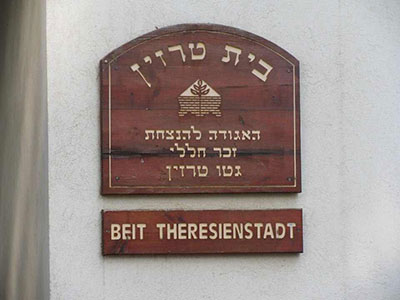

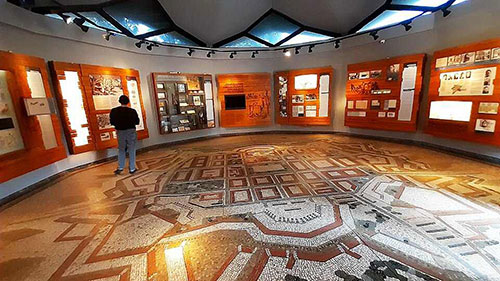
The most significant memorial in Israel associated with Edelstein is the museum and memorial complex Beit Theresienstadt, located at Kibbutz Givat Chaim in central Israel. The institution was founded by survivors of the Theresienstadt ghetto who made aliyah after surviving the Holocaust, who came up with the concept during survivor meetings in Israel beginning in 1955, when they decided to establish an educational and commemorative center dedicated to the memory of those murdered in the ghetto. From its earliest conception, the project was explicitly linked to Edelstein. The complex includes a museum and research center on the history of the Theresienstadt ghetto, memorial halls with names and testimonies of prisoners, archives and educational exhibits dealing with Jewish cultural life in the ghetto, and exhibits specifically describing Edelstein’s leadership, Zionist activity, and execution at Auschwitz in 1944.
Edelstein’s Zionism has remained a central element of his legacy. Israeli historical writing frequently situates him within the broader story of Central European Zionist leadership destroyed in the Holocaust. Memorials in Israel commemorate him as part of the lost generation of young Jewish organizers who might have played major roles in postwar Jewish state-building had they survived.
Edelstein’s story also illuminates the broader function of Theresienstadt. The ghetto was unique in combining features of a transit camp, labor site, and propaganda showcase, and, under his early administration, significant effort went into creating workshops, agricultural units, and housing systems that might persuade the Germans of the ghetto’s utility. While this strategy ultimately failed to prevent mass deportations, historians caution against judging it solely by outcome, noting that Jewish leaders at the time lacked knowledge of the full extermination program unfolding in the East.
Today, Edelstein is remembered as one of the most significant Jewish leaders within the Theresienstadt system, and streets and memorial plaques in Israel and the Czech Republic bear his name. Scholarly literature continues to examine his policies, motivations, and constraints as part of the broader moral history of Jewish leadership under Nazi rule, but, while debate about Judenrat figures remains complex, the prevailing historical judgment places Edelstein among those who attempted, within impossibly narrow limits, to preserve Jewish life and dignity.