 October 16, 2026
 Judging Others by One’s Own Standards


Parshas Korach
The parsha beings, “Vayikach Korach” (16:1) – Korach took. What exactly did he take? Rashi tells us that he took himself out of the consensus of the community which accepted the fact that G-d had chosen Aharon and his sons to be priests and challenged that choice.
Rav Dovid explains the words slightly differently. He took himself as the yardstick. He said to himself, “If I were given the opportunity to keep both the leadership of the people of Israel and the priesthood in my family, would I do so? I certainly would. I would not share any titles or power with anyone else.” So Korach assumed that is what Moshe did too. Korach argued that all of the people were worthy of the priesthood because they were all holy, but Moshe kept all of the titles to himself, not because G-d told him so, but because he himself decided.
What Korach failed to understand was that both Moshe and Aharon were reluctant leaders. Moshe argued with G-d when G-d picked him as the leader. Moshe wanted to give the role to Aharon. Aharon had to be cajoled into the priesthood rather than coveting it. Neither of them wanted the jobs they were given.
Of course, Korach failed to understand the humility of Moshe and Aharon. He was a fabulously rich man and, like many, he craved power more than money.
What about Datan and Aviram. Why did they challenge Moshe and claim that G-d had not given him the directive to appoint Aharon as the kohen? What was their beef with Moshe?
Well, they had stopped believing that G-d spoke to Moshe long ago when they, as Pharoah’s appointed supervisors of the Jewish slaves, heard Pharoah’s response to Moshe’s request to let the people go. Not only did Pharoah not do that, but he intensified the slavery and made them search for their own materials from which to manufacture bricks. That, they reasoned, would never have happened if G-d had really asked Moshe to lead the people out of Egypt. So Moshe must have appointed himself to that role, because if G-d had appointed him like he claimed, he would never have failed so spectacularly. In fact, Datan and Aviram were so skeptical of Moshe’s divine appointment that they never left Egypt with the exodus. They stayed behind and only joined the rest after the splitting of the sea, when it was clear that Moshe was G-d’s appointee. But that admission did not last long, and now they returned to their old ways and accused him of inventing the role of the priesthood for his brother.
When Moshe heard this, he fell on his face (116:4). This means he pleaded with G-d, like we do when we recite Tachanun. He foresaw what punishment would befall both Korach and Datan and Aviram, and, as always, he tried to intervene and mitigate their punishment.
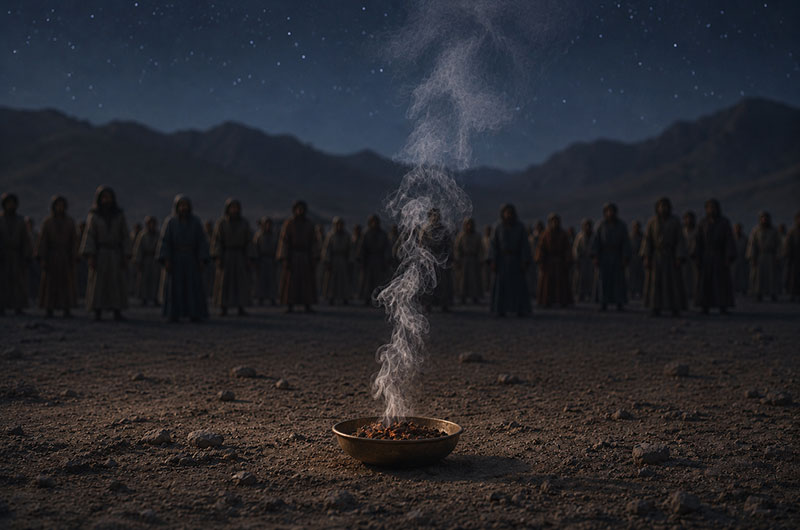
The only way Moshe could convince them that Aharon was the legitimate choice for the priesthood was by getting them to bring an offering themselves and to see what would happen. At that point G-d would let them all know who his true appointee was. The word the Torah uses for “let them know” is “ve’yoda” (16:5), rather than the more typical “ve’yodi’a.” That is because there was no way that either Korach or Dotan and Aviram were going to accept the verdict, so convinced were they of their position.