 October 9, 2026
 Leaving It All Behind


Parshiyos Matos-Masei
“If her father nullified her vows on the day he heard them, all the prohibitions she took upon herself shall not stand and G-d will forgive her” (30:6 and Rashi there). If the woman’s vows were nullified by her father, then there is no longer any danger that she will break them. Why then does she need forgiveness?
“One who declares a vow is like one who built a forbidden altar outside of the Temple, and one who fulfills the vow is like one who offered a sacrifice on it” (Nedarim 22a). Judaism, which celebrates the joy of life through the fulfillment of G-d’s commandments, frowns on voluntary restrictions. That which G-d has permitted to us, we should not prohibit to ourselves. Just as G-d has no desire for sacrifices that are not offered up in His Holy Temple, He has no desire for self-sacrifices that are not required by His Holy Torah. That is the meaning of the introductory words to our parsha, “Zeh ha’davar.” Moshe points to the sefer Torah and says, “These are the words that G-d has commanded,” only these words that are written in the Torah, not words of self-denial that one adds on one’s own initiative. That is why the person who takes a vow needs forgiveness, even if it was immediately annulled and never fulfilled.
G-d instructs Moshe that before he dies he must wage war against Midian for having enticed the people of Israel to behave immorally with Midianite women, an event which led to the death of 24,000 Jews (25:9). Moshe understood the import of the message. Once the war with Midian would be over, his life would be over, too. Yet he did not delay going to war. He had to fulfill G-d’s commandment with alacrity. Although G-d instructed Moshe to tell the people to take revenge against the Midianites for their own sakes and avenge their having lost so many people in the plague (31:2,) Moshe told them to wage war against Midian for G-d’s sake (31:3). Why did Moshe change the message? It was because he realized that if it was their own revenge they were seeking, they would have rather postponed the war to keep Moshe alive. But if it was G-d’s revenge they were seeking, they would have to wage war right away.
The descendants of Reuven and Gad had lots of cattle (32:1). In those days, wealth was counted by the number of heads of cattle one owned (Chullin 84b). The bnei Reuven and bnei Gad were prepared to live on the east bank of the Jordan away from the rest of the Jews, divorced from Jewish culture, because this was good for business, irrespective of the negative influence the foreign culture might have on their children. And they said as much. “We will build pens for our cattle and cities for our children,” putting their wealth first and the education of their children last, (32:16). In acceding to their request to settle on the east bank, Moshe reminded them that the spiritual welfare of their children comes first. “Build cities for your children and pens for your cattle” (32:24), he said, inverting their priorities.
The spoils of the war were divided equally between the soldiers who went to battle and the rest of the nation who stayed at home (31:27). Of the half given to the rest of the nation, one fiftieth was given to the Levi’im (31:30). The Levi’im who stayed behind in the Temple and contributed to the war effort by praying and learning Torah to ensure that G-d would protect the soldiers, deserved to be compensated. We see a similar collaboration between King David and his general Yoav. Yoav took charge of the military affairs, while King David devoted himself to intensive Torah study. Yoav was victorious in war because of the merit of King David’s Torah study (Shmuel II, 8:15; Sanhedrin 49a). As it has been said, it is the combination of the tillim (missiles) and Tehillim that wins the war.
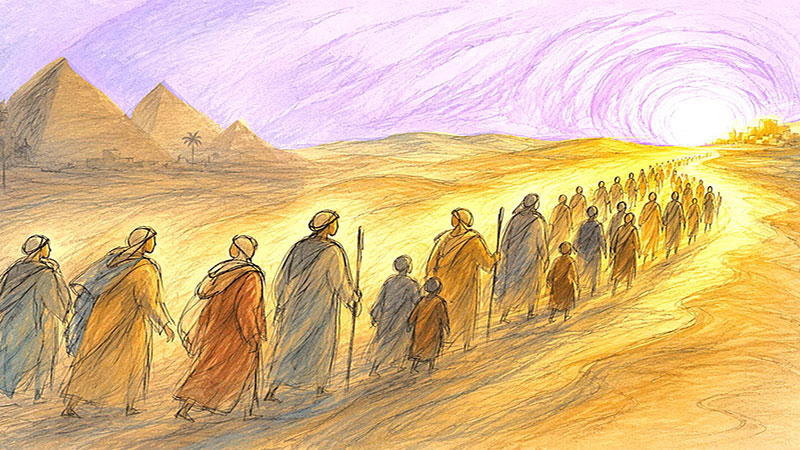
These are the journeys of the Children of Israel who left Egypt (33:1). Since the goal of leaving Egypt was to go to Eretz Yisrael, why does the Torah say that they journeyed out of Egypt? It should have said they journeyed toward the land of Israel? The answer is that the purpose of the journey was to wean the people of Israel off the Egyptian culture of materialism. “We fondly remember the fish that we ate in Egypt at no cost, along with the cucumbers, melons, leeks onions and garlic” (11:5). This reeducation could not be achieved in a few weeks. It took 40 years and 42 encampments. At each stop the Jews learned another lesson about how to rid themselves of their Egyptian ways. That is why the Torah tells us that “Moshe wrote their goings out according to their journeys by the commandment of G-d” (33:2), because the purpose of their journeys was to get Egypt out of them.
So why then does the Torah in the same verse immediately invert the phrase and say “and these are their journeys according to their goings out?” It is because the Jews struggled to rid themselves of their Egyptian ways. On many occasions, they turned around and began to march back to Egypt (Rashi, Shemos 14:2 and Devarim 2:1). They were the ones who on occasion inverted the mission and began to journey back to where they came from, even though it was G-d’s wish that they journey away from where they came.