 October 16, 2026
 Categories: Headline / Front Page / Perspectives
Let it Fall: The UN’s ‘Imminent Collapse’ And Long War on Israel
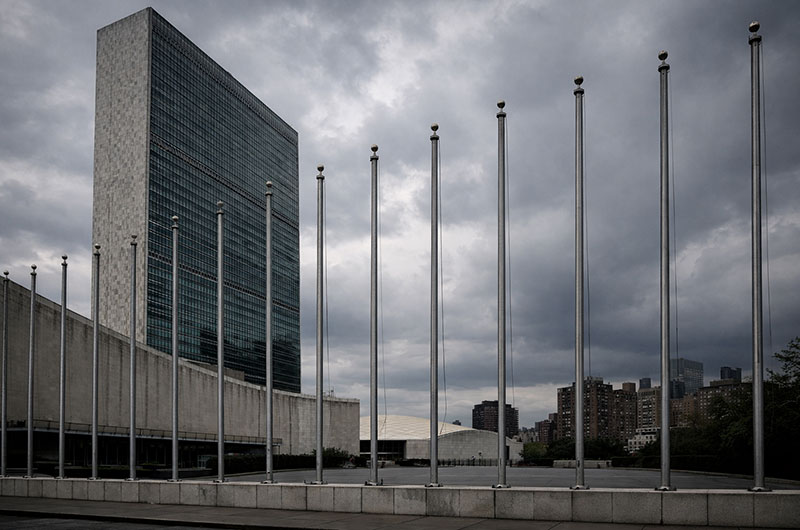


The United Nations says it may soon be unable to pay its bills.
Crushed by unpaid dues, chronic arrears, and budget shortfalls running into the billions, UN officials now say the organization may be forced to curtail operations – or even close its New York headquarters – as early as this summer.
The UN Secretary-General has gone so far as to publicly warn of an “imminent collapse.”
That outcome would be both a blessing and poetic justice. Few institutions have traveled a moral arc as stark and as perfidious as the body founded after World War II to preserve international peace and security.
The UN midwifed Israel’s birth – and then set out to criminalize its existence.
Instead of honoring its singular positive achievement – the plan that facilitated the remarkable establishment of the Jewish State following the darkest period in modern Jewish history – the UN has in practice become one of the principal forums for the state’s diplomatic isolation, serving tyrannies and terrorist groups committed to perpetrating another Holocaust.
Recall the history. In 1947, the General Assembly voted to partition Palestine under the British Mandate and endorsed a Jewish state as legitimate and necessary.
That early act of recognition, however, proved fleeting.
After Israel declared independence in 1948 and was invaded by five Arab armies, the UN’s posture quickly shifted from recognition to equivocation. It repeatedly framed the conflict as mutual violence, blurring the distinction between a newly recognized member state defending itself, and coordinated aggression by surrounding states rejecting its existence.
Israeli military actions were frequently described as “excessive” or “provocative,” while Arab aggression was treated as a political grievance.
This set an early precedent.
The creation of the UN Relief and Works Agency for Palestine Refugees in the Near East (UNRWA) in 1949 introduced a structural asymmetry. Palestinian refugees were given a unique, hereditary status not applied to any other refugee population in the postwar world.
At the same time, the UN ignored the expulsion of approximately 850,000 Jews from Arab countries, and the fact that Arab states refused to resettle Palestinian refugees as a political weapon. In doing so, the UN institutionalized a narrative in which Palestinian displacement was internationalized and eternalized and Jewish displacement was erased.
The asymmetry hardened over time.
By the mid-1950s, the UN General Assembly had already developed an emerging Arab–Soviet–Non-Aligned voting bloc and a tendency to treat Israel as a proxy target for anti-colonial rhetoric and Cold War alignment.
During the Sinai War in 1956, the UN again demonstrated a distinctive posture toward Israel. It was treated as an aggressor alongside Britain and France, despite Egypt’s prior six-year blockade of the Straits of Tiran (an act of war that prevented Israeli-flagged vessels and ships bound for Israel from reaching Eilat by sea) and persistent fedayeen attacks launched from Egyptian-controlled Gaza.
The establishment of the UN Emergency Force (UNEF) in the Sinai Peninsula placed constraints on Israel’s freedom of action, while Egypt faced no comparable international enforcement regarding terrorism or navigation rights. UNEF’s very design, deployable only with Egyptian consent, meant Israel’s security depended on the goodwill of its adversary.
That flaw could have been catastrophic in 1967.
On May 18 and 19, at Egypt’s demand, the UN abruptly withdrew UNEF from Sinai. UN Secretary-General U Thant didn’t consult Israel, seek Security Council authorization, or propose an alternative arrangement. He simply complied.
On May 22, Egyptian forces surged forward, and the Straits of Tiran were again closed to Israeli shipping.
Egypt’s President Gamal Abdel Nasser described the closing of the strategic waterway as a decisive step toward confrontation. Speaking at Air Force headquarters, he declared Egypt ready for war. On May 26, addressing Arab trade unionists, he stated that Egypt had taken “actual steps,” that full military coordination with Syria was in place, and that the battle would be “a general one” whose “basic objective will be to destroy Israel.”
Four days later, after signing a menacing military pact with Jordan, Nasser announced that the armies of Egypt, Jordan, Syria, and Lebanon – backed by Iraq and other Arab states – were “poised on the borders of Israel,” declaring that the “critical hour” had arrived, echoing years of earlier statements defining the eradication of Israel as the national Arab goal.
With Arab leaders openly proclaiming a war of destruction and UN guarantees exposed as meaningless, Israel preempted the assault, and in six days starting on June 5 decisively defeated the forces arrayed on its borders.
Israel’s stunning victory electrified Jewish communities and people of goodwill around the world. It also infuriated key organs of the UN system.
In place of any acknowledgment that a small member state had overcome an imminent existential threat, the UN constructed a permanent diplomatic structure – emergency sessions, condemnatory resolutions, and the Resolution 242 land-for-peace template – designed to convert Israel’s survival into a standing offense. Israel was branded the aggressor and its control of newly held territories, including lands that had never been recognized internationally as under Arab sovereignty, was condemned as “illegal occupation.”
At this point, describing the ensuing campaign as mere bias is no longer plausible. What has emerged over decades is an institutional war on Jewish sovereignty, a permanent prosecution in which Israel is treated by the UN as a dangerous outlaw.
Nothing illustrates this better than the raw numbers. Year after year, the UN General Assembly adopts more country-specific resolutions condemning Israel than it does against the rest of the world combined. Independent watchdog analyses of General Assembly and Human Rights Council voting patterns consistently show that from 2015 into the early 2020s, Israel was hit with well over 100 condemnatory resolutions, while notorious violators of human rights like Syria, Iran, North Korea, and Venezuela received only a fraction of that number.
In the old Commission on Human Rights – the UN’s principal human-rights body that was operational from 1947 until it was disbanded in 2006 – roughly half of all country-specific resolutions were directed at Israel. Some General Assembly resolutions went further, urging states to suspend or sever diplomatic, economic, and technological ties with Israel.
At the Commission’s successor body, the Human Rights Council, the anti-Israel policy is institutionalized and ritualized. The Jewish State is the only country in the world subjected to its own permanent agenda item (Agenda Item 7) ensuring that every regular session includes a special debate and a slate of resolutions devoted exclusively to its denunciation. All other countries, including the worst dictatorships on earth, are discussed under a generic agenda item.
Under this framework, the Council has adopted more resolutions against Israel than against any other state. The Council has created a standing machinery of “fact-finding” missions and commissions of inquiry that circle back every few years to rediscover, often verbatim, the same conclusion. Israel is found to be the root cause of conflict and the primary, often exclusive, violator of human rights.
Palestinian terrorism barely registers except as a reaction to Israeli policy.
The Commission’s recommendations follow naturally: prosecutions, sanctions, and arms embargoes aimed squarely at Israel, with no serious treatment of how Hamas, Islamic Jihad, or Hezbollah wage war.
The mandate of the Special Rapporteur on the “situation of human rights in the Palestinian territories occupied since 1967” takes the logic further still. It is unique among UN mandates in its explicit one-sidedness. The Rapporteur is tasked only with examining Israel’s alleged violations, not Palestinian abuses.
Successive mandate-holders have exploited this asymmetry to advance increasingly radical narratives. In recent years, the office has openly branded Israel an “apartheid regime,” and now speaks of “genocide,” “colonial erasure,” and “occupation, genocide, and profit” as a single, unified charge. The proposed remedy is punishment: sanctions, boycotts, and criminal proceedings against Israeli officials, coupled with demands for dismantling the alleged “colonial” regime.
In this parallel legal universe, Jewish life beyond the 1949 armistice lines is presumptively illegal.
The UN’s war on Israel doesn’t unfold only in debates and reports; it extends to operational agencies that shape realities on the ground.
Nowhere is this clearer than in the case of UNRWA. Investigations and legislative hearings have exposed systemic antisemitism in UNRWA schools, teachers glorifying terrorism on social media, and staff openly celebrating Hamas atrocities.
After the October 7 massacre, evidence emerged of UNRWA employees directly participating in or assisting the Hamas attacks. When the Israel Defense Forces uncovered an extensive terrorist tunnel network and sophisticated data center directly beneath UNRWA’s headquarters in Gaza, the fiction of UNRWA’s neutrality could no longer be sustained. The agency is entangled with a jihadist movement dedicated to Israel’s destruction.
UNESCO, the UN’s cultural wing, has also waged an anti-Israel campaign, this one a disinformation campaign to erase Jewish history. In 2016, UNESCO’s Executive Board adopted the “Occupied Palestine” resolution that referred to Israel throughout as “the occupying power” and described the Temple Mount in Jerusalem only by its Islamic names, while placing “Western Wall Plaza” in scare quotes. This was a deliberate effort to recode the most sacred site in Judaism as exclusively Islamic.
Other UN organs extend this war into the economic realm. The Human Rights Council’s database of companies allegedly involved in “settlement” activity functions as an official blacklist, designed to facilitate boycotts and to pressure corporations and investors to sever ties with Israel. No comparable list exists for Turkish firms in Northern Cyprus, Chinese companies in Tibet, or Pakistani interests in Kashmir. Only Israel merits a dedicated global apparatus to shame and punish economic interaction in disputed territory.
Beneath these mechanisms lies a narrative machine that recycles older forms of antisemitism in the language of international law and human rights. The UN’s infamous, Soviet-sponsored 1975 “Zionism is racism” resolution may have been repealed in 1999 after the Evil Empire’s fall, but its logic survived. It reemerged at the Durban conferences and in countless UN-sponsored forums, now clothed in the rhetoric of “apartheid,” “settler colonialism,” “ethnic cleansing,” and “genocide.”
Within this narrative, the deliberate murder of Israeli civilians by Palestinian terrorists is transmuted into “resistance.” When UN resolutions affirm a “legitimate right” to “resist occupation” that includes terrorism, they launder the moral claims of groups like Hamas into the bloodstream of international discourse.
The consequences are concrete.
First, the UN systematically undermines Israel’s right to self‑defense. If every Israeli military operation is pre‑framed as a war crime, every unintentional civilian casualty as proof of “genocide,” and every security measure as “apartheid,” the result is to delegitimize the very idea that Israel may defend itself against jihadist movements that openly declare their intention to annihilate it.
Second, the UN encourages lawfare. Activists and hostile governments seize on UN reports and resolutions as “evidence” to press cases at the International Criminal Court or in national courts against Israeli officials and soldiers. The UN’s output becomes both the indictment and the witness.
Third, the UN provides diplomatic and moral cover for Israel’s enemies. When Hamas fired rockets from schoolyards and hospitals, concealed command centers under refugee agencies, and used its own people as human shields, it was confident that the UN would look past these crimes to condemn Israel’s response.
Some Western governments have begun to break with this system. Legislatures on both sides of the Atlantic have documented UNRWA’s involvement with terrorism and antisemitism and called for funding freezes or fundamental restructuring. These include the U.S. Congress, the UK Parliament, the German Bundestag, and the European Parliament.
These moves are welcome and long overdue; they are acknowledgements by leading democracies that significant parts of the UN have become completely antagonistic – not just to Israel, but to the basic norms of fairness and self‑defense that any serious international order requires.
From an American perspective, the shift is especially late in coming. Parallel to intensifying its political war on Israel, the UN increasingly embraced an ideological posture that painted the world’s greatest democracy as a destabilizing neo-imperial power. Instead of dissipating with the collapse of the Soviet Union, the UN’s anti-American reflex hardened into habit, fixed in agency cultures, voting blocs, and permanent bureaucracies that treat the U.S. as a problem to be managed or contained.
Washington has thus spent decades bankrolling an institution that functions as a hostile arena in which American taxpayers effectively subsidize diplomatic, legal, and propaganda campaigns directed against their own interests and fundamental values. The UN’s majority routinely dresses up ideological enmity for Western civilization by systematically excusing, relativizing, or even legitimizing the perpetrators of anti‑Western violence, above all, Islamist movements and regimes that target Jews and Christians.
The choice is now unavoidable. The U.S. and its allies can continue to support an international system that singles out Israel for special condemnation and embeds eliminationist rhetoric in official documents. Or they can begin the hard work of building alternative frameworks: coalitions of democracies that set their own human‑rights benchmarks, investigate terrorism as well as counter‑terrorism, and refuse to outsource their moral judgments to a corrupt and politicized bureaucracy.
In this respect, President Trump took important first steps by pulling the U.S. out of UN bodies that had become engines of anti-American and anti-Israel agitation, and by cutting off funding to institutions such as UNRWA. With backing from a Republican Congress, he could go much further. The U.S. should step aside, withhold its dues and other funds – and let the UN collapse under the weight of its own failures.
Reform is no longer a serious option, certainly not by pouring more good money after bad – meaning, more American taxpayers’ money into the coffers of an institution whose continued existence no longer serves and actually undermines the national interest. Inherent flaws such as the Security Council veto, a General Assembly dominated by anti‑Western blocs, and the capture of key human‑rights organs by serial abusers are baked‑in defects, not glitches that better management can fix.
Add to this a long record of corruption, mismanagement, and moral failure. From the Iraq Oil-for-Food Program – where Saddam Hussein siphoned off billions through kickbacks, surcharges, and oil smuggling under UN supervision – to more recent financial scandals, independent investigations have repeatedly exposed bid-rigging, bribery, theft, conflicts of interest, weak audits, and a culture of impunity. Senior internal auditors have warned that effective oversight bodies are routinely marginalized, transparency efforts undermined, and accountability blocked by political considerations inside the organization itself.
Taken together, the UN’s many scandals prove that its normative and moral authority has collapsed, leaving a corrupt global bureaucracy that has become a tool of America’s enemies and mass-murdering monsters, while lecturing the world on everything from human rights to climate change.
Nonpayment of dues and fees will help to end this cruel charade; but there is still more that the U.S. can do. It can terminate the Headquarters Agreement that anchors the UN in New York City. The accord is a Congressional‑Executive agreement implemented by the United Nations Headquarters Agreement Act, a statute enacted by Congress in 1947.
Terminating the Headquarters Agreement requires both political branches working together. President Trump could start the process with an Executive Order directing the State Department to notify the UN that the U.S. intends to withdraw from the Agreement and sending Congress draft legislation to repeal the Headquarters Agreement Act. Congress can do that through the regular legislative process: passage of a repeal bill by simple majorities in both the House and Senate, followed by the President’s signature.
Congress should not just repeal the Act but also expressly authorize and direct the President to terminate and withdraw from the Agreement on behalf of the U.S. and to take such steps as are necessary to effectuate the withdrawal and to facilitate relocation of the UN abroad, assuming it stays in business – to neutral Switzerland, say, where the UN already has a significant presence.
On national‑security grounds alone, there is a strong argument for termination. From the early Cold War onward, the UN headquarters in New York was a magnet for espionage operations, especially by Soviet and later Russian services exploiting diplomatic cover. British and Swiss assessments from that period described large majorities of Soviet UN officials as engaged in intelligence work, with agents “crawling all over the building” in committee rooms, lounges, and the library.
That pattern has persisted into the present. Former U.S. and allied officials routinely describe the annual UN General Assembly as a “hotbed” of espionage, with delegations from U.S. adversaries arriving with intelligence teams whose real mission is to collect secrets, recruit sources, and run operations under UN diplomatic immunity.
The permanent missions of these adversaries are essentially platforms where intelligence officers serve as “political counselors,” “attachés,” or technical staff, often for years at a time, collecting information and running sources while enjoying the protections of diplomatic immunity.
It doesn’t have to be that way. New York doesn’t have to be the forever home of enemy diplomats and a sprawling cesspool of anti-American, anti-Israel, Jew-hating poison.
The 17 acres of prime Manhattan real estate presently occupied by the UN could be purchased by the federal government and redeveloped through a unique federal-municipal public‑private partnership into a model residential complex providing much‑needed middle‑income and affordable housing.
The symbolism would be exact. Families would live, work and raise children in safety on a site where a decaying international bureaucracy once menaced and harassed a small, beleaguered nation that is both a strategic U.S. ally and the only democracy in a region plagued by barbarism and despotism.
The process could begin to coincide with America’s 250th anniversary of independence, ahead of the November midterm elections – while Republicans still control both Houses of Congress.
There may be no better year to finally start getting the U.S. out of the UN. And the UN out of the U.S.