 October 16, 2026
 Categories: Headline / Perspectives / Op-Eds
Maniacs with Missiles: Iran’s Insane Foreign Policy


There can come a moment when a nation’s foreign policy ceases to be aggressive or misguided and becomes outright madness.
Iran passed that moment decades ago. Its Islamist rulers have spent nearly a half-century sacrificing their own people on the altar of a revolutionary ideology that demands war abroad, repression at home, and – if necessary – national suicide.
Theirs is not the behavior of normal leaders defending national interests. It is the behavior of an apocalyptic, clerical fascist regime that treats human lives as expendable fuel for a world-changing project.
When the mullahs seized power in 1979, they weren’t under foreign assault. No coalition moved to overthrow them. Yet they declared their intention to export their revolution, reshape the Middle East, and confront the world with their twisted ideology. That decision – ideological, not defensive – set the course.
Henry Kissinger observed that Iran must decide whether it is “a nation or a cause.” The Islamic Republic answered that question early. It chose to be a cause – and an evil one.
Iran’s first Supreme Leader, Ayatollah Ruhollah Khomeini, made the hierarchy explicit. The Islamic revolution, he said, outweighed the state itself. He saw it as a means to an end, an instrument for global struggle.
Iran quickly became the world’s leading state sponsor of terrorism, treating support for foreign radicals as a religious duty and an instrument of hegemony.
The regime built institutions for aggression. The Islamic Revolutionary Guard Corps and its Quds Force were designed to project power, cultivate proxy forces, and sustain permanent confrontation, including control over Iran’s ballistic missile program.
The pattern emerged clearly during the Iran–Iraq War. Saddam Hussein’s invasion in September 1980 justified a determined defense. Yet once Iranian forces regained the initiative, the regime refused ceasefire opportunities and prolonged the war. The objective shifted from defending Iran to toppling the Iraqi regime and advancing the revolution.
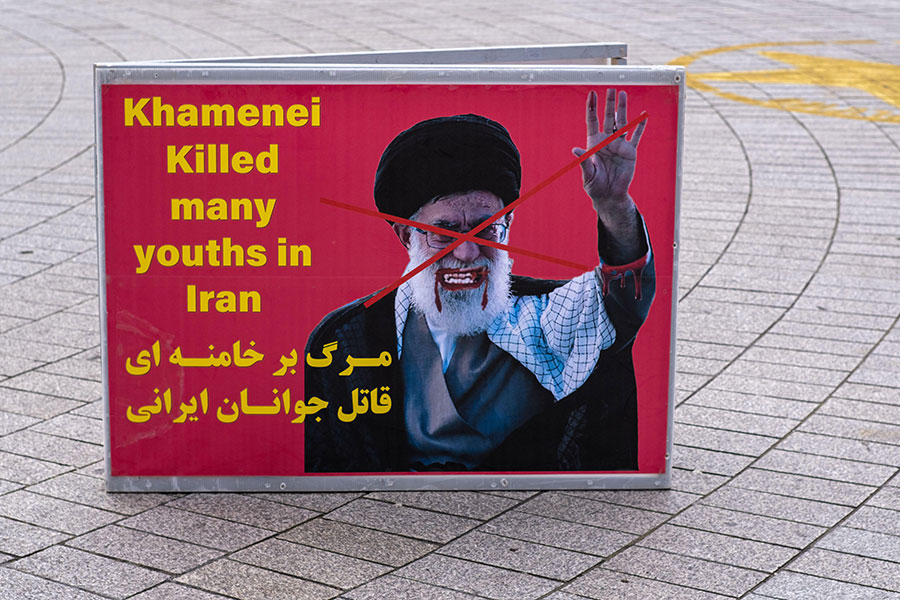
What followed was one of the most sickening episodes of modern warfare. Iranian commanders organized mass assaults in which lightly armed volunteers – many of them teenagers – were sent forward in waves across minefields and into entrenched positions. Some were given plastic “keys to paradise,” told that martyrdom would open the gates of heaven.
These were not aberrations of war. They reflected a leadership acting on a belief system in which death in service of the cause carries sacred meaning. The battlefield looked less like a modern army at war than a mass death cult in uniform.
The casualties were immense. The war dragged on for eight years – long after Iran’s territory had been secured. The strategic outcome did not justify the human cost. The decision to continue was ideological.
This places the Iranian regime in a rare category. Not since Nazi Germany has a powerful country been so destructive and self-destructive, and so committed to conquest and dominance at any cost to its own people.
The readiness to expend the young for an ideological end echoes the Nazi example. In the final phase of World War II, as Germany faced certain defeat, boys from the Hitler Youth were thrown into combat against advancing Allied forces – poorly trained, inadequately armed, and with no realistic prospect of altering the outcome.
In both cases, a fanatical regime chose to double down on ideology, sending its own youth to die. The result in Germany was utter destruction. Iran’s rulers show the same readiness to accept – and even invite – domestic destruction in the name of a cause.
The theological foundation matters. The Iranian regime’s worldview draws on a politicized version of Twelver Shi’ism centered on the return of the Hidden Imam – the Mahdi. In this framework, history moves toward a final confrontation and a just Islamic order established after upheaval and war.
Khomeini transformed this from a passive belief into an activist doctrine. The state was tasked with preparing the ground for that outcome. Later leaders and clerics went further, openly describing conflict as part of a process that could hasten the Mahdi’s return. The result is a political system that assigns sacred meaning to conflict itself.
After 1988, the regime increasingly looked outward. Iran constructed a network of armed proxies across the region. Hezbollah in Lebanon became the centerpiece, equipped with a large missile arsenal aimed at Israel. Hamas and Islamic Jihad received funding, weapons, and training. In Iraq and Syria, Iran backed militias aligned with its objectives. In Yemen, the Houthis gained Iranian support and developed long-range strike capabilities.
These forces extended Iran’s reach and kept the region on permanent edge.
Alongside its proxy war strategy, the regime built one of the largest and most diverse ballistic missile arsenals in the world, including precision systems capable of striking across the Middle East and even into Europe.
Iran enriched uranium at levels that brought it within reach of weapons-grade material, while hardening and dispersing its nuclear infrastructure against attack.
At the same time, the regime developed advanced attack drones and space-launch technologies that are widely understood to have direct ICBM applications.
Iran’s fixation on Israel brings the ideological core of its foreign policy into full view. The non-Arab nation has no territorial dispute with the Jewish state, no shared border, and no history of direct conflict before 1979. The regime’s hatred of Israel is doctrinal.
A state defined by the annihilation of another is a death cult. In the Iranian regime’s framework, Israel is an obstacle embedded in a religious narrative about history and redemption. Its elimination is treated as a necessary step in a broader struggle that has no conventional endpoint.
That is why this objective persists regardless of cost, risk, or changing circumstances – why Iran never suggests or even hints at entering into peace talks with Israel. From the regime’s perspective, there is nothing to negotiate. It is determined to destroy Israel regardless of its borders. In the regime’s eyes there is no place for a Jewish state of any size or political leaning in any part of “the Muslim world.”
The economic indictment is equally damning. Iran sits atop the world’s second-largest proven natural gas reserves and among the world’s largest oil deposits – resources that could have made it one of the wealthiest and most developed nations in the region. Instead, 47 years of revolutionary misrule have produced annual inflation rates around or above 40 percent, a national currency that has lost more than 90 percent of its value against the dollar in recent decades, endemic youth unemployment, and water crises threatening major cities, including Tehran, the capital.
The nuclear program alone, with its centrifuge halls, underground fortifications, and the crushing sanctions it attracted, consumed tens of billions of dollars that could have built hospitals, universities, and modern infrastructure.
Every missile fired by a Houthi drone, every rocket that Hezbollah launched into northern Israel, every Hamas tunnel dug under Gaza represents Iranian oil money that might have educated an Iranian child or irrigated an Iranian farm. The mullahs chose rockets over roads, proxy wars over prosperity, and an obsession with Israel’s erasure over their own country’s future.
The regime speaks openly about the scale of sacrifice it is prepared to accept. Senior officials – including figures marketed in the West as “moderates” because they wear a nicer suit or smile more politely – have boasted that Iran is ready to lose millions of people in a war if that is what it takes to destroy Israel and humiliate America. The current Iranian president recently spoke of being ready to sacrifice “14 million” Iranians.
Think about that number. Iran’s population today is over 90 million. Fourteen million may be all or nearly all those Iranians who still support the despised regime. It is willing to burn through its remaining followers like ammunition.
What kind of government talks this way? Not a normal one. This is why describing Iran’s rulers as merely authoritarian understates what they are. They are ideological demagogues driven by a revolutionary creed – maniacs with missiles.
Western diplomats, and especially liberal media outlets hostile to Israel, spent years trying to conjure regime “moderates.” Every few years a new regime figure was described as a pragmatist or a reformer, and the parade of wishful thinking began anew. “Experts” claimed that if only Washington showed enough “flexibility,” if only sanctions were eased, the Islamic Republic would evolve into a normal country.
That never happened because power in Iran belongs to the mullahs and the IRGC, whose very purpose is to preserve the revolution and continue its export. While the regime may change faces, its ideology is immutable.
Diplomacy with Iran, as traditionally understood, is therefore doomed from the outset. The regime approaches negotiations as a way to buy time, gain resources, and ease pressure while never abandoning its strategic aims.
None of this means the U.S. and its allies should reject every channel of communication. It means stripping away any remaining illusions about the enemy. A regime that sent children into minefields, armed regional proxy armies, produced tens of thousands of ballistic missiles, and insists on a “right” to develop nuclear weapons – while boasting of its readiness to sacrifice millions of its own citizens – isn’t a misunderstood rival waiting for the right incentive package. It is a totalitarian menace more akin to Nazi Germany than to any ordinary dictatorship.
The Nazis showed what happens when a regime values a depraved ideology over life. Iran’s clerical fascists are following the same path. They have suffered huge losses and major setbacks. However, if allowed to regroup and rebuild, they will pursue what Hitler and his henchmen – with their failed atomic bomb project, V-2 rockets that terrorized England, and the desperate dream of an “Amerika Rocket” – sought but never came close to achieving: a stockpile of nuclear warhead missiles capable of striking New York and Washington, D.C.
We ignore this threat at our peril.