 September 4, 2026
 Categories: Collecting / Features On The Jewish World
Mary Cassatt, The Impressionists, and the Dreyfus Affair
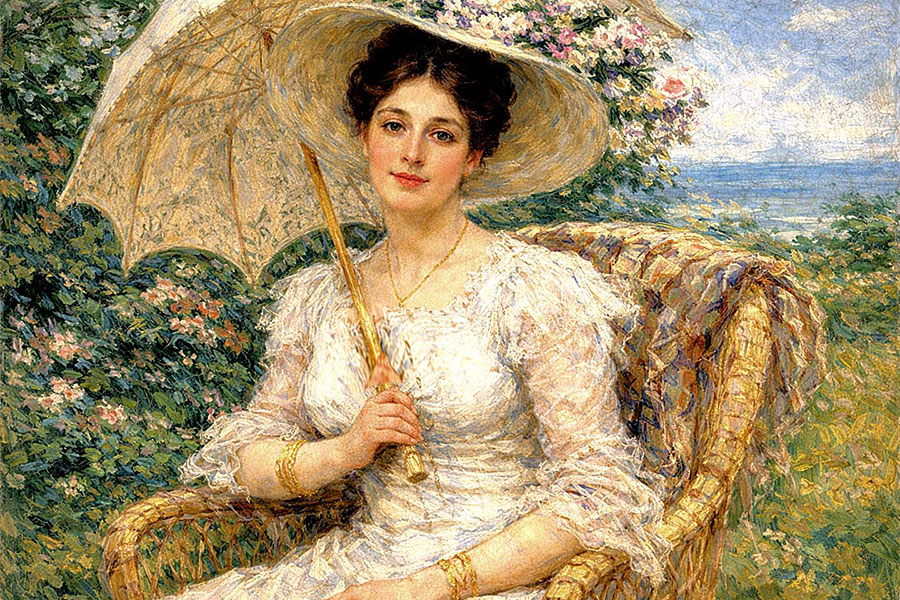


Mary Cassatt (1844-1926) occupies a singular place in the history of modern art. Born in Allegheny City, Pennsylvania into a prosperous and culturally ambitious family, she became one of the most important figures of the Impressionist movement and the most influential American artist of the nineteenth century working in Europe. Her career unfolded largely in France, where she lived for most of her adult life, yet her impact was transatlantic: she helped shape modern painting and printmaking while simultaneously educating and cultivating American collectors whose patronage would profoundly affect the reception of Impressionism. She is held in such high esteem not only because of the quality and originality of her work but also, as we shall see, because of the intellectual seriousness, independence, and moral clarity with which she navigated the artistic and political crises of her time.

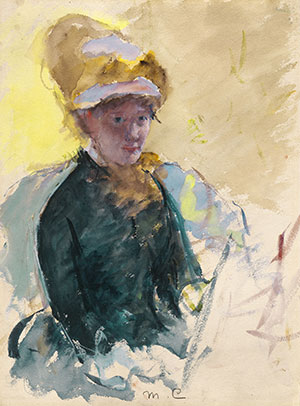
Cassatt’s artistic formation began unusually early. Raised in a family that valued education, travel, and languages, she studied art in Philadelphia before leaving for Europe in her early twenties, convinced that serious artistic training could not be obtained in the United States. After periods of study in Italy, Spain, and the Netherlands, she settled in Paris, where she absorbed the lessons of Old Master painting while closely observing contemporary developments. Her early ambition was to succeed within the official Salon system, and she achieved a degree of recognition there in the late 1860s and early 1870s. However, her encounter with Degas in the mid-1870s proved decisive when he recognized her talent immediately and invited her to exhibit with the Impressionists, marking a turning point in her career and placing her at the heart of the most radical artistic movement of the time.
Cassatt was among the most rigorous and inventive of the Impressionists, particularly in her exploration of line, color, and composition. Her sustained engagement with printmaking, particularly etching, drypoint, and color aquatint, placed her at the forefront of technical experimentation. The series of color prints she exhibited in the early 1890s, inspired in part by Japanese ukiyo-e woodcuts, are widely regarded as among the finest graphic works of the nineteenth century, and, as a painter, she developed a distinctive visual language centered on intimate scenes of women and children, emphasizing psychological presence, structural clarity, and formal restraint rather than sentimentality. Her work challenged conventional representations of femininity while asserting the seriousness of subjects traditionally considered domestic or private.
Cassatt’s stature also rests on her role as a cultural intermediary. Through her close relationships with American collectors, particularly Louisine and Henry Osborne Havemeyer (see further discussion below), she played a decisive role in shaping some of the most important Impressionist collections in the United States, and her advice helped to introduce works by Degas, Monet, Manet, Pissarro, and others into American museums and private collections, fundamentally altering the landscape of American taste. She did not simply promote artists that she admired aesthetically; she was attentive to questions of artistic integrity, moral courage, and historical significance such that this dimension of her influence becomes especially important when considering her position during the Dreyfus Affair.

The Dreyfus Affair, which erupted publicly in 1894 with the conviction of Captain Alfred Dreyfus for treason, was not merely a legal scandal. It became a profound moral and political crisis that divided French society and exposed deep currents of antisemitism, militarism, and authoritarianism, and intellectuals, writers, and artists were forced, implicitly or explicitly, to take sides. The Impressionists, often imagined as politically detached or solely concerned with aesthetic innovation, were in fact deeply affected by the Affair. The movement fractured along ideological lines, and these fractures reshaped personal relationships, professional networks, and reputations.
The Impressionists differed in their political and social opinions well before the Affair, and their varying attitudes toward France’s Jewish population proved to be one of the most divisive issues. Antisemitism caused the first defection from the impressionist movement when the deeply prejudiced Pierre-Auguste Renoir broke off all contact with Jews and ended his relationships with Jewish patrons, and, rather than exhibit his work alongside Jewish impressionist Jacob Abraham (Camille) Pissarro, he refused to participate in the 1882 independent salon.
Although Renoir’s antisemitism manifested itself in the 1880s, it was not until the Dreyfus Affair a decade later that the “Jewish question” divided the rest of the country and, along with it, the broader Impressionist movement. Though some sought to portray Renoir as trying to carefully walk the “middle ground” between the pro- and anti-Dreyfusards, his own daughter, Julie, regularly portrayed him as expressing overt anti-Jewish views, ascribing statements to her father such as “the Jews come to France to earn money, but if there is any fighting to be done they hide behind a tree” and that “the peculiarity of the Jews is to cause disintegration.” Much as the Nazis who followed him some 40 years later, Renoir characterized art of which he disapproved as “Jew art.”
Edgar Degas, a savage and cold-blooded antisemite, refused to employ Jewish models, railed against Jews to the point of tears of fury, and lent his name to The League of the French Fatherland, a group instituted in response to Emile Zola’s famous J'Accuse! to facilitate the assembly and coordination of the anti-Dreyfusard effort. He not only severed all his friendships with Jews (“that terrible race”) – in particular, with Pissarro, who had been one of Degas’s great supporters – but he even broke off all contact with non-Jews who happened to be Dreyfus supporters, including Cassatt, a passionate Dreyfusard.
Cassatt’s place within this rift is central to understanding both her moral outlook and her eventual estrangement from Degas. She was not Jewish, nor did she have any religious affiliation that predisposed her toward the Jewish community in France; her attitude toward Jews and Judaism emerged instead from a broader commitment to justice, individual rights, and republican values. She was acutely disturbed by the antisemitism that the Affair unleashed, particularly in the press and among cultural elites, and private correspondence reveals her dismay at the willingness of many in French society to accept forged evidence, judicial secrecy, and collective punishment in the name of national honor. As an American shaped by the legacy of the Civil War and by Enlightenment ideals absorbed through education and travel, she regarded the presumption of innocence and equality before the law as non-negotiable principles.
Cassatt’s sympathies lay firmly with the Dreyfusards, those who demanded a retrial and insisted on Dreyfus’s innocence long before it was officially acknowledged. Although she did not publish political essays or sign manifestos as conspicuously as some other intellectuals, her position was well known within her circle. She socialized with and supported artists and writers who were openly Dreyfusard and she withdrew from relationships with those whose opposition to Dreyfus was rooted in antisemitism or reactionary nationalism. Her stance was neither casual nor provisional; it reflected deeply held convictions that guided her behavior even when silence might have been more convenient or beneficial.
Her relationship with Camille Pissarro offers one point of reference. Pissarro, who was Jewish and whose white-bearded visage earned him the nickname “Father Abraham” among many Impressionists, became one of the most outspoken Dreyfusards. He paid a heavy price for it; he was ostracized by former friends, attacked in the press, and excluded from certain exhibitions and social circles, but Cassatt never abandoned him during this period. While they were not intimate friends, she continued to treat him with respect and solidarity, recognizing that the hostility directed at him was inseparable from the broader antisemitic climate fostered by the Affair. Her alignment with Monet who, although temperamentally less polemical than Pissarro, supported efforts to reopen the case and signed petitions calling for justice, further situates her well within the Dreyfusard camp. She shared Monet’s sense that the Affair represented a fundamental test of republican values, and their shared position reinforced professional and social ties and contributed to a network of artists and collectors committed to defending modern art against reactionary forces in both politics and culture.

The most painful and consequential rupture, however, was Cassatt’s break with Degas. Few artistic relationships in the nineteenth century were as intense, productive, and complex as that between the two artists. From their first collaboration in the late 1870s, Degas regarded Cassatt as an equal, a judgment he extended to very few artists, male or female; he praised her intelligence, discipline, and independence and he included her in exhibitions and projects that he carefully curated. Cassatt, for her part, profoundly admired Degas’s artistic genius.
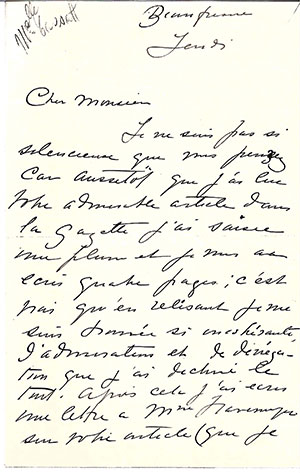

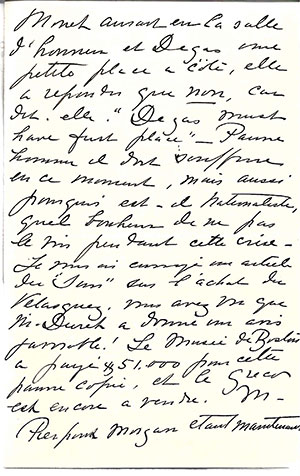

In the historic handwritten and undated correspondence exhibited here, Cassatt writes to an unknown correspondent regarding her thoughts about some of the leading artists of her day and, in particular, describes Degas as “nothing but the absolute greatest artist of all time:”
I am not as silent as you think, for as soon as I read your admirable article in the newspaper, I took up my pen and wrote you four pages. It is true that after rereading it, I found myself so filled with admiration and denial that I tore it all up. I then wrote a letter to Mrs. Havemeyer about your article (which I am sending her), and there, at least in English, I was able to say what I thought. Like me, she will know what you say about Cézanne and will be delighted by the allusion to Louise Collet. With Gauguin, it will always be difficult for me to comment. I knew him in his early days. I know that I was mistaken about Toulouse-Lautrec. But he's not a painter. In short, I see Degas as nothing but the absolute greatest artist of all time, and on that point we agree.Mrs. Havemeyer tells me that some people wanted to borrow her Degas for an exhibition where Monet would have the honor of a large room and Degas a small one next door; she refused, because, she says, “Degas must have first place.” The poor man must be suffering right now, but why is he? How glad I am not to see him during this crisis. I sent you an article... about the purchase of the Velázquez. You saw that Mr. Duret gave it a passable review! The Boston museum paid $51,000 for that limping copy, and the El Greco is still for sale. Since Mr. Pierpont Morgan is not the director of the New York museum, we hope he will buy it for his museum. Goya's Balcony is about to return from the framer, and we mustn't let it leave for New York before seeing it – what a versatile artist!
Here I am in the rain, thinking about these great geniuses, especially Poussin, and wondering why I spend my days working. How kind of you to have gone to see our representative. I'm ashamed that you went to so much trouble to honor me when you have serious matters to attend to. One last word about your article. If the jury system in Fine Arts ever seemed plausible to me, reading your article has converted me. How can one artist judge another contemporary artist? It's madness to believe one can be fair when one has such different opinions. If so, then what about the articles that perhaps don't take them into account?
Cassatt’s expression of high regard for Degas is entirely consistent with her long-standing view and she never wavered in her assessment of his artistic greatness, even after their personal relationship deteriorated over the Dreyfus Affair. It speaks well of Cassatt that she could admire his art while rejecting his moral stance, but she could not continue a close personal or professional relationship with someone whose views she regarded as fundamentally unjust and harmful.
Her reference in our letter to “The poor man [Degas] must be suffering right now, but why is he?” provides a poignant glimpse into this moment and can be understood on several levels, all of which are well documented and verifiable. Degas was, by the 1890s, experiencing severe physical decline, particularly in his eyesight, and progressive visual impairment plagued him for decades, increasingly limiting his ability to work and contributing to frustration, isolation, and bitterness. At the same time, Degas’s suffering during the Dreyfus years was also social and psychological: his uncompromising anti-Dreyfusard stance led him to isolate himself from former friends and allies; he withdrew from social circles that included Jews or Dreyfusards; and he entrenched himself in a narrower, more hostile environment. Cassatt’s question, “but why is he?” suggests a moral interrogation rather than a purely medical one, as she recognized his pain but questioned its source. Was he suffering because he had chosen to align himself with forces that fostered hatred and exclusion? The phrasing implies that she saw his suffering as, at least in part, self-inflicted, arising from his refusal to confront evidence and his embrace of antisemitic ideology.
Cassatt’s compassion, however, did not erase her judgment. She could acknowledge Degas’s physical decline and emotional distress while refusing to excuse his behavior, a crucial distinction that underscores the seriousness with which she approached the moral dimensions of the Affair. She did not reduce Degas to a caricature or deny his greatness; rather, she continued to regard him as a supreme artist, perhaps the supreme artist, but she also refused to subordinate justice to loyalty or admiration. Her break with Degas was therefore not a repudiation of his art but a refusal to compromise her principles.
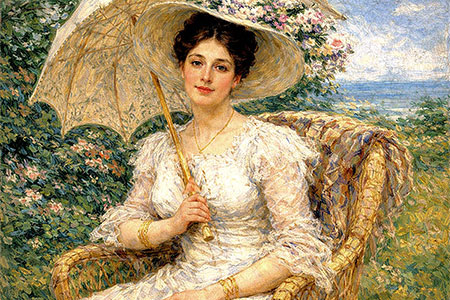
The “Mrs. Havemeyer” to whom Cassatt refers in our letter is Louisine Waldron Elder Havemeyer, one of the most significant art collectors and patrons of Impressionist art in the United States. Born in New York City in 1855, she was the daughter of a wealthy merchant family and moved within elite cultural circles from an early age. Cassatt met her in Paris in the 1870s when Louisine was a young art student attending boarding school; Cassatt, who was already established in the Paris art world, became her mentor in art appreciation and collecting. Louisine became a prominent philanthropist and women’s suffrage activist later in life, that activism was secular and universalist rather than tied to any religious identity.
Cassatt’s relationship with Louisine was one of deep friendship and mutual respect as well as a professional alliance. She advised the Havemeyers on collecting Impressionist and Post-Impressionist works, helping them to assemble one of the finest private collections of modern French art in the United States; her guidance was pivotal in shaping the Havemeyers’ acquisitions of Degas, Manet, Monet, Pissarro, and others, and she even created several pastels of Louisine and her children. Their collaboration exemplifies how Cassatt’s influence extended well beyond her own art to the broader reception of modern art in America.
When Cassatt writes that in her letter that she could articulate to Mrs. Havemeyer “what I thought” in English, she is referring to the fact that many of her sharpest critical judgments about contemporary artists and their reputations were easier to write clearly in her first language than in French.
Cassatt’s allusion to “what you say about Cézanne” points to her complicated stance toward an artist whose importance was emerging only gradually in her lifetime. She appreciated Impressionism deeply, but she was often skeptical of artists who departed radically from observational painting toward structural abstraction. She understood Cézanne’s significance, but she also thought that his work was overestimated in some circles and was ambiguous about its value to collectors, an ambivalence reflected in her correspondence. His paintings, which were structured, brooding, and pioneering in a way that challenged traditional aesthetics, were radically different from the Impressionists’ general emphasis on optical experience and intimate social scenes. For Cassatt, whose own work balanced formal control and empathetic representation, this shift was sometimes difficult to assimilate, and her acknowledgment of others’ remarks about Cézanne suggests respect for the discussion even if her own critical position was complex.
Cézanne, a close friend of Emile Zola’s who, ironically, had always referred to himself as Pissarro’s pupil, cut off all relations with his dear Jewish friend; he publicly denounced Zola, complaining that he “had been taken in” by the Dreyfusards; and he ostracized him and attacked his supporters. However, he was not as vociferously outspoken or public as were some of his contemporaries and he did not make public speeches or polemical statements about the case. Some sources link this stance partly to his increasingly conservative and Catholic milieu in Aix-en-Provence, where many anti-Dreyfusard sentiments were bound up with nationalism and mistrust of republican “intellectuals.”
Cassett’s “allusion to Louise Collet” (often spelled Colet in Anglophone texts) involves the well-known mid-nineteenth century French poet and novelist who came from a Catholic bourgeois background, was part of the Paris literary scene, and was known for her salon and her correspondence with Gustave Flaubert. Her mention of Colet speaks to her engagement with French cultural history and literary allusions and, because Colet frequently featured in contemporary debates about art, gender, and culture, Cassatt and Louisine Havemeyer, both well-read in French letters, would appreciate the reference.
Cassatt’s remark that “With Gauguin, it will always be difficult for me to comment. I knew him in his early days” evokes an artist whose work diverged sharply from Impressionism. Gauguin’s early Parisian years put him in contact with several avant-garde artists, but his later stylistic evolution toward Symbolism and primitivism put him outside the circle Cassatt navigated. She knew him when he was still trying to find his footing, but his later work, rich in personal symbolism and often alienating formal experimentation, made him a tricky subject for her to assess critically. As such, her statement about difficulty in commenting signals a lack of easy categorization rather than personal animosity; her conservatism about avant-garde departures like Gauguin reflects her belief that modern art should maintain a dialogue with observation and structure, a belief that she often defended in her private correspondence.
When she writes, “I know that I was mistaken about Toulouse-Lautrec,” she refers to Henri de Toulouse-Lautrec, an artist whose bold depictions of Parisian nightlife and graphic style were revolutionary; his work was initially highly controversial, even for avant-garde artists, because it refused to idealize its subjects. Cassatt’s humility in admitting earlier misjudgment highlights her integrity as a critic; reflects her willingness to revise her opinions in light of the artist’s achievement; underscores the seriousness with which she engaged with contemporary art criticism and evaluation; shows that she did not see modern art as factional and that artists could win her respect on merit, even if their approaches diverged from her own aesthetic priorities.
Our featured correspondence is more than a private communication; rather, it is a testament to the interlocking lives of artists, critics, and collectors in the late nineteenth and early twentieth centuries. Cassett’s network of correspondents ranged from American expatriates like Mrs. Havemeyer to French literati well versed in the cultural debates of the age, and her references to contemporary artists show a mind deeply engaged with the artistic currents of her time: willing to celebrate, willing to revise, and unwilling to resort to facile judgments.
Cassatt’s attitude toward Jews and Judaism during the Dreyfus Affair was marked by empathy and solidarity rather than romanticization or condescension. She did not exoticize Jewish identity, nor did she claim special insight into Jewish experience; instead, she responded to the concrete injustice inflicted upon a Jewish officer and to the broader campaign of vilification directed at Jews in French society. This position placed her in opposition to some of the most influential cultural figures of her time, a fact that underscores the seriousness of her commitment.
After Dreyfus’s eventual exoneration, Cassatt did not seek recognition for having been on the right side of history, nor did she revisit the controversy publicly or attempt to rehabilitate relationships that had been severed. Her later years were devoted primarily to her work, her advisory role to collectors and, as her own health declined, a more private existence. Yet, the legacy of the Affair remained embedded in her life and career and it had clarified her values and revealed the limits of artistic fellowship when confronted with profound moral disagreement.
Cassatt’s place in the history of the Dreyfus Affair is therefore both specific and emblematic. She was not a polemicist or a public activist, but she was a participant in the cultural struggle that the Affair engendered. Her choices had consequences, she accepted them with quiet resolve, and her break with Degas stands as one of the most telling examples of how the Affair reshaped artistic relationships, forcing individuals to confront the tension between admiration and conscience.
To understand Cassatt fully is to recognize that her greatness lies not only in her art but in the integrity with which she lived her life. Her unwavering assessment of Degas as the greatest artist of his time coexisted with a clear-eyed rejection of his moral failings, and her sympathy for his suffering did not blind her to its causes. In navigating the Dreyfus Affair, she demonstrated that it was possible to honor artistic genius without surrendering ethical judgment, a balance that, rare in any era, secures her place not only in the history of art but in the moral history of modern culture.