 September 25, 2026
 Categories: Arts / Collecting
Mordechai Maklef and David Ben Gurion
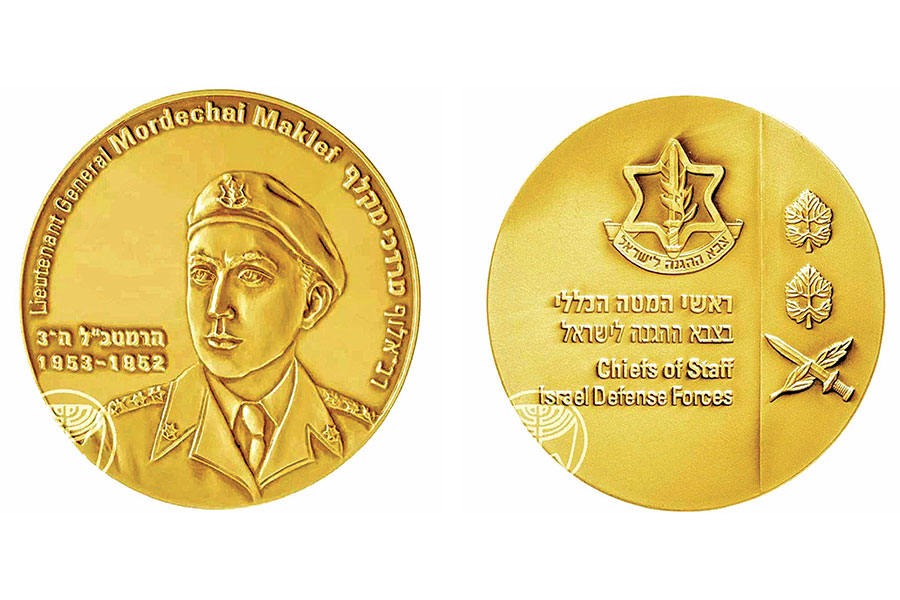


Mordechai Maklef (1920-1978), one of the formative commanders of the Israel Defense Forces and its third Chief of the General Staff, occupies a distinctive place in Israeli military and political history. His life embodied the trajectory of a generation that moved from the embattled Jewish communities of British Mandatory Rule of Eretz Yisrael, through the crucible of the 1948 War of Independence, and into the task of building a sovereign state’s permanent military institutions.
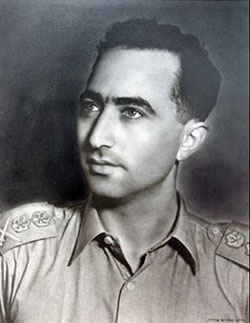
Born in Jerusalem, Maklef grew up during a period of escalating Arab-Jewish conflict, British imperial rule, and intense ideological ferment within the Yishuv, and his personal biography, military career, and relationship with Ben Gurion reveal not only the story of a seminal individual general, but also the evolving nature of Israeli civil-military relations, Zionist statecraft, and the tensions between professional soldiering and political authority during Israel’s early years.
Born into a Jewish family rooted in the Old Yishuv but integrated into the newer Zionist society, Maklef’s parents were observant Jews, and the household in which he was raised combined traditional Jewish practice with Zionist commitment, a synthesis common among Jerusalem families of that era who were neither ultra-Orthodox nor secular in the modern sense. He received a Jewish upbringing in which Hebrew language, Jewish history, and attachment to the Land of Israel were taken for granted. Like many young men of his generation, he was educated in the Hebrew school system of the Yishuv and later studied engineering at the Technion in Haifa, an institution that symbolized the Zionist project’s fusion of national revival with modern science and technology. His technical education played an important role in later shaping his approach to military organization, logistics, and infrastructure.
Maklef’s formative years were marked by violence and loss. During the Arab Revolt of 1936-1939, tensions in Jerusalem and its environs intensified and his parents and sister were murdered in 1939 by Arab rioters during an attack on Jewish residents. This traumatic event profoundly affected him and is widely cited in biographical accounts as a turning point that hardened his resolve to devote his life to the defense of the Jewish people and the Yishuv. Unlike some contemporaries who radicalized ideologically, Maklef’s response was primarily professional and military rather than rhetorical; he did not become known for incendiary public statements or ideological extremism but, instead, he passionately pursued disciplined service within the mainstream defense institutions of the Yishuv.
Maklef joined the Haganah at a young age and quickly distinguished himself as a capable officer. During World War II, like many Haganah leaders, he supported cooperation with the British war effort against Nazi Germany, viewing it as both a moral imperative and a means of gaining military experience, and he served in British-organized units that included Jewish volunteers from Eretz Yisrael, acquiring formal training and exposure to modern military doctrine. This period placed him within the same broad strategic framework as Ben Gurion, who believed that participation in the Allied war effort was essential for Jewish survival and future statehood, even while opposing harsh British restrictions on Jewish immigration; as Ben Gurion frequently articulated, “The war must be fought as if there were no White Paper, and the White Paper must be fought as if there as if there were no war.”
Maklef’s rise during the 1948 War of Independence was rapid and consequential. He served as commander of the Carmeli Brigade in northern Israel, where he played a significant role in securing the Galilee, and his leadership during Operation Hiram in October 1948, a large-scale offensive that resulted in the capture of Upper Galilee from Arab forces, remains one of the most discussed episodes of his career. The operation proved swift and militarily decisive, resulting in the collapse of organized Arab resistance in the region and the establishment of Israeli control up to the Lebanese border. From a military standpoint, Operation Hiram demonstrated Maklef’s ability to coordinate infantry, maneuver forces rapidly, and exploit intelligence and momentum, and it reflected the IDF’s growing confidence and professionalism in the later stages of the war.
At the same time, Operation Hiram has been the subject of sustained historical scrutiny because of the displacement of Arab civilians and allegations of harsh conduct by some units. The best-supported historical accounts indicate that Maklef operated at a time when the very survival and territorial integrity of the nascent state were at stake. While later historians have debated the moral dimensions of these events, Maklef’s role is best understood within the broader framework of a total war fought under extreme pressure. Like other Israeli commanders of the period, he operated within a context of existential war, fluid command structures, and political directives shaped by Ben Gurion and the provisional government, and reliable historical accounts indicate that he followed orders issued by higher command and that his actions were consistent with prevailing IDF operational norms of the time.
After the war, Maklef continued to rise through the IDF hierarchy, serving in several senior command and staff positions and developing a reputation as an efficient organizer, a disciplined professional, and a commander who emphasized preparedness and structural clarity. In 1952, at the relatively young age of 32, he was appointed Chief of the General Staff, succeeding Yigael Yadin, an appointment reflecting Ben Gurion’s preference at that time for younger commanders who combined combat experience with loyalty to civilian authority and a willingness to build a centralized, professional army subordinate to the state rather than to partisan militias.
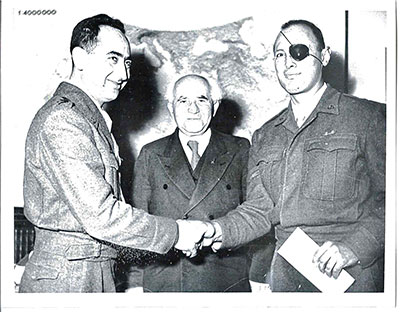
The relationship between Maklef and Ben Gurion was complex, marked by mutual respect but also by underlying tension. Ben Gurion, as Israel’s founding prime minister and minister of defense, was deeply involved in military affairs and he often intervened directly in operational and organizational decisions. Maklef accepted the principle of civilian supremacy without reservation, but he also sought to protect the professional autonomy of the General Staff. Unlike some later chiefs of staff, Maklef did not publicly challenge Ben Gurion; yet, private correspondence and memoirs of contemporaries suggest that disagreements arose over issues such as budget priorities, force structure, and the pace of military expansion.
During Maklef’s tenure as chief of staff from 1952-1953, the IDF underwent significant institutional consolidation, and he focused on training, reserve organization, and the integration of new immigrants into military service. This period was less defined by dramatic battlefield engagements than by the quieter, but no less crucial, work of transforming a wartime force into a standing national army. Maklef emphasized discipline and chain of command, values shaped both by his British military training and by Ben Gurion’s insistence on a unified, apolitical army.
Maklef’s term was relatively short, in part because of Ben Gurion’s impatience with what he perceived as excessive caution and bureaucratic rigidity within the military leadership; Ben Gurion favored assertive military doctrine and was willing to replace senior commanders if he believed they lacked the necessary strategic boldness. In 1953, Maklef was replaced by Moshe Dayan, whose flamboyant personality and aggressive approach aligned more closely with Ben Gurion’s evolving strategic outlook, a transition that was handled formally and without public acrimony but which unambiguously marked the end of Maklef’s central role in the IDF’s top command.
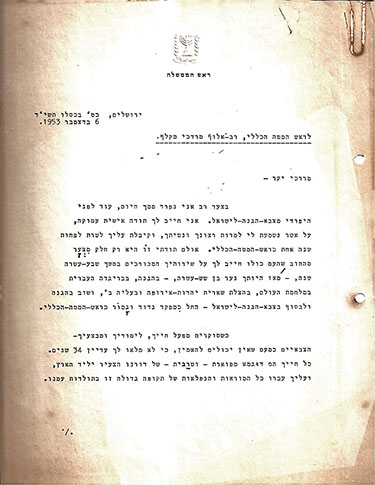
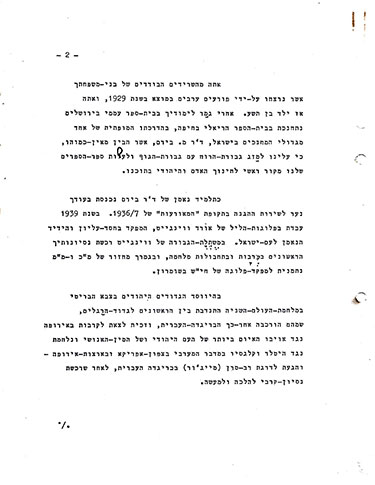
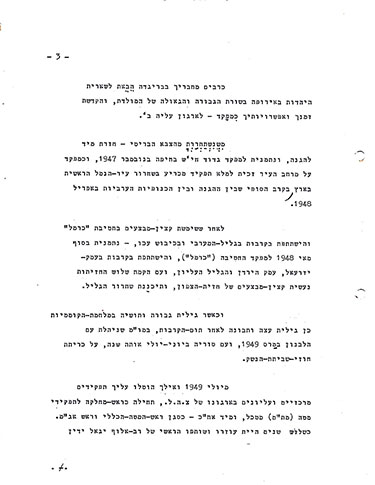
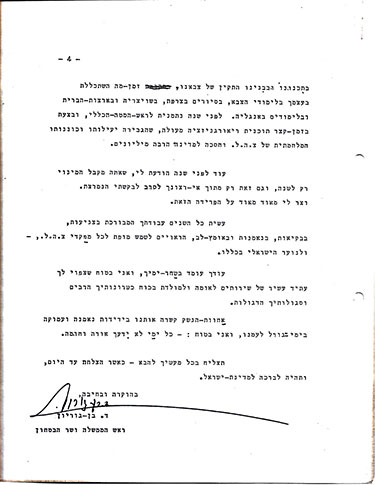
Exhibited here is a rare and historic Israel military document, a deeply moving 29 Kislev 5714 (December 6, 1953) farewell letter that Ben Gurion sent to Maklef, his outgoing chief of staff, on the occasion of his discharge from the IDF. In the correspondence, which reads like an excellent biography of Maklef, his contributions, and accomplishments, Ben Gurion expresses his “regret and sadness” at seeing Maklef leave his position – although the separation was solely at Ben Gurion’s direction:
To the Chief of the General Staff, Lieutenant General Mordechai Maklef,It is with great sadness that I part from you today, even before my own departure from the Israel Defense Forces. I owe you a profound personal debt of gratitude, for having obeyed me despite your own personal wishes and inclination and accepted upon yourself to serve for at least one year as chief of the general staff. However, this gratitude is but a small part of the debt that the entire nation owes you for your blessed services over seventeen years – since you were a sixteen-year-old youth – in the Haganah, in the Jewish Brigade in World War II, in saving the remnants of European Jewry and Aliyah Bet, and again in the Haganah, and finally in the Israel Defense Forces, from battalion commander and ending as Chief of the General Staff.
While reviewing your life’s work, your studies, and your actions – the military can hardly believe that you are not yet 34 years old. Your entire life is a glorious – and tragic – example for our young generation born in Israel, and you have experienced the horrors and wonders of this great period in the history of our people.
You are one of the few remnants of your family who were murdered by Arab rioters in Motza in 1929, and you were then a nine-year old boy. After completing your studies at a public school in Jerusalem, you were educated at the Reali School in Haifa, under the exemplary guidance of one of the greatest educators in Israel, Dr. M. Byrum, who understood like no other that we must merge the strength of the spirit with the strength of the body and to make our textbooks as a primary source for the education of the human being and the Jew within us.
As a faithful disciple of Dr. Byrum, you entered when you were yet a youth in the service of the Haganah during the “events” of 1936/7 [when the bloody clashes between the Jews and the Arabs in Eretz Yisrael took place during the period of the British Mandate]. In 1939, you worked in the night companies of O.W. Wingate, the commander with grace from above and the loyal friend of the Jewish people. At the Wingate training ground of valor, you gained your first experiences in battle and the tactics of war, and after completing a course as a squad and platoon commander, you were appointed commander of a company of the Israeli infantry in the Shomron.
On the establishment of the Jewish battalions in the British Army, you were among the first volunteers in the infantry regiment, from whom the Jewish Hebrew Brigade was later formed, and merited to go to battles in Europe against the most formidable enemy of the Jewish people and the human race, and you fought against Hitler and his henchmen in the Western Desert in North Africa and in European countries, and you reached the rank of Major in the Jewish Brigade after you acquired combat experience in principle and practice.
Like many of your comrades in the Brigade, you brought to the remnant of the Jews of Europe the message of strength heroism and the redemption of the Homeland, and you dedicated your time and efforts as commander to Aliyah Bet organization.
When you were discharged from the British Army – you returned immediately to the Haganah and you were appointed commander of the Haifa Infantry Battalion in November 1947, and as commander of the city area you merited to play a decisive role in the liberation of the main port in the country in the final battle between the Haganah and the Arab gangs in April 1948.
After serving as an operations officer in the central “Carmel” Brigade and participating in battles in the Western Galilee and the conquest of Acre – you were appointed at the end of May 1948 as commander of the Brigade (“Carmel”), and participated in battles in the Jezreel Valley, the Jordan Valley, and the Upper Galilee, and with the establishment of the three fronts, you became an operations officer in the Northern Front, planning the liberation of the Galilee.
And just as you demonstrated bravery and resourcefulness in the War of Independence, you also showed wisdom and prudence after the fighting ended, in the negotiations you conducted with Lebanon in March 1949, and with Syria in June-July of that year, regarding the conclusion of ceasefire agreements.
From July 1949 onwards, you were assigned central and senior positions in the IDF, first as head of a department, then as deputy chief of the general staff and head of the general staff (Matam) and immediately afterwards as the assistant head of the operations directorate. For three years, you were the assistant and chief partner of Maj. Gen. Yigal Yadin in the proper planning and building of our army, you have for some time now perfected yourself in military studies, on tours in France, Switzerland and the United States, and in studies in England. A year ago, you were appointed chief of the general staff and in a short time you carried out an excellent reorganization plan, which increased the efficiency and readiness of the IDF and saved the country many millions.
A year ago, you informed me that you were accepting the appointment for only a year, and that too only out of your unwillingness to refuse my earnest request. And I am very, very distressed about this separation.
You have performed your blessed work all these years with humility, with expertise, with loyalty and courage, worthy of serving as an example to all IDF commanders and to Israeli youth in general.
You are still standing in the dawn of your days [i.e., “you are still very young”], and I am certain that you have a rich future of service to the nation and the homeland through the power of your many talents and great virtues.
The brotherhood-in-arms binds us in a loyal and deep friendship during these days of destiny for our people and I am certain: all my days, no light or wall will fade.
May you succeed in all your future endeavors – as you have succeeded to this day and may you be a blessing to the State of Israel.
With appreciation and affection.
D. Ben Gurion
Prime Minister and Minister of Defense
Alyah Bet was a secret effort by the Zionist movement to bring over 100,000 Jewish refugees to Mandatory Palestine between 1934 and 1948, against the stated policy of the British.
The attack on Motza, a small agricultural settlement west of Jerusalem, during the Arab riots of August 1929 became one of the most searing symbols of the vulnerability of isolated Jewish communities under British Mandatory Rule. Motza was assaulted by Arab mobs amid a wider eruption of violence sparked by tensions over the Western Wall, and several Jewish residents were brutally murdered in their homes, among them members of long-established pioneer families, while others survived only by hiding or fleeing to Jerusalem. The episode shocked the Yishuv not only because of the savagery involved, but because Motza had maintained relatively good relations with neighboring Arab villages, reinforcing the grim lesson that personal ties offered little protection once large-scale nationalist violence was unleashed.
The Reali School (Beit HaSefer HaReali) in Haifa, founded in 1913 by Dr. Arthur Biram, was one of the most influential Hebrew educational institutions of the Yishuv, combining rigorous academic standards with a deeply Zionist ethos, emphasizing Hebrew language, Jewish history, physical education, and civic responsibility. The school embodied the aspiration to create a modern, self-confident Hebrew society rooted in both Jewish tradition and European humanistic education, and generations of students educated there went on to become leaders in the military, political, scientific, and cultural life of the future State of Israel.
Dr. M. Byrum was a British educator and intellectual who taught at the Reali School in Haifa during the Mandatory period and played a quiet but meaningful role in shaping its early academic culture. Trained in the British educational tradition, he brought to the Reali School a high standard of instruction, discipline, and intellectual seriousness, helping to bridge European pedagogical methods with the emerging Hebrew educational project, and his work exemplified the Reali School’s founding ideal: passionate Zionism and the creation of a modern Hebrew elite, grounded simultaneously in Jewish national consciousness and universal intellectual standards.
Orde Charles Wingate was one of the most consequential British officers ever to serve in Eretz Yisrael under British rule. A fervent Christian Zionist, he believed passionately in the Jewish return to the Land of Israel and translated that belief into action as the founder of the Special Night Squads during the Arab Revolt of 1936-1939. These units, composed of British soldiers and Jewish fighters, pioneered aggressive, mobile tactics that left a lasting imprint on the Haganah and, later, the Israel Defense Forces. Though ultimately removed by the British for his outspoken pro-Zionism, Wingate was revered by Jewish leaders as a military mentor and moral ally at a critical formative moment.
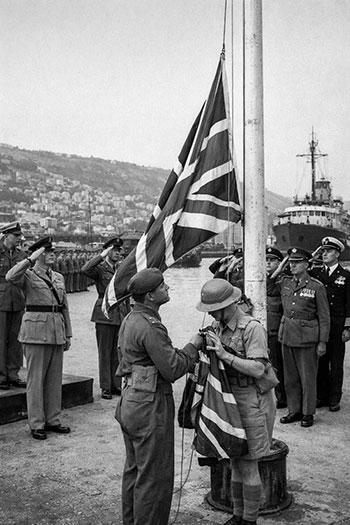
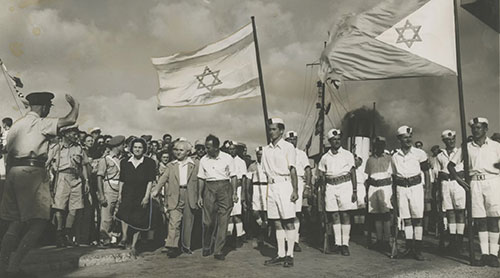
The symbolic end of British rule in Eretz Yisrael came with the lowering of the Union Jack in Haifa in May 1948, shortly before the declaration of the State of Israel, a ceremony that captured in a stark and widely reproduced photograph showing the British flag descending at the port city that had served as the administrative and logistical heart of the Mandate. The image conveys both imperial formality and palpable exhaustion, marking the close of three turbulent decades of British governance and, for the Jews of Eretz Yisrael, the moment represented not merely the departure of a colonial power, but the removal of the final barrier to sovereignty, on the very eve of independence and war.
After leaving his position as chief of staff, Maklef held senior roles in Israel’s defense establishment and later served in diplomatic and administrative capacities, including as director general of the Ministry of Defense and as Israel’s ambassador to the Soviet Union, a sensitive and demanding diplomatic post that he held until 1956. His service in Moscow coincided with a particularly complex period in Soviet–Israeli relations and effectively removed him from military decision-making during the Sinai Campaign. The planning and execution of that war were led by a different generation of IDF commanders, most notably Moshe Dayan as chief of staff, operating in close coordination with Ben Gurion. He never sought elective office and he did not cultivate a public political persona, choices consistent with his lifelong preference for professional service over ideological advocacy.
Maklef’s Judaism was an integral but understated aspect of his identity. He was born into a Jewish family that observed traditional practices, and there is no evidence that he rejected or abandoned these traditions in adulthood, but, at the same time, like many leaders of the Labor Zionist milieu, he did not publicly emphasize ritual observance. His life reflects the mainstream traditional-national Judaism characteristic of many Yishuv families of his generation, and reliable biographical sources indicate that while he identified strongly as a Jew and as a Zionist, they do not provide detailed documentation of his personal religious observance.
Maklef’s marriage was conducted according to Jewish law, as was customary in Israel, where marriage falls under the jurisdiction of the Chief Rabbinate, and his family life conformed to the norms of Jewish society in Israel. His children were Jewish by birth and were raised within Israeli Jewish society and what can be stated with confidence is that Maklef’s family was fully integrated into the Jewish national collective of Israel and did not stand apart from its institutions or communal life.
Maklef’s involvement with Jewish organizations was primarily channeled through state and quasi-state frameworks rather than through philanthropic or religious bodies. His service in the Haganah, the IDF, and the Ministry of Defense constituted a form of communal leadership deeply intertwined with the Jewish people’s collective project of statehood and self-defense. He did not become known as a donor or activist within Jewish charitable organizations, nor did he hold ceremonial positions in diaspora Jewish institutions; nevertheless, Jewish organizations and the Jewish press frequently recognized his contributions to Israel’s security. Contemporary Hebrew-language newspapers, including those aligned with Labor Zionism, portrayed him as a serious, disciplined commander who embodied responsibility and restraint, and the Jewish press in the diaspora tended to mention him primarily in connection with major military developments or leadership transitions, reflecting his low public profile.
Maklef never sought to articulate a personal ideological doctrine and his views on Zionism are best inferred from his actions and career: he clearly accepted the foundational Zionist premise of Jewish self-determination in the Land of Israel and dedicated his life to defending that achievement, but, unlike ideological theorists or political leaders, he did not engage in public debates about the cultural or religious meaning of Zionism. His approach aligned with Ben Gurion’s pragmatic state-building Zionism, which prioritized sovereignty, security, and institutional strength over ideological purity and, in that sense, his Zionism was practical rather than rhetorical.
Antisemitism powerfully shaped Maklef’s life. Growing up in Eretz Yisrael under the British Mandate, he experienced the vulnerability of Jewish communities in a hostile environment, culminating in the murder of his family members. While this violence occurred within the context of Arab-Jewish conflict rather than European antisemitism, it nonetheless reflected the broader reality of Jewish insecurity that Zionism sought to address. During World War II, he was acutely aware of the Holocaust unfolding in Europe, an awareness shared by all Haganah leaders and one that reinforced their determination to establish a Jewish state capable of defending itself.
When Maklef died in 1978 at the relatively young age of 58, he was buried in Israel and received a Jewish funeral in accordance with state and religious norms and his burial reflected his status as a senior military leader and a loyal servant of the Jewish state.
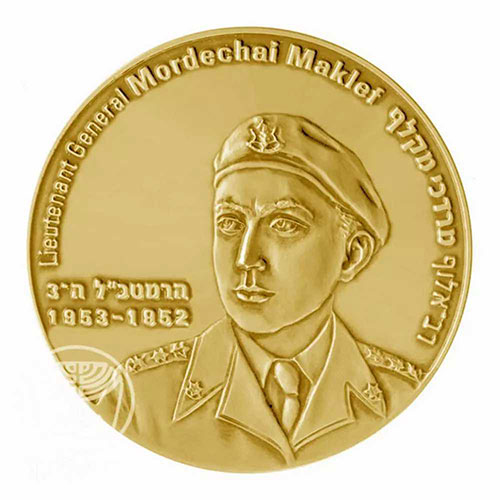
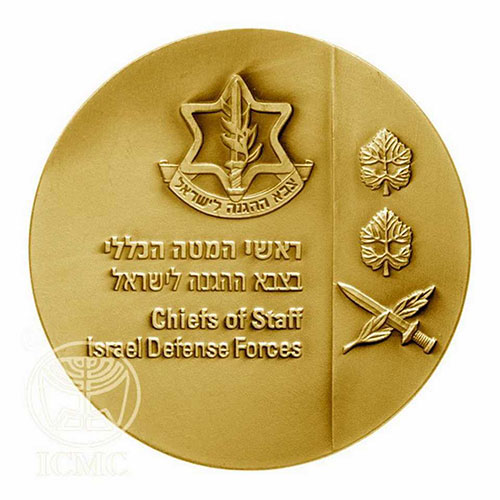
In retrospect, Maklef emerges as a figure of quiet significance rather than dramatic legend. He was certainly not a charismatic hero in the mold of Moshe Dayan, nor a political visionary like Ben Gurion. Rather, he represented the disciplined, professional officer whose contributions were essential to the survival and consolidation of the State of Israel. His relationship with Ben Gurion illustrates both the strengths and strains of Israel’s early civil-military dynamic: mutual dependence, shared purpose, and occasional friction, and, even after he was replaced after a brief tenure, he accepted Ben Gurion’s authority and served faithfully without public protest or political maneuvering.
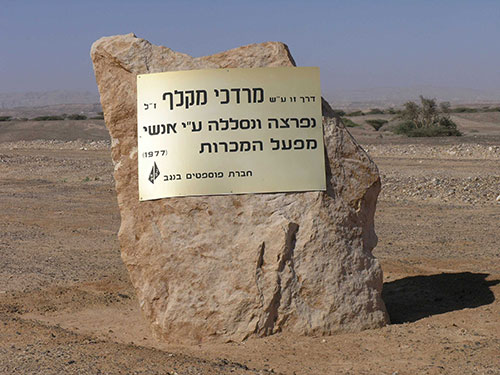
The leading Israeli press of his time generally treated him with respect, emphasizing his professionalism and integrity. Later historical assessments, including those by military historians, have tended to view his tenure as chief of staff as a transitional but important phase in the IDF’s development. Within the Jewish historical narrative, Maklef stands as a representative of a generation that combined Jewish tradition, Zionist commitment, and military professionalism in the service of national survival, and his life, shaped by personal tragedy and collective struggle, reflects the broader story of Israel’s emergence and the Jewish people’s quest for security and self-determination.