 September 18, 2026
 Categories: In Print / Front Page
New York’s Mayor Adams Weighs In on a City in Peril
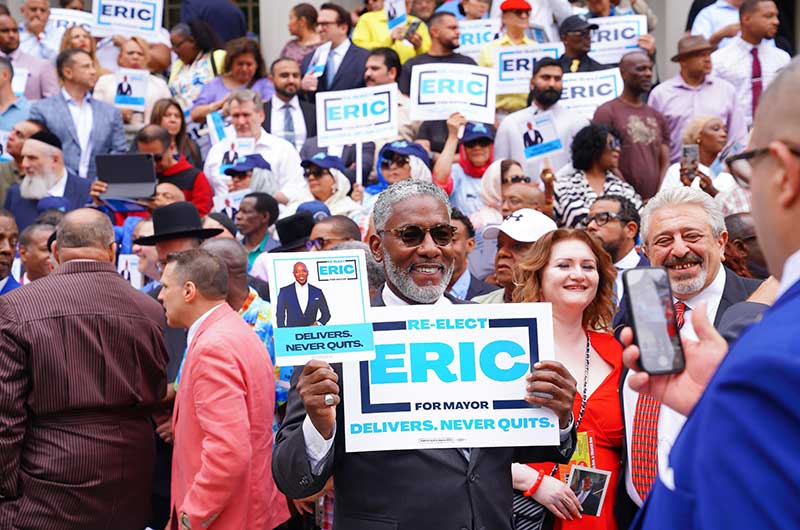


This November, New Yorkers will decide who will lead the city as mayor for the next four years. The stakes couldn’t be higher for New York’s Jewish community – as Zohran Mamdani, the newly chosen Democratic nominee, proudly identifies as a socialist and has been severely critical of Israel and its supporters. By winning the Democratic primary, Mamdani has achieved the impossible in modern day politics: a unified coalition of Democrats and Republicans rallying against a common threat to their city.
Last Thursday, on the steps of City Hall, Mayor Eric Adams officially launched his campaign for reelection as an Independent. During his first four years, he developed a strong relationship with the New York Jewish community, and several Orthodox Jews have prominent positions in his administration. But with two other candidates still on the ballot – former governor Andrew Cuomo (also now running as an Independent) and Guardian Angels founder Curtis Sliwa (the Republican nominee) – the race remains tight and unpredictable.
The Jewish Press sat down with the mayor to hear his thoughts about this pivotal upcoming election.
The Jewish Press: New York City is home to an estimated 1.1 million Jews, the largest single-city Jewish population in the world. As the incumbent mayor of New York City, please remind our readers what you have accomplished on behalf of the Jewish community to date.
Mayor Eric Adams: It’s a combination of symbolism and substance – they go together. Clearly, out of all the elected officials of the city, there has not been more of a vocal leader to combat antisemitic hate and to show real solidarity with not only the Jews who live in this city and country, but in Israel and, of course, across the globe. Our heritage events, our flag-raisings [of the Israeli flag], and marching in the Israel Day Parade, are really front and center. Anytime there is an action, we’ve stood up and led from the front – that’s the symbolism.
When you look at the substance, there are things that from the Jewish community I hear all the time that are very important to them. They want to feel safe. When they are out going to their synagogues and marching in their parades and when they are dropping their children off to school, they want to be safe. Then there’s education: What we have done around making sure the right of yeshivas to educate their children [in a way consistent with their beliefs], how we fought with Albany to make sure there are not any cuts in vouchers, and even when Albany cut the vouchers, we were willing to pick up the slack to make sure those Jewish students were able to get vouchers as they needed it. A large number of these vouchers that are distributed go to the Jewish community. Even the “substantially equivalent” [referring to parochial school curricula] fight that you see taking place in yeshivas now – we want to make sure that it’s done fairly. We have been really pushing back on some of the things that the New York State Education Department is doing. We want to use all of our powers to clearly articulate that children don’t only have to read Shakespeare, there are equivalent scholars in the Jewish community that are just as important.
Also, we have a significant presence of Jewish voices inside our administration: NYPD Deputy Chief Richie Taylor, the highest ranking Orthodox Jewish member here in our administration, NYPD Deputy Commissioner of Intelligence and Counterterrorism Rebecca Weiner, an Orthodox Jewish woman, and NYPD Police Commissioner Jessica Tisch – the first Jewish woman ever to be placed at the top of the police department. The Jewish community is very much embedded in the leadership of our administration and we’re going to continue to do the good work that we have done, funding critical programs and services in the Jewish community. There’s a real clear, symbiotic relationship between this administration and the Jewish community.
JP: You are running as an Independent on two ballot party lines – “EndAntisemitism” and “Safe And Affordable.” What inspired these choices?
I’m on two lines. One addresses the general concerns of the city – affordability and safety are the two top things that come up in polling numbers. The second is on a specific concern – antisemitism – and that line is intentional [in] sending the right message particularly when I’ve seen some of the candidates who are running who have a history of being antisemitic or siding with antisemitism. I think Zohran Mamdani is a real indicator and symbol of this – his embracing of Hamas, his anti-police commentary. I think that having a line that said “EndAntisemitism” is an appropriate line to put in place because our goal is to ensure that we end antisemitism. It will send a strong message; in this city we have the largest Jewish population outside of Israel. So this was intentional in my planning to reach those specific groups who are being impacted by antisemitism and empower them to use the power to vote to speak on how they think it’s important to have a mayor to run on the line.
JP: On June 24, New York State Assemblyman Zohran Mamdani shocked the Democratic Party establishment and the country by beating well-known Andrew Cuomo in the Democratic Primary for mayor of New York City. Mamdani has stated he is a Democratic Socialist. He is also pro-BDS (Boycott, Divestment, and Sanctions against the State of Israel). When asked last week by a reporter if he is in favor of capitalism, he quickly responded “no.” He has also referred to the Israel-Hamas war as a war crime and suggested he would arrest Israeli Prime Minister Benjamin Netanyahu if he visited New York City. Do you think someone like Mamdani can ultimately become mayor of America’s largest city?
One, I am not a socialist, this is not a socialist country, and this is not a socialist city. To believe he [Mamdani] can bring a socialist mindset to govern the city, I believe that’s problematic. This is a city of opportunity – you come here as a cab driver and become a medical doctor, a dishwasher can own a chain of restaurants. This is a city that is motivated to exceed and excel. The philosophy of socialism as a governing principle is just a failed system. Socialism doesn’t work – all you have to do is go to Cuba to see the rations that are giving out to people. So this concept [Mamdani proposed] of government supermarkets giving everything free without a real understanding of how to do governing is problematic for our city. I know there are people who are concerned about the affordability issue, because I lived in poverty. I know what it means to worry about your bills, about a roof over your head, and that is why we didn’t just say something – we did something. We put 30 billion dollars back into the pockets of New Yorkers, helping pay off medical debt, reducing the cost of Metrocards, paying college tuition of foster-care children, dropping the cost of childcare from $55 to less than $5 dollars a week, and just recently introducing a bill to Albany to drop income tax [for] low-income New Yorkers.
I think Mamdani’s style and thoughts are very entertaining, and he has great clips on TikTok and Twitter, but they are not good clips for governing this city. I believe it will be a huge mistake for our economy, for all the progress we’ve made – we’ve created more jobs than ever in the city’s history, and Broadway (theatre district) has had its best 12 months in recorded history. Also I think [Mamdani’s] a mistake when it comes to public safety. He is talking about “under no circumstances” hiring more police officers. His comments towards our police department are not only inappropriate, but he's going to give away a properly governed city.
JP: Now that he’s lost the Democratic primary, former New York State governor Andrew Cuomo has recently announced he will be running for mayor on an independent ballot party line called “Fight and Deliver.” This means there will likely be four candidates in the deciding election in November, with Guardian Angels founder Curtis Sliwa running on the Republican line. Why is Cuomo not good for New York City?
I’ve said over and over again: It’s going to come down to four primary candidates. Two of them – Curtis and Zohran – do not have a record, and one of them – Andrew [Cuomo] – is running from his record. Much of what Andrew put in place [as governor] I had to repair or fix. I had to fix the bail reform and police our city. The mental health crisis came from the closing of psychiatric beds under Cuomo; [under] the cannabis law we had shops opening across our city and I had to close 1,400 shops that came under his administration; the housing crisis; the loss of 1,500 individuals who died in the nursing homes is attached to his record. So you have to ask yourself – if Mayor Adams had to fix what Cuomo’s record shows, why are we going to have him be the mayor and bring that same level of governance? That’s why I think my record speaks for itself: Crime is down, jobs are up, we are educating our children and building healthy families and housing compared to the record he had [as governor that we ultimately had to fix].
JP: Has New York’s Jewish community become safer under your watch? What is the optimism you have for the city and what plans do you have to improve the lives of the Jewish community in the future?
Yes, and we will fight to continue to make sure it stays safe.
We are gritty, hard-working, resilient people in New York. After the attack on Sept. 11, 2001, the next day we got up – our teachers taught, builders built, retailers sold their goods, and it showed what we’re made of. And I think these last three years and six months I showed what New Yorkers are all about. No matter what we had to face both professionally and personally, we maintained and continued to lead the city forward. We continue to forge ahead. We’ve had hard times before, we navigated through them, from Covid to the migrants and asylum seekers, to the criminal justice problem. There is no place like New York and we need to be resilient as we’ve always been.