 October 16, 2026
 Categories: Features / Book Reviews
‘One Must See Themselves as Having Left Egypt’
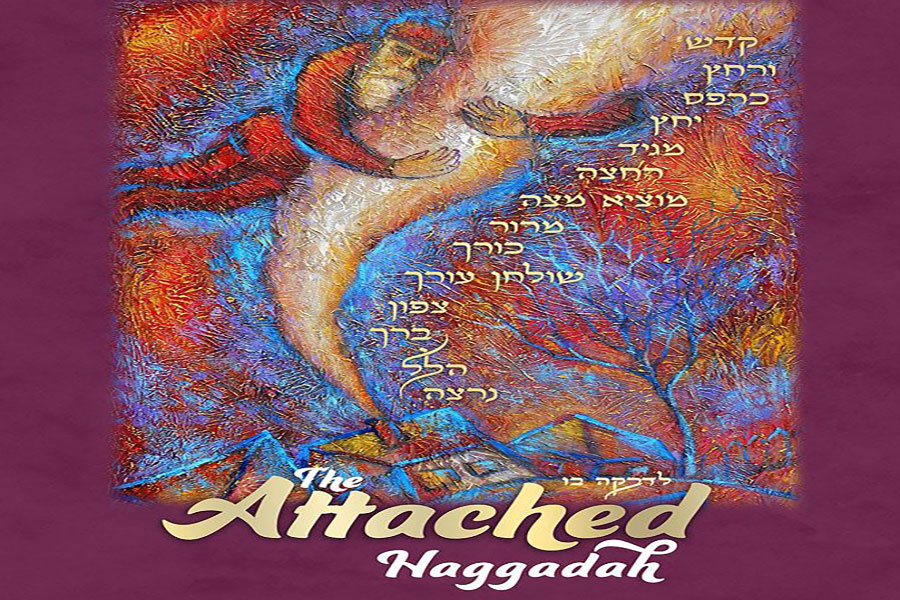


Title: The Attached Haggadah
Author: Rabbi Yaakov Danishefsky
Distributed by Feldheim
Every year, as Pesach approaches, the Jewish book market is flooded with yet another wave of new Haggados. The Pesach Haggadah is unique. It is not just a book that we own; it’s not even a book that we merely read and learn from. The Haggadah is, most essentially, a book that we use. And we use it so much that, according to many sources, the Pesach Haggadah has been produced in more editions, with more commentaries, than any other book in Jewish history.
So the question any new Haggadah must answer is simple: Why this one? Why choose this book to sit at the center of your table this year?
Rabbi Yaakov Danishefsky’s new book, The Attached Haggadah, answers that question by declining to compete with other editions in the usual way. The Attached Haggadah is not yet another collection of clever Torah insights, a massive anthology of others’ teachings, or a compilation of historical notes and riveting illustrations to help you “get through Maggid.” Instead, this Haggadah’s central aim is more demanding – and also more refreshing: the Pesach seder is supposed to be a real experiential encounter with a past that is still present. It is “[a]n immersion – a lived drama of personally and collectively leaving bondage.” (p. 1)
We are here together not merely to perform the seder or observe its mitzvos. We are here to place ourselves within the presently unfolding events of the miraculous Exodus from Egypt – and to find the slavery and hardship, miracles, uncertainty, hope, transformation, courage, and ultimately relationship with Hashem within our own selves.
By focusing on bringing readers into the experience of the seder, The Attached Haggadah also points to one of the reasons for the astounding proliferation of Haggadah editions: our endless – and also seemingly fruitless – quest for the perfect Pesach seder. With the insight that derives from Rabbi Danishefsky’s work as a wonderfully impactful therapist, this Haggadah names what virtually all of us know but rarely say out loud: our sedarim almost never live up to our hopes for them. We come in carrying expectations of meaningful divrei Torah, inspired singing, children wide-eyed, and a calm sense of regal holiness. And then reality arrives: exhaustion, last-minute rushing, complicated family dynamics, impatience, hungry kids, distracted adults. The Attached Haggadah captures this reality with disarming honesty: it’s striking, it says, that we call this night “the Seder,” because for many it is “one of the most disordered nights of the year.” (p. 32)
The Attached Haggadah aims at redeeming us – or really, giving us the tools to redeem ourselves – from the mess. “Perhaps that’s exactly the point,” Rabbi Danishefsky writes. A seder that doesn’t go smoothly doesn’t mean it failed. It means there is “an underlying order even amidst the chaos.” The Jewish people did not leave Egypt in settled calm; they left b’chipazon – with tension and pressure, dough still rising, homes still trembling. In other words: the chaos and even the letdowns we encounter at our sedarim aren’t an interruption of the Exodus story. They are part of our own present yetziyas Mitzrayim.
This is where The Attached Haggadah becomes therapeutic in the best, transformative sense. Rabbi Danishefsky recognizes how quickly disappointment becomes control, and control becomes conflict. When people try to force the night to match the fantasy of what it “should” be, the seder can turn into a battleground of anger, resentment, and spiritual letdown. The Attached Haggadah invites us into a different avodah: letting go of the demand that the night be perfect, so that the historical slavery and Exodus we are talking about can become real. That is an extraordinarily helpful reframing for a night that so often collapses under its own expectations.
How does this Haggadah do that?
First, it repeatedly invites the reader to identify themselves within the story, and to locate the story within themselves. Mitzrayim is not only a place our ancestors once suffered; it becomes a template for every inner exile and constriction we experience now (see p. 57). The Exodus, then, becomes an emotional and spiritual map. Guided by Rabbi Danishefsky’s brief, accessible, and evocative commentary, we are invited to ask ourselves: Where am I stuck? What am I enslaved to? What would it feel like to move – even one step – from constriction to the spaciousness of freedom? And what is that feeling of freedom grounded in?
The text is comfortable speaking to the parts of us that are ashamed, tired, guarded, or dry, and it refuses to treat those parts as distractions from avodas Hashem. On the contrary: The Attached Haggadah presents Hashem as One who sees beneath the surface, tending to the hidden layers of ourselves with precision and tenderness. This overall hashkafah (Hashem not merely as Judge, but as Teacher, Parent, and Healer who is rooting hard for our success) changes what it means to tell the story of our redemption and peoplehood.
This integrated approach to encountering the seder is highlighted in Rabbi Danishefsky’s treatment of Rabban Gamliel’s teaching that Pesach, Matzah, and Marror form the core of the night. The Haggadah uses this teaching to frame the seder as a model of wholeness: the Korban Pesach anchors us in our bodies and actions; matzah speaks to story, history, and interpretation as they play out in our minds; and marror activates raw emotion through the visceral taste of suffering on our tongues. And this is what it’s all about: “You need all three… You must know your story and analyze it with your mind… feel it in your heart… taste it with your body” (p. 116). Only then is the mitzvah truly fulfilled, because only then does the seder become a vehicle for the redemption of the whole self.
In this sense, The Attached Haggadah refreshingly refuses to portray – or to cultivate – a flattened religious persona that splits the human being into compartments, keeping thinking minds, feeling hearts, and materially acting bodies separate. The redemption of the seder is about “integration,” about the creation of a self in which mind doesn’t ignore heart, heart doesn’t drown body, and body doesn’t silence mind. Rather, “they become partners in a symphony.” (p. 115)
That last line captures what is perhaps the most concrete way The Attached Haggadah moves us from a seder of ideas and concepts to one of experience and relational connection: through a more whole encounter with mitzvos. Rabbi Danishefsky pushes mitzvah observance toward mindfulness – toward kavanah that makes the mitzvos of the night felt in the body, experienced in the heart, and clarified in the mind.
One powerful example appears in Rabbi Danishefsky’s treatment of the mitzvos of eating matzah and marror. The Haggadah invites us to experience these mitzvos deeply – not only to do them with our bodies, but to feel them in our hearts and conceptualize them in our minds. Instead of a rushed frenzy to eat the right amount of matzah in the required timeframe, or the inevitable comparisons of the taste, thickness, and price of various matzah brands, eating matzah is transformed into a focused reflection on the ways we gravitate toward experiential highs – whether material or spiritual – and on the quiet, comforting calm that can be experienced by sinking into trust and emunah in the value of ordinary, bland experiences.
In a similar fashion, Rabbi Danishefsky frames the mitzvah of eating marror as a tool for reflecting on – and truly practicing – how the inevitable difficulties of our lives can and must be experienced and fully processed in order to bring us to redemptive healing. The Gemara’s halachic insistence that swallowing marror without chewing does not fulfill the mitzvah is reframed as a spiritual psychology of redemption: healing requires tasting what hurts rather than bypassing it. Rabbi Danishefsky speaks candidly as a therapist noting that the degree of healing we achieve is directly correlated with the degree of pain we are willing to allow ourselves to feel. Whether one reads that clinically or spiritually, the message is deeply seder-appropriate: leaving Egypt means not only declaring liberation, but connecting with what we have been enslaved by. The mitzvos of the night become vehicles that help us metabolize it all.
In these and numerous other places throughout the commentary, The Attached Haggadah illustrates how the seder can truly be something more – even while it is not living up to our (often unreasonable) expectations of what it is “supposed” to be. This Haggadah is, in a real sense, a seder instruction manual. It teaches, in a gentle, engaging, and rigorous way: don’t rush through this night; don’t allow the mitzvos and recitation of the Haggadah to devolve into empty performance. Use them as portals into an experience that is meant to do something to you.
In a market flooded with new Haggados, this one stands out. It doesn’t offer yet another (sort of) new commentary. Instead, The Attached Haggadah gives you an entirely new posture for the seder: come as you are; expect mess; relinquish control; let the mitzvos touch all of you; let the story find you; and allow the seder to be an encounter instead of a performance.