

 November 27, 2026
Categories: Headline / Parsha / Torah
Parshas Vayishlach: What Cannot Come with Us


We are often better at leaving places than leaving behind what they gave us.
We change jobs. We move homes, and sometimes communities. We walk away from relationships or environments that no longer work. We pack our belongings, close a door, and begin moving toward whatever comes next.
The physical departure is usually obvious. What is less obvious is what travels with us: habits, assumptions, ways of seeing ourselves, and pieces of a life we thought we had left behind.
Transformation runs throughout Parshas Vayishlach, including one of the Torah’s most recognizable stories of change.
Yaakov wrestles through the night with a mysterious figure and emerges with a new name, Yisrael. His identity shifts. His relationship with Esav changes. He returns to the land he once fled.
But later in the parsha is another transformation, a quieter one that receives far less attention. It begins with what Yaakov’s family is still carrying.
With Lavan, But Not Like Lavan
When Yaakov sends messengers ahead to Esav, he tells them, “Im Lavan garti,” I lived with Lavan. Jewish tradition finds something powerful embedded in those words: Yaakov lived for twenty years in Lavan’s world without allowing Lavan’s values to become his own.
It is a remarkable claim. Yaakov survived a household shaped by manipulation and shifting loyalties, and emerged believing that his surroundings had not determined who he had become.
He lived there, but he did not become “of there.”
That tension would become a familiar one in Jewish life. We have lived for centuries among other nations, building homes, livelihoods, and communities while remaining responsible for preserving what makes Jewish life Jewish. Living among others was never necessarily the same as disappearing into them. We are not called to hide from the wider world. If we are to bring something distinctly Jewish into it, we have to be part of it while still knowing what is ours. Belonging does not have to mean becoming indistinguishable.
Yaakov’s words suggest that this balance begins much earlier than our exile. He worked in Lavan’s world. He married there, raised children there, and built his livelihood there. Lavan’s world became part of Yaakov’s story. The claim is not that living there left no mark. It is that living with Lavan did not require Yaakov to become Lavan.
And yet, that distinction may be more complicated than it first appears.
When the family fled Lavan in Vayetzei, Rachel took her father’s teraphim. Jewish tradition offers different ways to understand what she intended. One explanation is that Rachel wanted to separate her father from idolatry. In that reading, she did not take the teraphim because she was drawn to Lavan’s beliefs. She took them because she rejected them.
There is something deeply human in that possibility. Sometimes what follows us from a difficult place is not what we loved about it. It is what we spent years resisting.
We can leave an environment and still organize parts of ourselves in response to it. We are no longer living by its rules, but those rules are still defining the argument.
Rachel may have wanted the teraphim out of Lavan’s hands. Yet they still left his household with her.
What Remained in the Household
By the time Hashem tells Yaakov to return to Beis El, Lavan is far behind him. Yaakov has prepared to face Esav, wrestled through the night and received the name Yisrael. He has survived the encounter he feared for years.
Yet before the family moves forward again, Yaakov turns to everyone with him and tells them to remove the foreign gods in their midst, to purify themselves and change their clothes. They surrender the foreign objects in their possession, along with their earrings, and Yaakov buries them beneath a tree near Shechem.
The Torah never identifies these objects as Rachel’s teraphim, and we should not turn an intriguing possibility into a textual fact. Still, the sequence is difficult to ignore. Yaakov has declared that he lived with Lavan without becoming like Lavan, yet something from the world he rejected remains present within his household.
Perhaps both things can be true.
We tend to treat integrity as though it creates a sealed border around us. If we remain faithful to our principles, we imagine that nothing foreign has entered.
Human beings are rarely that impermeable.
We can reject a culture while absorbing some of its habits. We can oppose someone’s values while continuing to respond according to patterns that person established. We can leave an unhealthy system while unknowingly recreating pieces of it elsewhere.
Sometimes the evidence of what influenced us does not appear in what we believe. It appears in what has quietly entered the household.
Remove, Purify, Change
There is another intriguing detail. Yaakov receives the name Yisrael after wrestling through the night, but Hashem gives him the name Yisrael again after the family reaches Beis El.
Between those two namings, Yaakov gives his household three instructions.
The order matters. First the foreign objects are removed. Then comes purification. Then, even their clothing changes. Only afterward does the journey resume. Yaakov seems to understand that removal alone is insufficient. A decision can change our circumstances before it changes us.
Getting rid of something is only the beginning.
The old environment may be gone while its expectations remain. A relationship can end while we continue anticipating the same responses from everyone who comes after. We may no longer need a particular defense and still reach for it automatically. We may reject someone else’s understanding of who we are without yet knowing who we are without it.
The clothing is particularly evocative because it is visible. Whatever changes internally must eventually affect the life lived externally. Transformation cannot remain merely a conviction.
The first naming of Yisrael comes through struggle. The second comes after return. Between the two are confrontation, consequences, purification, and the difficult work of bringing an entire household forward.
Perhaps identity is not only discovered during the extraordinary night when we wrestle with who we are. It is also built through what we do after morning comes.
Returning to Beis El
The timing matters. Yaakov does not conduct this inventory when the family first leaves Lavan or immediately after encountering Esav. It happens when Hashem calls him back to Beis El.
Beis El is where Yaakov once slept while fleeing Esav and where Hashem promised to remain with him and eventually bring him back. Now that return is happening, but Yaakov cannot return as the man who left. He arrives with wives, children, possessions, and years of experience. He has been deceived, faced Esav, wrestled through the night, and acquired a new name. Returning to Beis El cannot mean recovering the person who once dreamed there. That person no longer exists.
Even the new name does not entirely replace the old one. Although Yaakov is given the name Yisrael and told “No longer shall you be called Jacob,” the Torah continues to use both names, a complexity that Jewish commentators have long noticed.
Perhaps that is one of the Torah’s most honest observations about transformation. Growth is not always replacement. We do not become someone entirely different and leave the old self somewhere behind us. Parts remain. Names remain. Memories remain. What changes is the relationship we have to them.
Yaakov can only return as someone changed by the road, responsible now for deciding what those changes will mean.
What Belongs to the Next Journey
Yaakov’s family does not leave everything from Lavan’s household behind. The family itself was largely built there. Relationships, experiences, and lessons continue with them.
The past is already coming with them. The real question is in what form.
Some of what we carry becomes wisdom. Some becomes memory, strength, or caution. Other parts continue controlling us long after the conditions that created them have disappeared. Discernment means learning the difference.
These things rarely announce themselves as foreign gods. They look familiar. We have carried them long enough that we stop asking why they are still in our hands.
Beneath the Trees
Then the Torah gives us two burials.
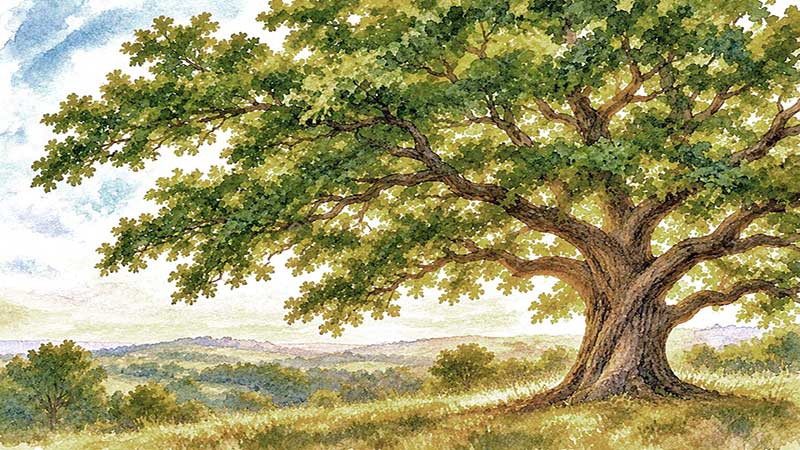
Yaakov takes the surrendered objects and buries them beneath a tree near Shechem. Only a few verses later, after the family reaches Beis El, Devorah, Rivkah’s nurse, dies. She too is buried beneath a tree, and the place is given a name of mourning, Allon Bachus, the Oak of Weeping.
The Torah does not tell us to connect the two scenes, and perhaps we should resist making the symmetry too neat. Still, their proximity is striking. Some things from the past must be relinquished. Others must be mourned.
Not everything we leave behind was something we needed to escape. Some things are precious and still cannot accompany us further. Some losses are necessary choices. Others are losses we would never have chosen.
There are things we bury because they should no longer remain in our hands, and things we bury because we would have carried them forever if we could.
Perhaps maturity lies partly in knowing the difference.
Vayishlach is filled with transformations large enough to name. Yaakov wrestles through the night, becomes Yisrael, and faces Esav after years of fear. But transformation is not confined to the dramatic encounter. It also happens in the inventory afterward, when we examine what entered our lives along the way and decide what deserves to continue with us.
Hashem calls Yaakov back to Beis El, but the return is not an invitation to go backward. Yaakov cannot become the person who once dreamed there. He can only return as the person the journey has made him, responsible now for deciding what those years will mean.
Before the family continues, they stop beneath the trees.
Some things are carried forward. Some things are mourned. Some things are transformed.
And some things can go no farther.