 October 9, 2026
 Categories: Headline / Parsha / Torah
Picking Up the Pieces
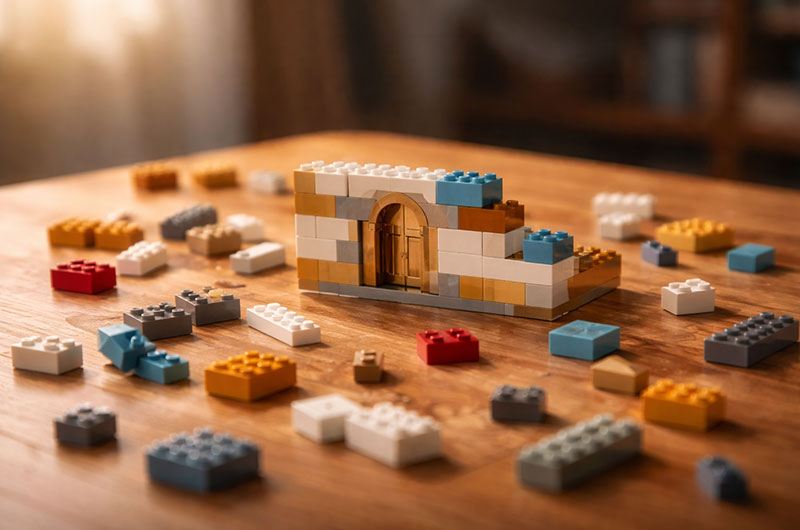


Not long ago at our parent-child learning program, a young boy came over and asked about the large Lego Beis HaMikdash set his parents had bought him for Chanukah. It was one of those enormous kits with thousands of tiny pieces designed to be assembled once and then displayed. He looked up at me with complete seriousness and asked a halachic question: Can I build the Beis HaMikdash on Shabbos?
I told him that his question is actually Rashi in this week’s parsha. Before commanding the construction of the Mishkan, Moshe first teaches the laws of Shabbos. Rashi explains that the Torah places Shabbos here to teach that even the holiest building project in history stops for Shabbos. The father was thrilled with the answer. The boy, not as much.
But his question opens something much deeper. Parshas Vayakhel is not really about whether the Mishkan may be built on Shabbos. It is about something far more difficult. It is about what it means to build something holy after everything has already fallen apart.
The Mishkan described in Parshas Vayakhel is not the first time the Torah commands its construction. We already received those instructions earlier in Sefer Shemos, in Parshas Terumah and Tetzaveh, where every beam, curtain, and measurement is described in careful detail. The Ramban establishes that the Torah follows chronological order unless it signals otherwise. That means Vayakhel comes directly in the wake of Cheit HaEgel. After the Golden Calf. After the rupture.
Forty days after the revelation at Sinai, after the most extraordinary spiritual experience in history, the Jewish people lost their way. And now Moshe stands before that same nation and repeats the very same instructions to build the very same Mishkan. The gold is the same gold. The wood is the same wood. The curtains are the same curtains. And yet something fundamental has changed.
Rav Aharon Lichtenstein once observed that the Mishkan described in Vayakhel is the same structure, but it represents a completely different relationship. The Mishkan commanded in Parshas Terumah was given to a people still standing in the glow of Sinai. It was meant to extend that closeness. The Mishkan actually built in Vayakhel comes after failure, disappointment, and a loss of trust. The structure is the same. But the relationship it holds is not.
The first word of the parsha already hints at the process of repair. Vayakhel. Moshe gathers the people together. Before the instructions for the Mishkan are repeated, the Torah describes a gathering. Moshe does not simply deliver instructions. He brings the people back together.
This matters more than it first appears. After something breaks, people often withdraw. Shame pushes people away from the very relationships that might help repair what was damaged. Distance feels safer than vulnerability. But repair does not begin with construction. It begins with showing up. The Jewish people had experienced a catastrophic failure, yet Moshe’s first act is not to rebuke them or issue instructions. His first act is to gather them again as a people. Only after that can the work of building begin.
There are really two kinds of religious life. The first is built out of inspiration. It begins with clarity and excitement. Something opens inside a person. A Shabbos feels different. A shiur changes how the Torah is understood. Commitment feels natural because the experience itself carries you forward. This was the moment of Sinai. The Mishkan first commanded in Parshas Terumah grows directly out of those moments.
But inspiration does not last forever. Life introduces confusion, disappointment, and failure. Even the generation that stood at Sinai could lose its way. At that moment a second kind of religious life becomes possible. This second life is not built out of inspiration. It is built out of return.
Rebbe Nachman described spiritual life as a movement of ratzo v’shov, moments of drawing close and moments of falling away. This is not a flaw in the system. It is the system. The Torah never imagines a life of uninterrupted ascent. It imagines a life in which a person moves forward, loses the thread, and then finds the way back. The return itself becomes part of the relationship. In some ways it becomes the deepest part, because it is chosen rather than given.
This rhythm appears not only in our relationship with Hashem. It appears in every meaningful relationship we have. Friendships begin with warmth and ease. People show up for each other naturally. Then something small happens. Someone was unavailable when they were needed. A misunderstanding went unspoken. A difficult conversation was quietly avoided. Nothing dramatic occurs, but the silence grows. Distance slowly replaces closeness. Relationships rarely collapse all at once. More often they erode because no one takes the first step toward repair.
Most of us know exactly what that moment feels like. The moment when you realize something meaningful has frayed and the question becomes whether it can still be rebuilt. That is the moment Parshas Vayakhel addresses. The Mishkan built after Cheit HaEgel is not constructed by people who never failed. It is built by people who failed and came back anyway. The command to build the Mishkan was given to a nation still standing in the glow of Sinai. The Mishkan itself was built by a nation that had fallen and found the courage to return.
When the boy asked whether he could build the Beis HaMikdash on Shabbos, he was simply trying to understand the halacha. But beneath the question was something deeper. He wanted to build something holy. He wanted to be part of it.
Most of us are no longer standing at the beginning of our religious lives. We are somewhere in the middle. We have experienced our Sinai moments, the moments of inspiration, clarity, and closeness. And we have also experienced our Cheit HaEgel moments. The commitments we allowed to slip. The relationships that quietly frayed. The versions of ourselves we stepped away from after failure.
Parshas Vayakhel is addressed to that person. Not to the person still standing at Sinai, but to the person standing afterward and wondering whether it is still possible to rebuild. The Torah’s answer begins with a single word: Vayakhel. Gather yourself. Show up again. Bring what you have.
The Mishkan was not built by people who never failed. It was built by people who failed, gathered themselves, and returned. And in the Torah’s vision of spiritual life, the deepest structures are often the ones that are rebuilt.