 October 9, 2026
 Categories: Features On The Jewish World
Rav Shneur Kotler’s Letter to the Editor of Dos Yiddishe Vort
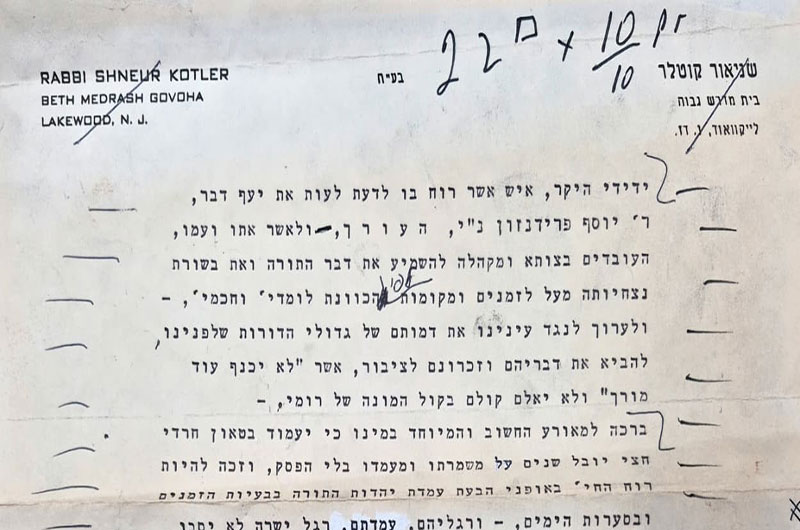


This week, I came across a remarkable letter, the kind that doesn’t merely belong in an archive, but demands to be reread in the present tense.
The letter was written on the 22nd of Tammuz, 1979 by Rav Shneur Kotler, zt”l, and addressed to R’ Joseph Friedenson, the legendary editor of Dos Yiddishe Vort, on the occasion of the paper’s 25th anniversary. On the surface, it is a congratulatory note to a Yiddish newspaper. In truth, it is a sweeping meditation on the spiritual transformation of Torah Jewry in the postwar world – and an uncannily relevant diagnosis of where we stand today.
Rav Kotler reflects on the dramatic changes that took place in the quarter-century since the founding of Dos Yiddishe Vort. But the most striking element is not institutional growth per se; it is the profound shift in the self-perception of Torah Jewry.
“We have merited,” Rav Kotler writes, “to see a rise and momentum in education, in the growth of Torah institutions in the Holy Land and in the diaspora, in the awakening of Torah study and in the strength of the stand of the Torah world with strength and splendor.” What emerges from his words is not triumphalism, but gratitude – a sense that survival itself had matured into confidence. The Torah world was no longer merely reacting to the devastation of Europe; it was rebuilding with conviction.
Rav Kotler situates this moment within the framework articulated by the Chofetz Chaim – the era of Ikveta Demeshicha, the footsteps of Mashiach. A time, he notes, of revelation: when forces of destruction are exposed openly, when false slogans that once “covered the face of the earth” are scattered like chaff, and when, amid the collapse of ideologies, one eternal truth remains standing.
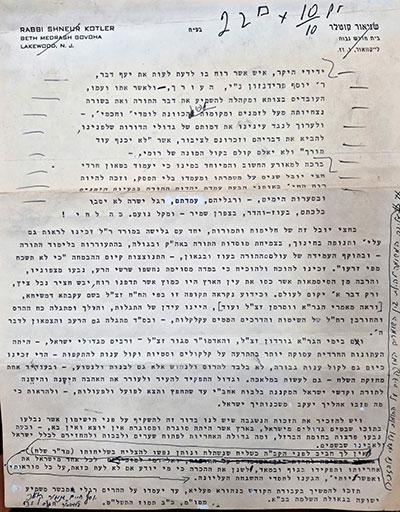
This was not merely a sociological observation. It was a theological one. Rav Kotler understood that periods of spiritual confusion are often accompanied by an intensified hunger for the word of G-d – and a parallel unmasking of “crooked methods and ways” that cannot endure the light of truth.
Perhaps most telling is his comparison between earlier generations of the charedi press and his own. In the days of Rav Eliyahu Gordon and the Gerrer Rebbe, zt”l, the Torah press was largely defensive – warning, protesting, responding to attacks. By 1979, Rav Kotler sensed something new: a “voice of mighty response” that did not merely uproot falsehood, but also built and planted. A press that could defend and inspire, protect and awaken.
And here, Rav Kotler places the true burden of responsibility. The task, he writes, is to reawaken the ancient love for Torah and holiness that lies dormant in Jewish hearts – to help it emerge into action, commitment, and pride. Not to invent something new, but to reveal what already exists beneath the surface. “How goodly are your tents, O Jacob,” he concludes, invoking the eternal beauty of a people rooted in Torah.
Toward the end of the letter, Rav Kotler turns to what was then a quiet but historic development: the first cracks in the Iron Curtain. For decades, Soviet Jewry had been sealed off – “a land that was closed and locked, none going out and none coming in.” And suddenly, breaches were forming.
Rav Kotler’s words are almost prophetic in hindsight. He speaks not of political victory, but of responsibility – the obligation to “open gates and hearts” and to return these lost tribes to the community of Israel and to their Father in Heaven.
Reading this letter today, nearly half a century later, one is struck by how little and how much has changed. The institutions Rav Kotler celebrated have multiplied beyond what he could have imagined. The challenges he warned about have not receded; they have intensified and mutated. And the task he assigned, to build, to awaken, to reveal the eternal beneath the noise, remains squarely upon us.