 September 4, 2026
 Separating from the Community
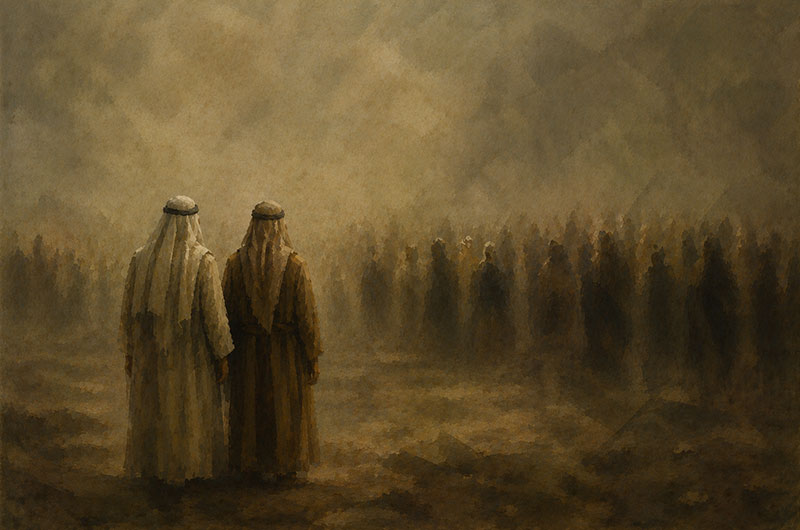


At the beginning of the rebellion of Korach, Datan and Aviram, and their supporters, Moshe attempts to placate the rebels and encourage them to repent. Once Moshe recognizes that they will not be content with anything less than overthrowing him and usurping the leadership of Israel from those Divinely ordained, he realizes that the evildoers are destined to meet a terrible fate. So, he turns his focus instead to the rest of Israel, to try to break them away from this nefarious influence before a terrible calamity befalls the entire nation.
When Hashem commands Moshe and Aharon to remove themselves from the community so that the troublemakers can all be destroyed, these two tzaddikim prostrate themselves and plead for the lives of the people of Israel who are in fact actively rebelling against them (Bamidbar 16:21-22). But doesn’t Hashem have the power to destroy the wicked while protecting the righteous among them? What is to stop Hashem from destroying Israel while Moshe and Aharon are standing in their midst? In fact, Ramban doesn’t mention it here, but it is from this very same story that we learn of the sons of Korach, who were righteous and miraculously saved from the doom that met the rest of their family. There is something happening between Hashem on the one hand, and Moshe and Aharon on the other. Hashem is drawing a line to identify the wicked, while Moshe and Aharon are moving the boundary.
Right away, Moshe and Aharon seek to place the blame upon Korach. Ramban points out that David HaMelech used the same tactic, blaming himself as leader for the offenses committed by the community. In the desert, there were many times that the people were frustrated or discouraged and had reason (in their own minds) to doubt or question the leadership of Moshe. But they could see that Moshe was backed by the power of Hashem and they were afraid to speak up. Korach seizes his opportunity when Israel is at their lowest spiritual point in the aftermath of the episode of the spies. Israel’s faith in Moshe has been weakened, and Korach seeks to weaken it further still by demonstrating that everyone is holy and anyone can bring the incense offering without dying as Nadav and Avihu did. Moshe has passed the priesthood from the firstborns to his brother’s family, the Kohanim. But Korach, as a firstborn, seeks to represent the firstborns of Israel on behalf of all of Israel, against what he casts as Moshe’s nepotism.
It is interesting to note and very much to their credit that for the most part, the firstborns of Israel are not participants in his rebellion. Nevertheless, the transition from firstborn to Kohen accompanies an end to the use of bamot, or personal altars for the service of Hashem. Henceforth, the overall spiritual management of Israel will shift permanently from the community as a whole to a central authority. Korach proclaims his revolt in the name of all the holy people who have been marginalized. But in spite of his posturing and his arguments on behalf of the honor of the common Israelite, it is only he himself whom he serves and truly seeks to aggrandize.
Only Moshe and Aharon are willing to sacrifice themselves and ignore their self-interest for the good of Israel. Thus, they say to Hashem, “Please don’t blame Israel for their wickedness in defying Hashem and His prophet. They were manipulated by Korach, and only Korach should be punished.” It is true that only the leaders of the rebellion are destroyed in the supernatural calamities evoked by Moshe through the power of Hashem. But Hashem repeats His command that Moshe and Aharon remove themselves from the community. The tzaddikim have made a compelling case to mitigate the crime, but it simply isn’t true that the people are blameless. Soon a terrible plague sweeps the camp which Moshe has to send Aharon to stop by miraculous means.
Before Israel can be redeemed, they have to take responsibility for their own moral failures and repent on their own behalf. Moshe and Aharon can teach the people; they can lead them – they can even save them from a plague. But only the evildoer can do teshuva for the evil he has done.