October 2, 2026
 Categories: Halacha & Hashkafa
Short-Lived Lights
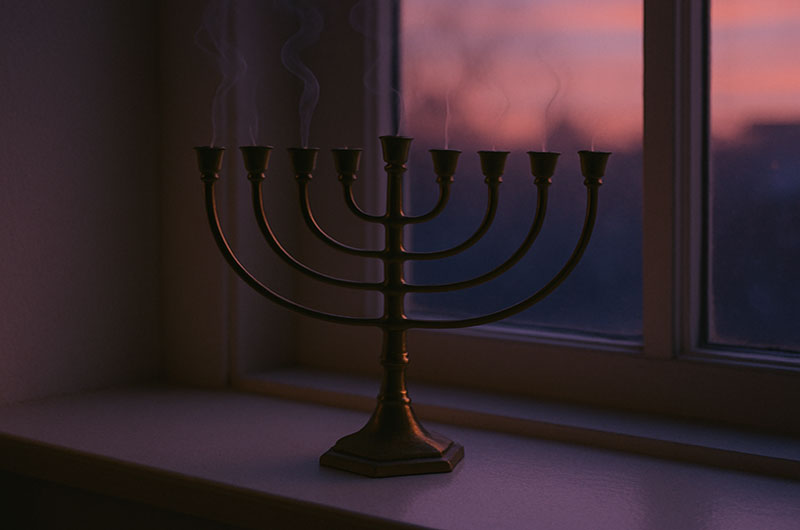


The Gross home was radiating excitement. It was both Shabbos and the sixth night of Chanukah, and several of the Grosses’ married children were spending the weekend with them. Eleven menoros of all shapes and sizes lined the packed windowsill, ready for a beautiful shared lighting.
Earlier that afternoon, Mr. Gross had unpacked two new boxes of One-Hour Chanukah Candles which he had purchased that week.
“These are the reliable kind,” he told his wife confidently. “They’re labeled to burn at least an hour – suitable for Shabbos Chanukah.”
The family lit together, the room glowing warmly as 77 soft flames flickered in unison. After singing “Haneiros Halalu,” everyone headed out to shul for Kabbalas Shabbos.
When Mr. Gross returned home from shul later that evening, though, his wife seemed concerned.
“All the flames were out long before you got back,” Mrs. Gross said. “I kept an eye on them – they didn’t even make it to the 50-minute mark.”
Mr. Gross’s face tightened. “Fifty minutes? These are sold as one-hour candles!” he said. “That’s not a small difference.”
Mrs. Gross hesitated. “I’m not entirely sure they even lasted half an hour after sunset…”
“That’s really troubling,” Mr. Gross said. “If a product claims ‘one hour,’ it should meet that standard. People rely on that for the mitzvah.”
“Maybe there are variations,” their son Avi cautiously suggested. “Sometimes, candles burn differently in different environments.”
“Maybe, but a label is a label,” Mr. Gross replied. “If the candles don’t perform as advertised, that’s a problem – halachically and commercially!”
Unsure whether he had a legitimate claim against the company, Mr. Gross approached Rabbi Dayan in shul Shabbos morning.
“Can I demand a refund for the candles?”
“We must differentiate between defective merchandise, mistaken purchase, misleading advertisement, and unusual circumstances of use,” replied Rabbi Dayan.
“Consider, for example, the mpg (miles per gallon) advertised for cars. Usually, carmakers state these specifications under optimal conditions. The actual mileage in practice will vary, as cautioned in the small print, usually lower.
If a product does not live up to its stated specs but was manufactured properly and is intact like other products of its kind, it is not considered ‘defective merchandise’ (mum b’mekach) (C.M. 232:6).
Nonetheless, if the buyer specifically indicated at the time of purchase that the technical specifications as stated were important (gilui daas, even if not stipulated as an absolute condition) and it was understood that otherwise he would not be interested in the product, it could be considered a mistaken purchase (mekach ta’us) (C.M. 207:3).
Regardless, if the product clearly cannot live up to its stated specs, there would presumably be a violation of misleading advertising, which could fall under the rubric of geneivas daas. This does not serve as basis, though, to void the sale and entitle the customer to a refund. Furthermore, if it is common in the industry that the specs apply only under optimal conditions, there would not even be a violation of geneivas daas; the specs are still valuable for comparing car models to one another (C.M. 228:6-14).
Finally, at most, the seller is expected to advertise based on standard circumstances. For our purposes, a candle stated to last an hour can be expected to last that long when lighting a single menorah and with proper spacing between the candles (like on simple tin menoros).
However, there is no expectation that the candles will last that long when closely spaced and/or when several menoros are lit adjacent to each other – especially on the sixth night of Chanukah, when there are seven candles in each menorah and there is intense heat. Therefore, you cannot demand a refund.
For this reason, it is best to light on Friday with oil, which can easily last until after tzeis hakochavim, or to use at least one Shabbos candle that lasts several hours. Otherwise, make sure to distance the menoros from each other and that there is reasonable space between the candles.
“Even during the week,” concluded Rabbi Dayan, “on the last night or two of Chanukah, it is advisable to use long candles or to distance the menoros, because regular candles may not last half an hour when there are many candles close together.”
Verdict: A product that was manufactured properly is not considered defective merchandise, even if it does not meet the stated specs in practice. In certain cases, it may be deemed a mistaken sale.