 October 16, 2026
 Categories: Headline / Features
Souvenirs from the Dawn of Zionism


Seventy-eight years ago this week, on May 14, 1948, the State of Israel was established. To celebrate this monumental event in Jewish history, here are some related medals from my personal collection.
Theodor Herzl was the founder of political Zionism, whose purpose was to create a modern homeland for the Jewish people. Witnessing the public degradation of Alfred Dreyfus – the French Jewish army officer falsely accused of treason – and hearing antisemitic shouts in the streets of Paris, Herzl became convinced that Jews needed a sovereign state. In 1897, Herzl created the Zionist Congress; the first meeting was held that year in Basel, Switzerland. Following the success of that inaugural meeting, for the second Zionist Congress in 1898, Herzl asked his friend Samuel Friedrich Beer, a sculptor who had gained recognition as a portraitist, to design a medal to commemorate the gathering, held again in Basel.
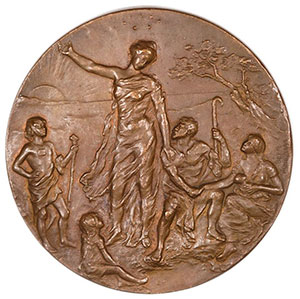
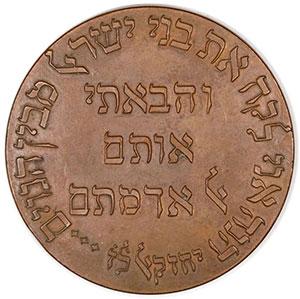
That medal is seen here in the first two photos. It is struck in heavy bronze and measuring 63 mm in diameter. The obverse depicts a standing female figure pointing to a new dawn, with a weary man holding a shepherd’s crook, his wife holding a newborn, and their two children looking up at her. This scene is an allegory for a new direction for the Jewish people. The reverse features the Hebrew verse “Behold and I take the sons of Israel from among the nations and I have brought them to their land” (Ezekiel 37:21). The medal is signed “Beer 1898 Paris,” as it was produced in France.
In the November 26, 1898 issue of the American political magazine Harper’s Weekly, there was a lengthy and detailed report on the goings-on at the second Zionist Congress, held in the last days of August 1898. The article displays photographs of the attendees at the conference, a photograph of Herzl, the flag of the Zionist Congress, and pictures of both sides of this medal. Addressing the medal, it states, “How proud we were of this commemorative medal, partly because designed by a French-Jewish Zionist, and struck off in the mint of France (an act of rare and saving grace anno Dreyfus), furthermore because it so graphically illustrates the purpose of Zionism!” The article concludes with a highly complementary description of the figural scene on the medal.
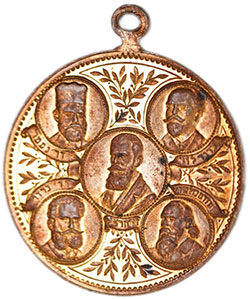
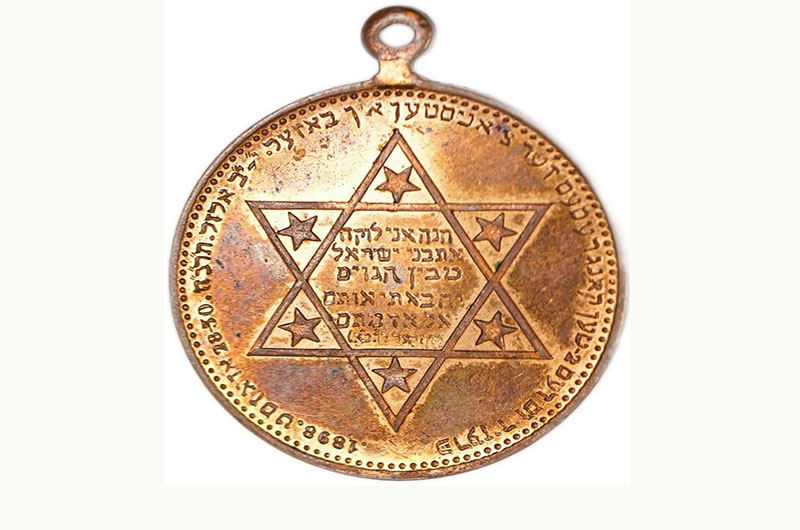
While this medal was officially issued for all the attendees of the second Zionist Congress, the following medal was an unofficial issue by an unknown private party for sale to the public as a souvenir. Made of brass with an integral loop so it could be worn around the neck or used to carry on one’s person (for example, as a pocket watch fob), this medal is 30 mm in diameter. The obverse features portraits of the leading Zionist figures during this time period, with each portrait identified with the leader’s last name in Hebrew. As expected, in the center appears Theodor Herzl. The rest of the men are, clockwise from above: Bernard Lazare – French journalist and anarchist, the first to break the story of the Dreyfus affair, and an activist against anti-antisemitism who became a staunch supporter of Zionism. He was close to and a partner with Herzl in his travels, though he always maintained his anarchic views that clashed with the Jewish bourgeoisie that Herzl represented; Dr. Max Mandelstam - prominent Russian Jewish ophthalmologist, a founder of Hibat Tzion and vice-president of the Congress; Dr. Max Nordau – renowned physician, writer, and leading Zionist brought into the movement by the Dreyfus Affair. He placed great emphasis on the extensive diplomatic activity needed for the movement’s success, in addition to the settlement of the land of Israel, and was a co-founder of the World Zionist Organization; Rabbi Dr. Moshe Gaster – rabbi of the Spanish and Portuguese synagogue in London, and a noted scholar and historian of Spanish and Portuguese Jewry. He was active in the Hovevei Tzion movement and served as one of Herzl’s deputies.
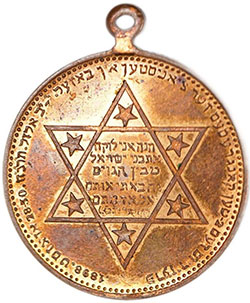
The reverse side of the medal depicts a large Star of David, and in the center of the star is the same Hebrew verse from Ezekiel that is seen on the reverse of the official-issue bronze medal. Surrounding the star, on the edge, it states in Yiddish: “Presidium of the 2nd Zionist Congress in Basel, 10-12 Elul 5658, August 28-30, 1898.” While German and Hebrew were the official languages of the Congress, Yiddish was the language of the Jewish masses, particularly those residing in Eastern Europe, so it makes sense that this medal, made for the public, would feature Yiddish. This is the earliest known medal featuring the Yiddish language.
The last medal seen here is for the Jewish National Fund, also known by its acronym JNF, or KKL for the original Hebrew Keren Kayemet L’Yisrael. The Jewish National Fund was founded at the fifth Zionist Congress in 1901 as a means of raising funds from Jews for the purpose of purchasing land in Israel and preparing it for Jewish settlement. Made of brass and measuring 31 mm, this medal, like the aforementioned one, was also issued with an integral loop. The obverse depicts a young boy placing a coin into a Jewish National Fund donation box, with a map of the Land of Israel in the background. At bottom is the Hebrew inscription “Give redemption to the land.” The reverse side (not shown) contains a depiction of the Temple Menorah with a Star of David as the center light, and below it “Keren Kayemet L’Yisrael.” The medal is signed “Roukomovsky/Paris.”
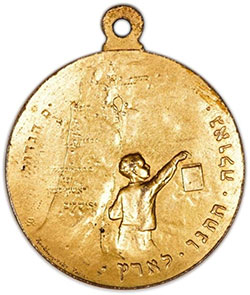
This medal was designed by Israel Rouchomovsky (on this medal spelled with a “k” and not a “ch” in the center), who was an incredibly gifted artisan and passionate Zionist. Rouchomovsky’s fame as a goldsmith spread across Europe, and while he was still living in his native Odessa during the last decade of the 19th century, he produced a variety of miniature silver medals depicting Jews praying at the Western Wall, and farming scenes from one of the earliest settlements in Israel, Rishon Le’Tzion. The map of Israel seen in the background behind the child putting money into a charity box has a number of cities labeled, including Haifa, Rishon Le’Tzion, Jaffa, Jerusalem, and others, but notably, Tel Aviv, which was founded in 1909, is absent. Rouchomovsky moved to Paris in 1910. I surmise that when he designed this medal, he was using a map that was issued before Tel Aviv was added to it. It is thought that this medal was produced sometime between 1910 and 1915, which would make it the first medal ever made for the Jewish National Fund.
Happy 78th birthday to Medinat Yisrael! Am Yisrael Chai!