 October 9, 2026
 Categories: Arts
Special Chazzanut Series 2026: Cantor Moti Boyer Discusses the Yom Kippur Tefillot
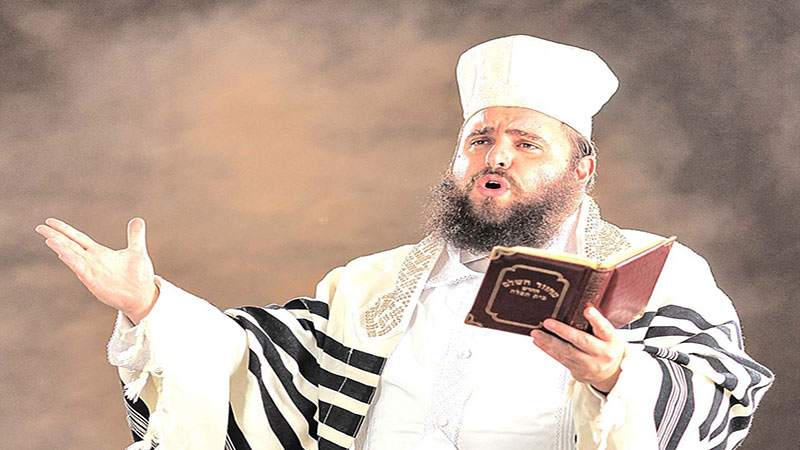


Next week is Yom Kippur, the holiest day of the year and the peak of the Yamim Nora’im. I wanted to learn more about the special tefillot, so I reached out to my friend, Cantor Moti Boyer – whom I also interviewed for this column last year – for an open conversation about the unique melodies of the Yom Kippur tefillot.
Boyer is a walking encyclopedia of chazzanut. Beyond being an accomplished cantor, he is also a researcher and composer. His depth of knowledge in chazzanut is so vast that simply chatting with him about the craft is always a joy – the information just flows out of him seamlessly. As we spoke, his father was sitting nearby and chimed in, adding a wonderful dimension to our conversation.
We began by talking about Kol Nidre, the special tefillah that opens Yom Kippur. The nusach of Kol Nidre is Skarbova. As we explained in the recent Yaakov Lemmer column, Skarbova tunes serve as emotional anchors in the tefillah. There is also the concept of Niggunim miSinai (Melodies from Sinai), which refers to a sacred repertoire of ancient Ashkenazi tunes specifically for the Yamim Nora’im that have been preserved for centuries and carry a unique holy status.
The nusach of Kol Nidre is traced back to the Maharil (Rabbi Jacob Moelin), one of the prominent Rishonim who served as a shaliach tzibbur and codified the Ashkenazi nusach – much like Rabbi Meir Shatz (author of Akdamut), who was also a renowned baal tefillah.
Discussing Skarbova’s origins led us into a broader conversation about nusach. Boyer pointed out a fascinating historical tidbit regarding Ukrainian Jewry: Their prayer tradition was deeply shaped by Rabbi Raphael of Bershad, zt”l (1751-1827), a primary disciple of Rabbi Pinchas of Koretz, zt”l. His unique nusach left an indelible mark on Jews throughout Ukraine and the surrounding regions.
Boyer then expanded on the evolution of Ukrainian chazzanut. While drawing its soul from the teachings of Rabbi Raphael of Bershad, modern Ukrainian cantorial music was fundamentally reshaped by Cantor Bezalel Shulsinger, famously known as “Bezalel Odesser.” Shulsinger introduced full choral arrangements into the prayer service. Until his era, the accepted standard was simply a trio consisting of a cantor, a bass, and a zinger (treble chorister). Shulsinger trained legendary cantors, including Yeruham “HaKatan” Blindman of Berdychiv, Nissan Spivak (“Nissi Belzer”), and Velvel Shestopol, known as “Velvel Khersoner” after his cantorial post in Kherson, Ukraine.
Boyer then highlighted another intriguing historical connection: At the end of the 18th century and into the 19th, leading Ukrainian cantors – including Pinchas Minkowski, Velvel Shestopol, and Baruch Schorr – traveled to Vienna to study under the renowned Salomon Sulzer. Upon returning, these cantors brought the sophisticated Viennese choral style back with them, forever transforming the soundscape of Ukrainian synagogues.
We then turned our conversation to the special piyutim of Yom Kippur night, beginning with “Ya’aleh Tachanunenu.”
“Tell me something interesting about this piyut,” I asked Boyer.
He pointed to a rare piece composed by Yossele Rosenblatt in which there is a duet between the cantor and the poet. In this setting, Rosenblatt creates a literal dialogue between the cantor and the poet in a question-and-answer format.
“There is another magnificent piece recorded by Cantor Gershon Sirota in a few different renditions,” Boyer added. “If I remember correctly, it was composed by either Yakavkin or Polyakov. Its defining hallmark is a uniquely profound outpouring of soul (hishtapchut hanefesh).”
We then moved on to one of my personal favorites, “Ki Hineh KaChomer.” There is the famous Skarbova tune that is accepted across all Ashkenazi communities. But there is also a brilliant composition by Cantor Leib Glantz, who is considered a pioneer for his modern approach to the cantorial recitative (a style famously developed by Yossele Rosenblatt). Glantz introduced augmented and diminished intervals as well as unconventional coloraturas – virtuosic, ornate runs and rapid vocal leaps.
“When I was looking through my sheet music collection,” Boyer told me, “I came across a piece by the famous Cantor Nissi Belzer.” (Belzer was a student of Yeruham HaKatan. Because Belzer didn’t have a naturally powerful voice, his style relied on rich, expressive phrasing, sharp musical moves, and detailed vocal arrangements for his choir.) “Looking closely at Belzer’s notes, I spotted the exact foundational elements that Glantz likely built upon for his ‘Ki Hineh KaChomer.’ The variations, modulations, and overall nusach share striking similarities, though Glantz delivered it in his own unique signature style.”
Of course, there are dozens of other compositions set to this text by iconic cantors like Steinberg, Shestopol, Baruch Schorr, and many others. Then there is the famous rendition performed by Moishe Oysher, who became legendary for blending traditional cantorial motifs with American jazz. Another notable setting of “Ki Hineh KaChomer” is the famous Chabad melody composed by one of the Kharitonov brothers, who served as court composers in Liubavič. It’s a fantastic tune set in a rhythmic 6/8 meter.
Another popular piyut recited on Yom Kippur night is “Omnan Ken” (“Omnan ken yetzer sochen banu... Salachti...”).
For this piece, Boyer usually uses the Vizhnitz tune which was composed by Cantor Yaakov Shmuel Margovsky, better known as Zeidel Rovner. He wrote a massive, elaborate cantorial masterpiece for this text, and the popular Vizhnitz tune we hear today is actually a shortened excerpt taken straight from that larger work.
We then shifted to discussing the daytime tefillot.
We brought up the legendary Cantor Shlomo Kashtan – father of Tzvi Hirsch Weintraub – who in his youth served in the court of the Kozhnitzer Maggid, zt”l. One of his most famous masterpieces is set to “Ki K’shimcha,” which was immortalized in classic recordings by cantors like Gershon Sirota, Alter Yechiel Karniol, and many others.
“The single piece most iconic to Yom Kippur daytime,” Boyer noted, “is Cantor Zavel Kwartin’s masterpiece for the piyut ‘Tiher Rabbi Yishmael,’ recited during the Asarah Harugei Malchut (The Ten Martyrs) service in Musaf.” Even though Kwartin’s compositions often shared similar melodic structures, he was considered a true trailblazer. His fiercely independent style, coupled with an unmatched, soul-stirring expressiveness and deep emotional appeal, set him apart.
Finally, we discussed a special piece recorded by Cantor David Roitman for the text “Atah Hivdalta,” which is also sung within Chabad. This composition is historically attributed to none other than Bezalel Odesser – the foundational Ukrainian cantor we mentioned earlier.
He also mentioned another indispensable masterpiece that is part of the Yom Kippur canon: “V’Af Hu Hayah Mitkaven” from the Avodah service.
Yossele Rosenblatt composed this piece when he was very young, incorporating an exquisite duet between the cantor and the poet. Rosenblatt actually recorded it twice – once alongside the famous Cantor Samuel Malavsky and another time with his own brother, Cantor Levi Rosenblatt.
There is a wonderful story told about this composition: Rosenblatt once performed it in the presence of the Bobover Rebbe, Rabbi Ben Zion Halberstam (Hy”d). Upon hearing the piece, the Rebbe was so deeply moved by its grace and beauty that he remarked that he was certain this was precisely how the singing of the Levites sounded in the Beit HaMikdash.
Boyer is a very busy man. Besides being a cantor, he performs all over the world, records new pieces, and spends hours researching cantorial history. Not many cantors today also compose, but Boyer has already composed over 100 cantorial pieces.
This year brought a nice change for him. After leading the first Selichot service in London for seven years in a row, Boyer stayed closer to home this year and led the opening Selichot in Givat Shmuel.
You can listen to Cantor Moti Boyer and follow his work on his Facebook, YouTube, and Instagram pages.
G’mar chatima tova!