 October 30, 2026
Categories: Halacha & Hashkafa / Torah
Spoiled Cholent
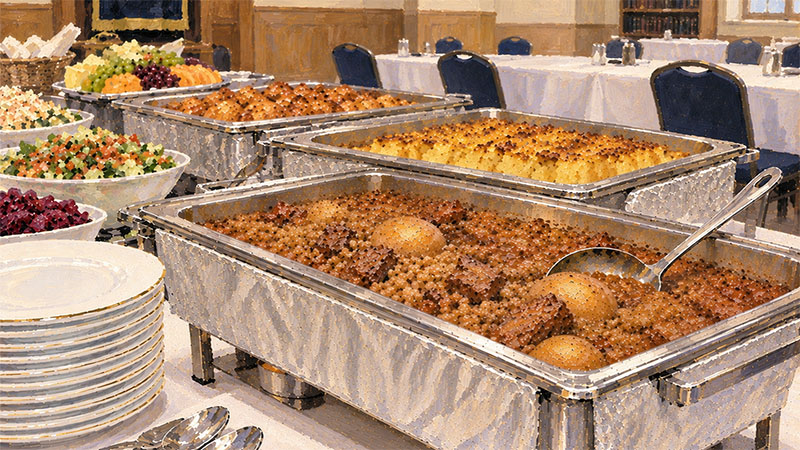


The Berman family was celebrating their son’s aufruf. They had hired Mr. Essin to cater the Shabbos meals. Everything was going smoothly until the cholent was brought out on Shabbos morning.
As the waiter was serving the cholent, he noticed that something was wrong. The cholent had spoiled and was inedible! He quickly informed the kitchen staff, and the cholent dishes were removed.
There was plenty of other food, but not having cholent to serve was embarrassing. Cholent was expected at the Shabbos morning meal, and the Bermans felt uncomfortable that they could not offer it to their guests.
After Shabbos, Mr. Essin contacted the Bermans. “I’m very sorry about what happened,” he apologized. “Of course, I’ll credit you for the cost of the cholent. I’m also willing to offer a small additional credit as a gesture of goodwill.”
“A small credit?” Mr. Berman replied indignantly. “You embarrassed us in front of all our guests and the mechutanim! We spent a considerable amount arranging this Shabbos, and not having such a basic part of the meal was embarrassing. You owe us substantial compensation for the shame you caused.”
Mr. Essin was taken aback. “I understand your frustration, but I prepared the cholent as I always do,” he countered. “I am just as surprised as you that something went wrong. I’m happy to make a goodwill gesture, but I don’t accept that I’m liable for your embarrassment.”
“That’s not good enough,” Mr. Berman insisted. “You were hired to provide proper Shabbos meals, and you failed. Surely you must bear responsibility for the shame we suffered!”
Unable to reach an agreement, the two came before Rabbi Dayan and presented their positions. Mr. Berman asked:
“Is Mr. Essin liable for the shame he caused?”
“The Gemara (B.B. 93b) cites the opinion of R. Shimon b. Gamliel that if someone hires a professional to mill grain, bake bread, or slaughter an animal for him and the professional performs the job improperly, the professional is liable not only for the ruined grain, flour, or animal, but also for the person’s embarrassment towards his guests, whom he cannot feed,” replied Rabbi Dayan.
“Similarly, R. Shimon b. Gamliel mentions a ‘great practice’ in Yerushalayim that if someone hired a caterer who then ruined the meal, the caterer is liable for the embarrassment involved.
However, the Sages disagree and obligate the caterer only for the actual damage, not the embarrassment, which is considered grama and does not carry an enforceable liability.
The Tur (O.C. #170) mentions the practice of Yerushalayim, but the Shulchan Aruch and later authorities omit it (Pischei Choshen, Nezikin 11:[50]).
Some explain that the Tur mentioned this practice even though there is no halachic liability according to the Sages, since the people of Yerushalayim chose to act stringently nonetheless, and we should learn from their example (Mateh Yeduda (Ayash) O.C. 170:1).
However, this is – at most – a voluntary stringency.
While there does exist liability for boshes (shame) in halacha, it is one of the five payments associated specifically with physical assault that are derived from the verse in Devarim (25:11). Thus, if one verbally shamed another person without any physical contact, there is no liability for boshes. The shame incurred is considered grama, for which there is only a heavenly obligation if the act was done intentionally (see Pischei Choshen, Nezikin 3:39, 11:23). Similarly, if a person spat on another and the saliva touched the victim’s body, the person is liable for the embarrassment he caused; however, if he spit only on the victim’s clothing, he is not liable. Even so, beis din can pressure the assailant to appease the victim as it sees fit (C.M. 420:38).
Furthermore, although the other four payments for physical injury (nezek, tza’ar, ripui,and sheves) apply even when the damage was unintended or accidental, the Gemara (B.K. 27a) derives that liability for boshes applies only when there was intent to damage, even without explicit intent to shame (C.M. 421:1-11)
“Therefore, in our case, Mr. Essin carries no liability for your embarrassment towards the guests,” concluded Rabbi Dayan. “According to the Tur, there may be a basis to appease as a stringency, but where the failure was unexpected, even this is not necessary, other than as a gesture of goodwill.”
Verdict: Liability for boshes (shame) applies only when there is physical contact with intent to damage. Otherwise, the shame caused is at most grama, for which there is no enforceable liability. When the act was unintentional, there is not even a heavenly obligation, other than as an expression of goodwill.