 September 18, 2026
 Categories: In Print / Featured / Jewish Community
Street Co-Naming Turns into a Family and Congregational Celebration


A special, heartwarming community celebration of a scholarly man’s life took place on Sunday, September 14 in the stylish and posh Brooklyn neighborhood of Mill Basin. The neighborhood is adjacent to picturesque Jamaica Bay, with docks dotting the waterfront landscape.
Rabbi Dr. David Halpern, HaRav Dovid Zanvill ben Reb Shlomo, of blessed memory, served as founding rabbi and spiritual leader of Flatbush Park Jewish Center for 64 years. He was possibly the longest tenured pulpit rabbi of a single congregation in North America.
The area, which features McMansions next to smaller homes constructed when the area was first built up during the late 1950s, was originally mainly swamp land. During the first decade of Mill Basin’s existence, Jews, Italian Catholics, Irish Catholics and Asians were the primary residents. At the center of this fledgling development, on Barlow Drive North, the Halpern family set down roots. When Flatbush Park Jewish Center (FPJC) was granted permission by a judge to build, the Jewish community was finally anchored to a synagogue.
In 1952, at age 23, the newly minted rabbi, a graduate of Rabbi Isaac Elchanan Theological Seminary of Yeshiva University, began holding services inside storefronts on Mill Avenue and later on Avenue N before the congregation moved to its current location in 1960.
FPJC encompasses a large area of land on Avenue U between East 63rd and East 64th Streets, and extends for more than half a block between Avenue U and Avenue T in southeast Brooklyn.
“I remember when this was farmland – when there was nothing here,” recalled Rabbi Halpern’s widow, Sheila. A court was asked to decide what to do with the land, she said, and Rabbi Halpern told the judge: “‘This neighborhood needs a synagogue. We have a church, we have a school, but we don’t have a synagogue.’ The judge banged down the gavel and said, ‘Rabbi Halpern, it is your property!’ and that’s when we built Flatbush Park Jewish Center.” During his 65-year tenure, the Rabbi attended 14,000 brit milahs, bar and bat mitzvahs, weddings, unveilings, and everything from cradle to grave, according to Mrs. Halpern.

Even with such a busy schedule, Rabbi Halpern maintained a balance between fussing over his wife and three children and attending family events while still catering to the needs of the congregation and advocating for causes he was passionate about: Soviet Jewry, Israel, local yeshivas, and kashrut services.
“My kids were raised here. We managed to keep a balance between a healthy home life and a growing and healthy congregation,” Mrs. Halpern, 89, said. “My kids came to shul every Shabbos. My grandson had his bar mitzvah here. We had a family bris here. We did a lot of things here. It was wonderful.”
Rabbi and Sheila Halpern raised three children – Neil, Risa, and Beth.
“I feel close to my father and I think about him every single day,” Beth (Halpern) Sitts, 65, told The Jewish Press. “I feel he didn’t really pass away because he’s really in me. The speeches were all about what he did in the community, but at home he was very focused on the children and the family. They [the shul leadership] were thanking us for giving him to them, but we never felt that way.”
“My friends were like, ‘I’m so jealous of you. Your father teaches you everything,’” she continued. “He was just an amazing person. We never felt that he was too busy… I do matchmaking and I always think, how would my father handle it? He had so much patience. So much love for every Jew. I try to get along with every type of Jewish person.”
Risa (Halpern) Weinstein did not wish to be interviewed, but her son, Josh Weinstein, 24, offered his thoughts about his late grandfather. “My grandfather was a very big inspiration. He was a leader, involved in YU (Yeshiva University). I attended YU; I worked at YU in the president’s office. Everywhere I go I see the fruits of his labor… He was an amazing person, a mentor. He had a very specific way about him,” Weinstein, of West Hempstead, Nassau County, said. “He wouldn’t have built this whole institution for the community and we wouldn’t have tons of people here today [at the ceremony] if he didn’t impact so many people.”
Only one member of the congregation’s leadership delivered remarks at the ceremony.
“He always said he was there to praise, not to criticize. He was a real rebel, since he was considered the first Orthodox rabbi to dance with his wife in public,” said Bernie Grotell, 75, a Bergen Beach resident. “I also had a special relationship with Rabbi Halpern when I served as treasurer from 2003 through 2008. We spoke almost every day about finances and everything that was going on in the neighborhood. He knew every neighbor, what they did for a living as well as their overall background. He was well-educated. You could talk to him about almost any subject.”
Grotell said the rabbi used to love to speak about his children’s achievements. “Every time Neal wrote another article, gave another speech, or took on a new project, he told me about it or showed me articles. He was so proud of his daughters, Risa and Beth, as well as his lovely wife, Sheila,” Grotell concluded.
“Although the street co-naming for Rabbi Halpern is a major event, it is a permanent tribute to a man that has given so much to his community and to everyone that he has come in contact with,” community member Jeff Pomerantz, 77, told The Jewish Press. “Flatbush Park Jewish Center was started and continues to be a vibrant part of Jewish life in Mill Basin and its surrounding area due to the vision, love, and hard work and warmth of Rabbi Halpern, supported by his partner in life, Rebbetzin Sheila Halpern.”
Rabbi Halpern’s son, Neil, 68, a New Milford, N.J. resident, spoke at length about the five mitzvot in the Shema contained in the parchment inside a mezuzah casing. He associated how each point related to his father.
“The first mitzvah is loving G-d. My father was a man of great faith in Hashem. This faith and love of Hashem carried him through very challenging times as a young husband, father, and rabbi after he was orphaned by age 35 and subsequently lost his beloved brother, Rabbi Morris Halpern of Beth Ora in Montreal, at a young age.
“The second mitzvah is studying and teaching Torah. Studying and teaching Torah was his life. My father studied Chumash, Navi, Mishnayos, Gemara, and the dreaded dikduk (Hebrew grammar), with his children and grandchildren…
“The third mitzvah is reciting the Shema twice a day. In terms of this mitzvah, I think it’s about davening. My father loved going to shul – minyanim were the highlights of his day. You could see it on his face. Growing up, inclement weather was never an excuse or an obstacle for not going to shul. Rain, snow, or heat, we went to shul. We even had back-up clothing in his office.
“The fourth mitzvah is putting on tefillin. My father also valued buying tefillin for his grandchildren and attending their Hanachat Tefillin in their respective shuls. On a personal note, I wear today the ‘new’ tefillin that my father gifted me for my 40th birthday, a few years ago, to replace my bar mitzvah tefillin.
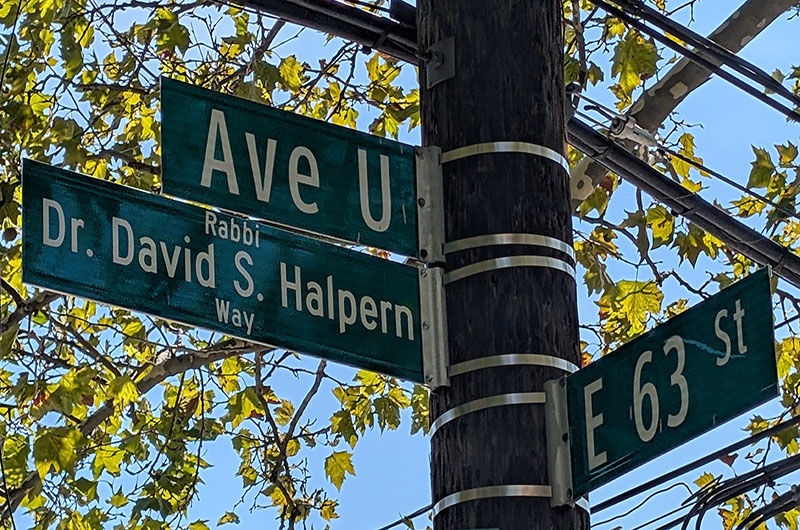
“The fifth mitzvah of the first paragraph of Shema is the mitzvah of mezuzah. I think the placing of the signpost, a figurative mezuzah, on the corner of East 63rd Street and Avenue U, the symbolic gateway to FPJC, is a very fitting tribute to my father.
After my father passed, I found in his desk an envelope filled with parchments for mezuzot and mezuzah boxes themselves. My father was always prepared to help a new family put up a mezuzah in their homes. I believe that my father is peering down on us today from Olam Haba, the next world. He is certainly very happy and filled with pride and appreciation with the installation of the Rabbi David Halpern signpost, the symbolic mezuzah we are dedicating today. He is sorely missed by all of us,” Neil Halpern concluded.
The synagogue’s current spiritual leader, Rabbi Yisroel Perelson, 49, also used a metaphor to describe his predecessor. “Rabbi David Halpern created a Flatbush Park Jewish Center with a shade that never expires. It doesn’t matter what Jewish person comes in here, they experience that beautiful shade, that beautiful protection, that beautiful connection to G-d. Rabbi Halpern has built an empire.
“Do you know how he did it? He did it by being our rabbi, by being our father, by being our friend... Person by person. He was there for the weddings, bar, bat mitzvahs, and brisim. Every single simcha that was ours was his. He didn’t miss any simcha,” Rabbi Perelson told the few dozen attendees assembled for the program.
“I look at him as Dovid HaMelech. Do you know what Dovid HaMelech said? At night, don’t put your hand in your pocket. [Meaning] don’t get complacent... What King David is saying [is] when a person gets older and he looks forward to retirement and he feels, ‘You know what, I did enough,’ then you disappear – you’re gone, you stay at home. That was not Rabbi David Halpern. I remember in his 70s, in his 80s, he was still active. He didn’t say, ‘I did enough. I contributed.’ Absolutely not. It was not time for him to put his hands in his pockets,” Rabbi Perelson said.
“The new street sign is under a beautiful tree on the corner ready for someone to look up and get some shade and think about what Rabbi Halpern did for the shul,” Rabbi Perelson added.
In the early years, the congregants, many of whom who were World War II veterans from Orthodox Jewish backgrounds and survivors of the Holocaust, were drawn to the neighborhood for its affordable homes, costing about $10,000 each with a two-percent interest rate.
Fillmore Gardens was the first neighborhood. After that neighborhood was established, the area flourished with the migration of Jews from East New York and Brownsville to Mill Basin, Bergen Beach, Georgetown, and the Kings Plaza area through the 1950s and 1960s.
Many congregants and friends attending the event on Sunday, September 14, had memorable stories about Rabbi Halpern.

“Rabbi Halpern was a mentor to me. He taught me many of the aspects of rabbanus,” Rabbi Moshe Mirsky, assistant rabbi to Rabbi Halpern for 10 years from 1995 to late 2004, who later served as rabbi of Congregation Beth Israel in Schenectady, told The Jewish Press. “I met him first when he was almost 70 and he came to work every day and he took an intense interest in everything. He demanded excellence of himself and then by extension of others.”
“There was an aspect of the rabbinate, which I think is being lost – the idea of being the rabbi of a community and being a pastoral rabbi visiting people when they are sick and forming relationships with them. That is an aspect which I think is well-worth learning from [Rabbi Halpern], especially in today’s society when we have AI to help us with everything, even getting Torah classes… He believed in forming those personal relationships which our society so desperately needs today,” Mirsky concluded.
Adam Shapiro, 58, a musician, dentist and resident of Bergen Beach, said Rabbi Halpern always knew the right words to say to ingratiate himself to newcomers. “When I was going out with my wife, I was welcomed amazingly and I wanted him to perform the wedding. He was someone you could actually talk to. He was so refined and dignified like a senator… When he married me and my wife, it was one of two weddings he had the same night. He really went to everybody’s weddings.” Shapiro recalled that Rabbi Halpern “even let the kids lead the davening, which was unusual. Most shuls don’t do that.”
“He knew exactly what to say to each person to make you feel comfortable…He knew exactly what to say, when not to say something. You could really emulate that,” Shapiro concluded.
“Rabbi Halpern had a profound impact on my life. He was the rabbi that officiated my bar mitzvah, my wedding, all parts of my life,” Jack Hershkovich, 49, a Mill Basin resident, told The Jewish Press. “Every week I looked forward to his Divrei Torah. We learned so much from him. Just the way he held himself. He was so refined, so distinguished. There will never be another man like Rabbi Halpern.”
In addition to friends and family, former and current elected officials attended the co-naming event. Among the elected officials in attendance were state Senator Roxanne Persaud; Assemblywoman Jaime Williams, who represents Mill Basin; Assemblyman Alec Brook-Krasny, a Russian Jew, who wanted to speak about Rabbi Halpern’s dedication to Soviet Jewry; and Gil Cygler from the Brooklyn Chamber of Commerce. Also at the event was Alex Rovt, the vice-chairman of the synagogue’s board of directors and a billionaire private business owner in Mill Basin who hails from Munkács, a Jewish community in the Carpathian Mountains. While he did not attend, Mayor Eric Adams sent the synagogue leadership a proclamation extolling the virtues of Rabbi Dr. David Halpern.
New York City Public Advocate Jumaane Williams and City Councilwoman Mercedes Narcisse were the only elected officials to speak at the street co-naming.
Although he never met Rabbi Halpern personally, Williams spoke glowingly about the rabbi. “Rabbi Halpern took time to serve our country as the Jewish chaplain in the 71st Infantry, 42nd Rainbow Division of the New York National Guard. Additionally, he was an active member of the Rabbinical Board of Flatbush, serving as chairman of the Congress Committee for decades and two years as its president,” Williams, 49, said, reading from a letter he presented to the synagogue leadership. “Through his work and leadership, he helped to strengthen and unite individuals in the community and throughout the city. As Public Advocate, I know the importance of community advocacy for doing what you can with what you have. We are here to serve as many people as possible. I appreciate the commitment and compassion that Rabbi Halpern brought to you [the congregants] and our city.”
Narcisse, 60, who represents Mill Basin in the New York City Council and was the prime sponsor of the legislation to rename the corner of Avenue U and East 63rd Street “Rabbi Dr. David S. Halpern Way,” spoke about her remembrances of Rabbi Halpern. “He was a teacher, a guide, a voice of moral clarity. For so many, he provided comfort in difficult times, and we have difficult times now. I wish we had Rabbi Halpern here today. Our state and religious leaders mold our moral compass and Rabbi Halpern embodied that role fully. He reminded us that doing right is not always the easiest path but it is always the one worth walking,” Narcisse said. “Let us honor Rabbi Halpern by striving to live with the same compassion and integrity he showed us throughout his life. In a world that too often feels divided, we need more of that compassion. More reminders to see one another with kindness. To listen with understanding and to work together in unity. Rabbi Halpern lived the values and left the footprints for us to follow. It is up to us to carry them forward. Let’s all be a little bit like Rabbi Halpern.”
By creating the Flatbush Park Jewish Center, Rabbi Halpern started a trend in the greater Mill Basin area. There are now 10 Orthodox synagogues in Mill Basin and the surrounding neighborhoods, all with a different emphasis and approach to their services. None are competing congregations. Flatbush Park Jewish Center is known as the mothership of the area synagogues.
(It is also the synagogue where I became a bar mitzvah, graduated from the Talmud Torah school, and cherished the Purim carnivals. This was the center of my life growing up.)
Former assemblyman, Surrogate’s Court judge, and Kings County Democratic Committee chair Frank Seddio, speaking from his seat rather than on stage, concluded the remarks by sharing his fond recollections of his decades-long friendship with Rabbi Halpern, the rabbi’s great success in building the Flatbush Park Jewish Center, and helping to maintain the wonderful greater Mill Basin community.
Following the program in the sanctuary, the attendees went outside to the corner of East 63rd Street and Avenue U. Rabbi Halpern’s widow, Sheila, and her son, Neil, pulled the cord and unveiled the new street sign.
It is a complicated, bureaucratic process to get a street co-named in New York City. Co-namings are only granted to individuals who are deceased, and require an act of legislation that must be signed into law by the mayor after review from his counsel’s office. First the proposal must go through the local community board, a public hearing, and recommendation by the councilmember representing the area, who then submits the measure to the full New York City Council.
This month will mark Rabbi Halpern’s ninth yahrzeit. He passed away at age 88 back in 2016 (Tishrei 5777), just after Simchat Torah. May his memory, commemorated by this new street sign, be for a blessing.