 October 23, 2026
 Categories: Headline / Holidays / Torah
The Apple in Honey: A Minhag with a Misconstrued Past
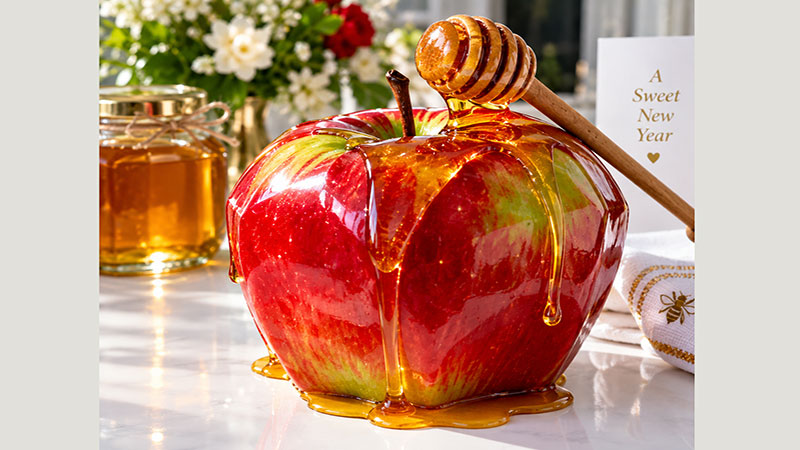


On Rosh Hashanah, there are many minhagim that developed as ways to mark the beginning of the Jewish New Year. One of the most famous is dipping apple in honey. This minhag dates back to the medieval period, to at least the thirteenth century. We take a piece of apple, dip it in honey, recite the beracha, and say Shana tova u’mesukah, that the apple in the honey should symbolize a sweet new year.
Misconceptions about the origin of this minhag abound, including misinformation that has circulated online and in articles by well established media outlets such as The Times of Israel and The New York Times, as well as by prominent historians of Jewish history at major American universities. As a result, many today are misinformed about the origins of this minhag and its meaning.
Many of these writers attribute the origin to the Maharil, Rabbi Yaakov Halevi Moelin, a prominent posek from fourteenth century Germany, and claim that the custom comes from the Ashkenazi world. How did this misinformation arise? Several decades ago, a Jewish historian wrote a book and attributed the custom to the Maharil because she had read excerpts from him cited in a religious work. She then built a narrative around this error, connecting it to German apple harvest festivals and inventing a secular Germanic origin for the minhag. Academic books now cite this, university classes teach it, and newspapers repeat it.
However, nothing could be further from the truth.
The origins of the minhag come from the Sephardic world. The earliest source is the 14th-century scholar, Rabbi Dovid Abudraham, also known as the Abudraham. He cites this ritual as a long-established custom in Spain that existed for at least several generations in Seville, where he lived, from a time when Seville was still under Islamic control. The Maharil, the Rema, and later Ashkenazi poskim cite the Abudraham as the origin of the minhag’s mesorah.
One historian even dedicated part of a book to claim that the custom was brought to America in the second half of the nineteenth century by Eastern European immigrants because, in his limited research, he believed it was purely Ashkenazic. Given the Sephardic origins of the minhag, and the diligence with which the old Spanish-Portuguese communities preserved pre-expulsion customs, it is highly probable that when twenty-three Sephardic Jews came to America in 1654 and founded Shearith Israel, they would have brought this custom with them.
Most historians and journalists writing on this topic do not read the original sources. They cite older scholarly works where the original mistake appears. This is the danger when secular historians write about Jewish history without familiarity with rabbinic literature. The lack of familiarity with halachic primary sources caused errors to creep in, or entire fictional narratives to emerge from these misunderstandings. As anyone who studies history knows, once an earlier historian makes an error, many later writers simply copy it without checking the source, and misinformation filters down through historical narratives until later scholars correct it.
In the Abudraham’s writings on Rosh Hashanah, he cites many institutionalized minhagim that had already become codified within Spanish Jewish life. He records the origins of many of the simanim, some from the Gemara, others from the Geonim, such as gourds, leeks, dates, and others. He is the earliest source for fish as a siman as well. Even for older simanim with earlier sources, the Abudraham is the source for how we say the play on words beracha over them.
In the 13th and 14th centuries, the Iberian Peninsula was a place where Jews from the Christian and Islamic worlds would interact with each other. As a result, the rabbinic centers in these areas became places where Torah teachings and writings from the greater Ashkenazi world and the greater Sephardic sphere of influence combined, making writings from Spain in that time extremely valuable to Torah scholarship.
The Abudraham was a talmid of Rabbi Yaakov ben Asher, known as the Tur. The Tur had been born in Germany and received his semicha there under his father, Rabbeinu Asher, known as the Rosh, before they fled to Spain. The Rosh himself was a talmid of the Maharam M’Rottenberg. The Abudraham was therefore very familiar with Ashkenazi minhagim, and whenever a custom had Ashkenazi origins, he clearly states so, often citing the Maharam as the source.
In the same text, where the earliest mention of apple in honey appears, the Abudraham cites earlier symbolic practices for the new year. He writes that while in Sephardic lands, people brought the head of a fish or a lamb, he had a mesorah from the Maharam that some Ashkenazim used the head of a ram to symbolize the ram of the Akeidas Yitzchak. When it comes to the apple in honey, he mentions it but is vague about its meaning. Later writers provide many explanations.
Let us look at the explanations for the minhag of apple in honey.
One explanation for the apple comes from the Gemara in Shabbos 88a. Rabbi Chama, the son of Rabbi Chanina, said: “What is the meaning of that which is written: ‘As an apple tree among the trees of the wood’ (Shir HaShirim 2:3). Why were the Jewish people likened to an apple tree? It is to tell you that just as the apple tree’s fruit grows before its leaves, so too the Jewish people accorded precedence to ‘naaseh’ over ‘nishma.’” Just as the Jewish nation said “we will do and we will hear,” the apple tree grows its fruit before its leaves. By eating the apple on Rosh Hashanah, we remind Hashem that our ancestors accepted His laws before knowing what they were, and we ask to be treated kindly for that. The Vilna Gaon cites this verse and its explanations as the source.
A second explanation, cited by the Maharil and the Rema, comes from the Gemara in Taanis 29b. Rabbi Yehuda, the son of Rabbi Shmuel bar Sheilat, explains the verse in Bereishis before Yaakov receives the blessings from Yitzchak: “And he said: ‘See, the smell of my son is as the smell of a field which Hashem has blessed’” (27:27). Rav Yehuda said in the name of Rav: This smell was like that of a field of apple trees. The Gemara teaches that it was the scent of the apple field that convinced Yitzchak to give the blessings of “the dew of the Heavens and the fatness of the earth” and “those who curse you shall be cursed, and those who bless you shall be blessed.” By eating the apple, we remind Hashem of the blessings given to Yaakov and his descendants. According to this opinion, the significance of the apple comes from its scent, and we place it in honey to sweeten that blessing.
For the honey, Tehillim 119:102-104 says: “From Your judgments I did not turn away, for You guided me. How sweet are Your words to my palate, more than honey to my mouth. From Your commandments I gain understanding; therefore, I hate all ways of falsehood.” We face Hashem’s judgment because His words guide us, and the Torah is sweeter than honey. Through it we gain understanding and reject falsehood.
This biblical combination of apple and honey is spiritually deep, connecting us to the promises of the past, our ancestors’ heritage, and Hashem’s judgment on Rosh Hashanah. When we say, “May it be Your will, Hashem, our G d and the G d of our fathers, that You renew us for a good and sweet year,” the reminder of our ancestors carries profound meaning.
The Abudraham cites the minhag of the apple and the honey in the same place as the food wordplay tradition. So is there a wordplay involved in this? Let us look at the wordplay for tapuach.
One option is that tapuach resembles tayfach, which means to expand. Just as the apple tree produces fruit before leaves and the fruit expands outward, so too our merits should expand outward, or our good fortune should expand outward, and that expansion should be renewed for the new year and sweetened with honey.
Another is from the Hebrew word tippach, which means despair or disappointment. Just as we experience despair and misfortune, for the new year these should be sweetened into hope and good fortune. Anything negative from the past year should become sweetened for the coming year.
These wordplay explanations fit the theme of this part of the Rosh Hashanah meal, alongside the deeper spiritual meanings.
The minhag of apple in honey has a deeply rooted history reaching back centuries, with biblical connections. It is a custom whose origin is commonly misunderstood due to errors by academics, but clarified through Torah scholarship. Its meanings run both spiritually deep and delightfully pun based, fitting the themes of Rosh Hashanah. So this year, as we dip our apple in honey, we should appreciate its history, its role in our heritage, and its deep meaning, so that we merit a true shanah tovah.