 October 23, 2026
 Categories: Torah / Parsha / Headline
The Bookends


Parshas Vezos Ha'beracha
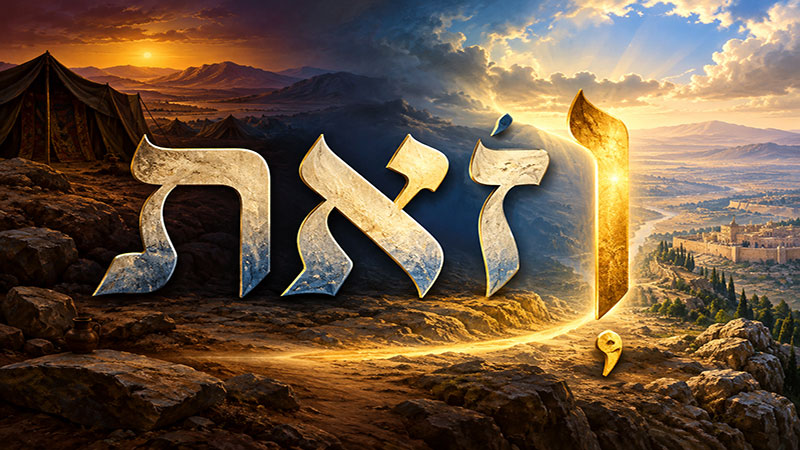
Vezos ha’beracha – And this is the blessing that Moshe, the man of G-d, gave the people of Israel before his death (33:1).
Why does the Torah add the letter Vav, which means “and,” before the word “zos,” which means “this.” Because there was a similar beracha which came before. The word “Vezos” harkens back to the blessing that Yaakov gave his children before his death. “And this (Vezos) is what Yaakov spoke to them and he blessed them” (Bereishis 49:28). Yaakov wanted to reveal the ultimate end to his sons, but the Shechinah departed from him and he spoke about other things.
A similar thing happened to Moshe. Just before he died, G-d took him up to the mountain of Nevo and showed him not only the land into which his people would go, but also what would befall them in the future. G-d told Moshe about the wars they would fight, the defeats they would endure and that finally the Temple would be destroyed and that they would be driven out of the land (Rashi, 34:1-3). G –d revealed to him all the events which were destined to occur to the people of Israel until the time of Techiyas Ha’meisim, when the dead would be revived.
This preview of the future could be given only to Moshe who was Ish Ha’elokim, a man of G-d. It was a message that could not be passed on to the living because as humans, we are not meant to know the future. Such knowledge would destroy our motivation to live in the present. That too is why Moshe was barred from entering the land of Israel, because he knew too much and would tell.
In addition, the word “Vezos” refers back to the warnings and curses that preceded in the parshiyos of Ki Savo, Nitzavim, Vayelech and Ha’azinu. “And if you take these warnings seriously,” Moshe cautions, “you will be worthy of the blessings that follow.”
Before bestowing the blessings, Moshe makes a short introduction to explain why the Jews are worthy of these blessings.
It begins with the following. “G-d came from Sinai, shone forth to them from Seir and made an appearance in Mount Paran” (33:2).
The people of Israel accepted the Torah unquestioningly, even though it was previously rejected by Eisav (Seir) and by Yishmael (Paran). Eisav rejected it because it prohibits murder and Yishmael rejected it because it prohibits theft. The Jews could have rejected it, too, because it prohibits illicit relations (arayos), which they were particularly tempted by and to which they succumbed later on at the time of the golden calf and Pe’er. But they agreed to abide by the Torah despite their desires and even though they knew that the Torah is an Eish Das, a fiery law which can consume its transgressors.
Even though the fortunes of other nations may be determined by the stars, the fate of G-d’s holy nation is in His hands (33:3). The Jewish nation has earned His protection because they squeezed themselves around the base of Mount Sinai and accepted the yoke of G-d’s Torah (33:3). They understood that the Torah is not a yerusha an inheritance for the exclusive benefit of those who were present at Sinai, but it is a morasha, a transferable treasure to be pass down to future generations (33:4).
After this introduction Moshe gets to the blessings themselves, one for each of the twelve tribes (Rashi 33:7). The Torah refers to these blessings as blessings for the Children of Israel collectively (33:1), even though they were given to each tribe individually, because the well-being of each tribe contributes to the well-being of the entire nation.
Reuven is blessed on account of his brotherly love for Yosef. Unlike Eisav, who plotted to kill Yaakov because he took away the first born rights from him, Reuven forgave Yosef for doing the same and even tried to save his life.
Yehuda was blessed because, as his name suggests (Bereishis 29:35), he attributed all of his military success to G-d. G-d heard the prayers of Yehuda and delivered the people from war to peace. In return for Yehuda raising the voice of Yaakov, the voice of prayer, G-d lent him the hands of Eisav (33:6).
Since Yosef supported his brothers throughout the famine, even though they tried to kill him, he is blessed with an abundance of produce. G-d rewards generosity with generosity (33:13-17)
When describing the partnership between Zevulun and Yissachar (33:18), the Torah mentions Zevulun first because it is his success in business that enables Yissachar to dedicate himself to sitting and learning in the ivory tower of Torah.
“They shall offer righteous sacrifices” (33:18). When the businessperson is close to and guided by his Torah partner, whatever charity he gives will be legally earned, not the product of sharp business practices.
The Torah begins with the word Bereishis and end with the word Yisrael.
As Rashi comments (Bereishis 1:1) the word Bereishis is grammatically challenging. Rashi tells us that in creating the world, G-d consulted the blueprint of creation called the Torah, which preceded creation. We know that the world was created for the sake of the Torah and the people of Israel were created to keep the Torah. Everything in this world was created to implement the Torah. We are created with five fingers because we require each one of them to perform a mitzvah. The middle finger, called the kometz, is created for the kohen to perform kemitzah and each finger is allocated its own mitzvah (Kesubos 5b).
So, we have creation at the beginning, whose purpose it is to maintain the Torah. We have the Torah itself in the middle. And we have the name Yisrael at the end, the people who fulfill the Torah. Creation itself the people of Israel are the bookends which uphold the Torah.