 August 14, 2026
 Categories: In Print / Halacha & Hashkafa
The Daf, the Price of Property, and the Pricelessness of Life
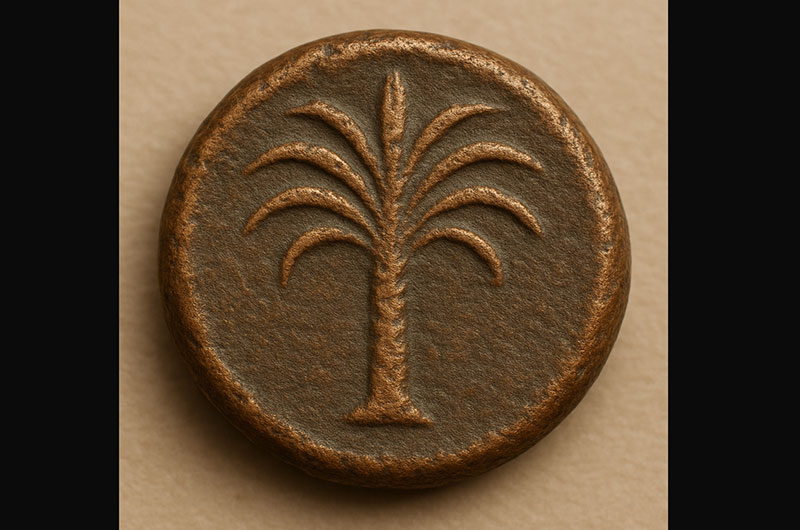


Jewish law is so sensitive to the rights of every person that it even discusses the rights of a person entitled to a fraction of the value of the smallest coin, a perutah. The contrast with the priceless value of the human being, multiplied by over 1,000, regardless of the ethnicity of the victims, is indescribable.
Note: The classic perutah was a copper coin (Rashi to Kiddushin 2a, s.v. perutah), which was the smallest coin in circulation during the Second Temple period. More specifically (and maybe more than you will ever want to know), it is believed to have been circulated in ancient Judea from around the 2nd Century BCE to the 4th Century of the Common Era. It was minted by the Hasmonean and Herodian dynasties and continued to be minted by Roman Judean procurators and later by Jewish rebels during the First Jewish Revolt. The Rambam (Hilchot To'en ve’Nit'an 3:1) defined it as a small coin whose weight is half a barley's kernel weight of pure silver.
The “modern” perutah was minted in the country of Israel after it was established in 1948 as a thousandth part of an Israeli pound, but was discontinued in 1960 due to devaluations of the currency.
All of this history seems pretty uncontroversial, but query about the widely held view that the measurement of the perutah traces its way back to matan Torah and it is considered Halacha l’Moshe miSinai. At some point, Rashi resolved this conundrum by simply referring to the perutah as the lowest valued coin of each era.This article refers to the classic coin and usage, and does not address the fact that an actual Judean Bronze coin now can fetch hundreds of dollars or more on the open market.
Descendants of Noah (non-Jews) are only required to abide by seven basic universal laws (actually, categories of laws), but they are held to a high standard for these universal laws. A non-Jew is liable for theft of even less than the value of a perutah. But if he stole less than the value of a perutah from a Jew, he is not liable, because the Jew is presumed to have generously waived the debt in this instance (Avoda Zarah 71b), as noted by Rashi (without the tongue in cheek word “generously”). but certainly today, as ever before, nobody has a right to waive a murder of one person (Jew or non-Jew) or a massacre of over 1,000, and counting (as occurred in a single day in 2023, and continuing).
Somehow there is an implication that in the instance of stealing less than a perutah, the non-Jew is liable for punishment as discussed later (Avoda Zarah 72a) in the discussion of pulling the stolen item to show acquisition. The Gemara deemed him liable in this instance “because he caused a Jew distress” by stealing the item, even though by the halachot of acquisition, the thief did not acquire it. Somehow the massacre of over 1,000 people on one day, and the loss of life that followed – on both sides of the border – caused more than one person more than a small amount of distress, and the loss of life tragically continues.
The Gemara refers to punishment without requiring restitution, but then asks, “And what does it mean that the stolen object is not subject to restitution? It means that it is not subject to the halachot (the Jewish laws) of restitution because it is not technically a theft. Of course, in the case of the individuals massacred in 2023 and beyond, restitution is impossible; the murdered individuals – and the people who died as a result of the fighting that followed – cannot be brought back to life, but efforts can certainly be made to prevent such massacres and loss of life in the future, of course with a minimum of collateral damage.
The Talmud notes that when or until a price was fixed for a transaction, the transaction was not deemed to take effect. Of course, no price can ever be fixed for a human life, on either side of the border.
The Gemara asked, “From where do you say that wherever a price was not fixed for a transaction, the buyer has not acquired it (even if an act of acquisition occurred)? It is based on the Mishna: if a Jew sells his wine to a non-Jew, if he fixed a price, before measuring the wine into the non-Jew’s vessel, benefitting from the money paid for the wine is permitted. But if the Jew measured the wine into the non-Jew’s vessel, rendering it forbidden, before he fixed a price, the money paid for the wine is forbidden” (Avoda Zarah 72a). No action and no measurement can overcome the lack of fixing a price, all the more so where no price can be fixed.
The Talmud discusses what happens if a donkey laden with produce is brought into a house, as improbable a scenario as could possibly be imagined in this day and age (maybe a truck today into a garage), yet it says that in that scenario, a purchaser can still retract the transaction if he did not agree to fix a price, as no binding act of acquisition took place. Nowadays, we have to be concerned about missiles laden with explosives aimed at and penetrating civilian houses, G-d forbid. To say that we did not agree to the “transaction” would be an understatement; such actions would surely not be permitted in any ceasefire agreement, and of course although there can be a price for repairing a house, no price can be put on the lives of the people inside, Jew or non-Jew.
Having said all of this, we actually don’t have to get involved in splitting hairs, or perutot, as above. Another of the Noahide laws is Lo tirtzach, don’t murder. Enough said.
May everyone be sensitive as to every penny of everyone else, and all the more sensitive about every human soul, which of course is priceless, no matter whose side of a border they may be on.