 October 16, 2026
 Categories: Headline / Perspectives / Op-Eds
The European Challenge to Brit Milah
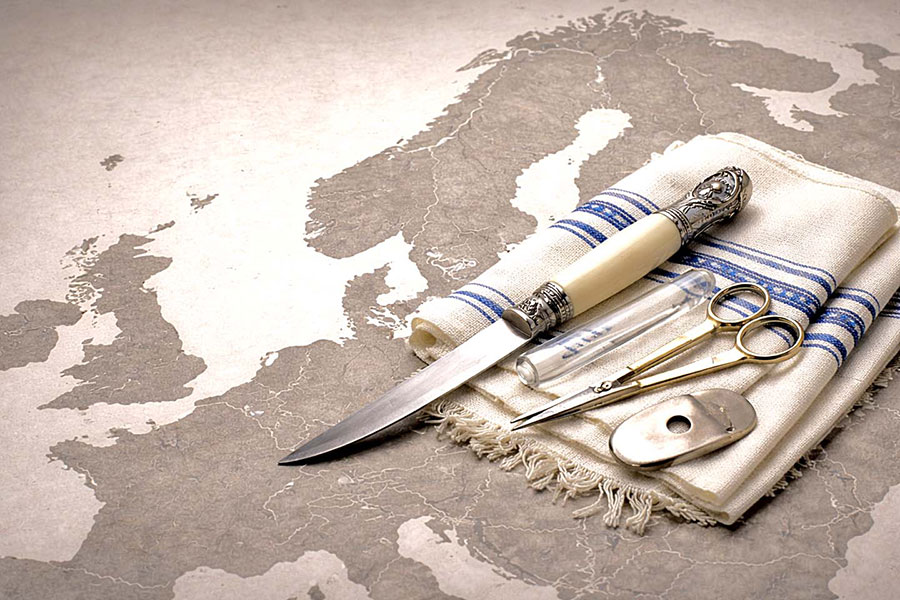


For more than a century, brit milah has been a persistent test of Europe’s commitment to religious liberty. In recent decades, that test has become increasingly severe as, across the continent, lawmakers, activists, and regulators have sought to restrict or criminalize the practice through medical regulations, alleged child-protection frameworks, or prosecutions of religious practitioners. Although no European state has – as of yet – formally outlawed Jewish circumcision outright, the trajectory of public policy in several countries suggests a growing willingness to treat one of Judaism’s most ancient commandments as a suspicious or even illegal act.
The practice is rooted in the biblical covenant between G-d and Abraham in Genesis 17, where circumcision is described not merely as a custom but as the physical sign of Jewish identity itself, and of course as a commandment by G-d. For more than three millennia, Jews have risked persecution to maintain it; the Greeks of the Hellenistic period attempted to suppress it as a marker of Jewish distinctiveness; Roman authorities later forbade it at various moments; and during the Nazi era, even the possession of circumcision instruments could be used as evidence of Jewish identity. For that reason, modern attempts in Europe to regulate or discourage circumcision inevitably carry historical and emotional echoes that resonate in the Jewish collective soul.
The contemporary controversy has emerged most dramatically in the early twenty-first century as activist groups opposing circumcision, often describing the practice as “genital mutilation,” began campaigning across Europe to restrict it. In 2012, a regional court in Cologne, Germany, issued a landmark decision declaring the circumcision of minors to constitute bodily harm even when performed for religious reasons, a ruling that triggered global alarm within Jewish and Muslim communities. Germany’s federal government ultimately responded by passing legislation explicitly protecting religious circumcision, but the episode demonstrated how vulnerable the practice could be to judicial reinterpretation – especially in an environment of dramatically increasing antisemitism in Europe, a land that is already little more than a mass Jewish graveyard.
Elsewhere in Europe, the pressures continued to mount. Parliamentary debates in Denmark, Iceland, and the Netherlands considered proposals to ban non-medical circumcision of minors and, in some cases, the proposals failed only after intense international criticism. The Nordic debates were particularly striking because they framed circumcision primarily as a children’s-rights issue rather than as a matter of religious liberty. Jewish leaders responded that such framing misunderstands both the safety of the procedure and the nature of the religious obligation.
European medical opinion has been far from unanimous in this debate, with some European pediatric associations expressing skepticism about the medical benefits of circumcision and other international medical authorities have taken the opposite view. The American Academy of Pediatrics, for example, has concluded that the health benefits of newborn circumcision, which include reduced risks of urinary tract infections, certain sexually transmitted infections, and penile cancer, significantly outweigh the risks when the procedure is properly performed. The World Health Organization has also endorsed male circumcision as an important preventive measure against HIV transmission in certain contexts. These positions sharply contrast with the claims of European activists who portray circumcision as inherently harmful with no corresponding benefit.
Within Jewish law itself there are also detailed discussions about how circumcision should be performed. Classical rabbinic literature describes three essential steps: the cutting of the foreskin (milah), the exposure of the membrane (peri’ah), and the suction of blood from the wound (metzitzah). Historically this suction was often performed by mouth, a method known as metzitzah b’peh. In modern times, many rabbis permit the suction to be performed using a sterile glass tube or other instrument rather than direct oral contact, and some prominent rabbinic authorities, particularly in more modern Orthodox circles, have endorsed the use of such instruments as a precaution against infection. Other rabbinical leaders, particularly in certain ultra-Orthodox communities, insist that the traditional method remains halachically preferable, if not mandated.
This internal debate within Judaism has sometimes been exploited by critics seeking to regulate circumcision from outside the community. A prominent example has emerged in Belgium, particularly Antwerp, home to one of Europe’s largest and most historic Orthodox Jewish populations. Antwerp’s Jewish community, numbering approximately 18,000 people, has long been known for its traditional religious life, including the performance of circumcision by trained mohels, specialists who undergo years of apprenticeship and religious training.
In recent years, however, Belgian authorities have begun investigating circumcision practices under the country’s medical licensing laws. The controversy intensified after complaints were filed by Moshe Aryeh Friedman, an anti-Zionist activist originally from New York who has lived in Antwerp for many years who, in November 2023, filed a police complaint accusing several local mohels of endangering infants by allegedly performing metzitzah b’peh.
Friedman himself is a controversial figure within the Belgian Jewish community. Known for his opposition to many mainstream Orthodox institutions, he has frequently clashed with community leadership and has criticized traditional practices ranging from kosher slaughter to certain forms of circumcision. Some members of Antwerp’s Jewish community regard him as a dissident or provocateur. Nevertheless, his complaint triggered a formal investigation by Belgian prosecutors, and police raids followed. In May 2025, officers searched the homes of several mohels in Antwerp and confiscated circumcision instruments, including ritual knives and medical equipment used in the ceremony. The raids shocked the Jewish community, which understandably viewed them as a direct intrusion into religious life.
The legal basis for the investigation was not a specific anti-circumcision law but, rather, Belgium’s general regulations governing the practice of medicine. Prosecutors argued that circumcision is a medical procedure that should be performed only by licensed medical professionals. As a result, several mohels, who are religious practitioners and not physicians, were accused of performing a surgical intervention without a medical license.
Significantly, the accused mohels deny the specific allegation that they performed metzitzah b’peh and argue that the complaint against them misrepresents their procedures. This denial matters legally because proving that oral suction occurred would likely require testimony from parents or witnesses present at a circumcision ceremony and, because such evidence is difficult to obtain, prosecutors appear to have focused primarily on the medical-licensing violation, which is easier to prove in court. As such, three mohels eventually faced criminal charges after Belgian prosecutors ultimately concluded that they had sufficient evidence to pursue charges against the men for performing a surgical procedure without a medical license.
No trial date has yet been scheduled and court proceedings could take months to begin, but the unresolved case has already generated a significant international diplomatic dispute. In February 2026, U.S. Ambassador to Belgium Bill White, describing the case as “unacceptable harassment of the Jewish community,” publicly demanded that Belgian authorities drop the prosecution. The Belgian government reacted sharply; Foreign Minister Maxime Prévot summoned the American ambassador and rejected accusations of antisemitism, insisting that Belgium was simply enforcing neutral medical regulations and that the judiciary must be allowed to operate independently.
The Jewish reaction was immediate and fierce. Organizations such as the European Jewish Association and the European Jewish Congress have argued that criminalizing mohels effectively criminalizes Jewish life, since circumcision is a mandatory commandment of Judaism. Belgian Jewish leaders and members of parliament, including the country’s only Orthodox Jewish MP, Michael Freilich, argued that Belgium should explicitly recognize trained mohels as authorized practitioners of ritual circumcision.
For many observers the symbolism of the Antwerp case was unmistakable. Only a few years earlier Belgium had banned kosher slaughter in parts of the country, despite vigorous objections from Jewish and Muslim communities; critics therefore saw the circumcision investigation as part of a broader pattern in which European governments restrict minority religious practices under the banner of modern regulation.
The situation in Ireland illustrates another approach by European authorities: the use of professional licensing laws to control circumcision. Ireland’s Medical Practitioners Act of 2007 regulates the practice of medicine in the country and makes it a criminal offense for unregistered individuals to carry out medical procedures; violations can carry penalties of up to five years in prison and fines exceeding €130,000.
Rabbi Jonathan Abraham – who bears the name of the first Jew to have a brit milah – is a London-based Orthodox rabbi and trained mohel who often travels internationally to perform circumcisions and is affiliated with the long-established UK Initiation Society, the institution that trains and supervises Jewish circumcisers in Britain. The incident that led to his arrest occurred on July 30, 2024 in Dublin, when Irish police (Gardaí) entered a private residence where Abraham had been invited to perform circumcisions. According to testimony presented in court, officers observed him with surgical instruments and concluded that he had already circumcised one infant and was preparing to perform another. He was immediately arrested and charged under Ireland’s Medical Practitioners Act 2007, and the prosecution’s legal theory was straightforward: circumcision constitutes a surgical act, and Abraham was not registered as a medical practitioner in Ireland, which he readily admitted. Circumcision itself is not illegal in Ireland and, for many years, mohels had traveled there to perform the procedure without interference. The sudden enforcement of the Medical Practitioners Act therefore came as a shock to both Jewish leaders and religious circumcisers across Europe.
The judicial proceedings moved rapidly at first. In an August 1, 2024 hearing, Abraham appeared before the Dublin District Court and prosecutors objected to bail, arguing that because he lived in London and had a large family there, he was at risk of not returning for his trial. The judge accepted that argument and for several weeks Abraham was held in Cloverhill Prison in Dublin, much of the time in solitary confinement. During this period, he launched a legal challenge to his detention with the High Court, arguing that his constitutional and religious rights were being violated because prison authorities failed to provide kosher food and prevented him from using religious items such as tefillin. The High Court acknowledged that the prison had indeed failed to accommodate some of his religious needs, but it nevertheless ruled that his detention itself was lawful and declined to order his release on those grounds.
Meanwhile, Jewish leaders mobilized to secure his release on bail. Ireland’s Chief Rabbi, Rabbi Yoni Wieder, publicly vouched for Abraham’s character, and members of the Jewish community helped assemble a substantial financial guarantee for the court. On August 22, 2024, after roughly three weeks in prison, the High Court reversed the earlier decision and granted bail at €60,000, which was raised in part by the Irish Jewish community. Under the bail order, he was permitted to return to London while awaiting trial, provided that he comply with several conditions, including surrendering travel documents and appearing for future court hearings. As of this writing, the criminal case itself has not been dismissed and the matter is awaiting full trial proceedings in the Irish courts.
The broader reaction within Ireland’s Jewish community was immediate and deeply anxious. Ireland has one of the smallest Jewish populations in Europe, only about 2,500 to 3,000 people, and it has relatively few trained mohels. For decades, the community relied heavily on visiting circumcisers from Britain and Abraham himself had traveled to Ireland repeatedly to perform circumcisions before the arrest occurred; because of that reliance, his prosecution raised the possibility that traditional circumcision might become practically impossible in Ireland if visiting mohels risked arrest.
Jewish leaders began exploring alternatives, with some families reportedly considered traveling to the United Kingdom or to Israel to perform circumcisions rather than risk legal complications at home. At the same time, Jewish communal authorities opened discussions with Irish legal experts and government officials in an effort to clarify the law. Leaders of the Jewish Representative Council of Ireland warned that the prosecution could make it extremely difficult for observant Jews to remain in the country if religious circumcision could not be performed, but there has yet to be any credible evidence that large numbers of Jews have left Ireland because of the case.
Critics of circumcision frequently frame the issue as one of children’s rights or bodily autonomy, but this framing overlooks the reality that parents routinely make irreversible decisions on behalf of their children in many contexts, including vaccination, medical treatment, and education. Critics further argue that that medical procedures should be regulated for safety reasons, but Jewish leaders responded that trained mohels have performed circumcisions safely for centuries; that the procedure, when carried out in its traditional context, has an extremely low complication rate; and that many countries, including the United States and Israel, explicitly permit religious circumcision outside hospital settings.
The broader European debate therefore raises a profound question about the limits of liberal democracy. On paper, European states strongly protect freedom of religion; yet, when ancient religious practices conflict with modern regulatory sensibilities, whether regarding animal slaughter, ritual clothing, or circumcision, these protections range from fragile to useless.
The Antwerp prosecutions and the Irish case demonstrate how easily that covenant can become entangled in legal disputes and they also reveal the deep unease that many European Jews feel when governments begin scrutinizing core religious rites. For a people whose history on the continent includes expulsions, forced conversions, and ultimately the Holocaust, the policing of circumcision carries an emotional resonance that cannot be dismissed. If Europe wishes to remain a continent where Jewish life can flourish, it must recognize that the freedom to practice Judaism includes the freedom to perform brit milah and that regulations designed without sensitivity to this reality risk sending a message that Jewish traditions are welcome only when they conform to secular expectations.
For observers across Europe, particularly in Jewish communities already watching developments in Belgium, Denmark, and elsewhere, the case has become a warning that the future of brit milah may increasingly depend not on explicit bans but on how governments interpret seemingly neutral professional regulations. The modern European debate over circumcision is therefore not merely a medical or legal controversy, but a test of pluralism itself. A society confident in its liberal principles should be able to accommodate ancient religious practices while ensuring basic safety standards. When governments instead choose prosecution of mohels and confiscation of ritual tools, they risk reviving a pattern that Jews know all too well: the gradual narrowing of the space in which their traditions can be practiced.