 August 28, 2026
 Categories: Headline / Features / Book Reviews
The Faith You Can Live Inside
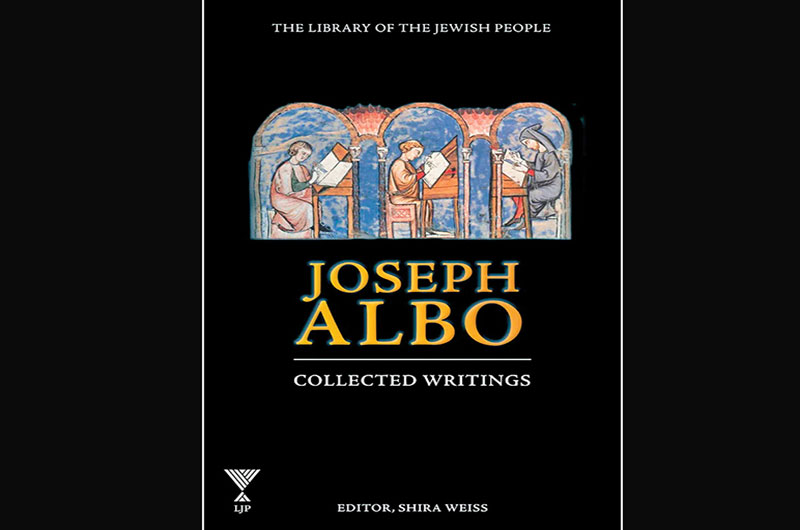


Title: Joseph Albo: Collected Writings
Edited by Shira Weiss
The Library of the Jewish People / Koren Publishers Jerusalem
1,766 pages
Maimonides taught that the gate to eternal life is the intellect. A soul is saved, in his account, by what it manages to know, and the highest human achievement is the perfected mind. It is a magnificent idea, and a cold one, and it leaves most Jews standing outside the gate. Joseph Albo spent the better part of a very long book throwing that gate open.
A darshan by trade, Albo wrote in the worst years Spanish Jewry had known, a generation after the massacres of 1391, in the shadow of the conversions that followed. He had stood through the Disputation of Tortosa, 69 sessions across nearly two years, where a Jewish convert argued the Church's case before an antipope and the rabbis were made to answer for their faith without giving offense. But the book that grew out of those years, Sefer ha'Ikkarim, the Book of Principles, is not a defense. It is a complete account of Jewish belief, and an unusually readable one, and its great argument is about how an ordinary person reaches G-d.
That book is the heart of this collection, a companion to the series' earlier volume of Hasdai Crescas, who was Albo's teacher and whose fingerprints are on every page. It reaches English readers in Joseph Albo: Collected Writings, edited by Shira Weiss and published by the Library of the Jewish People, an imprint of Koren Publishers Jerusalem, which here reprints Isaac Husik's classic translation, adds a new introduction, and brings Albo's only surviving responsum into English for the first time.
Crescas had broken with Maimonides on exactly this point. Where Maimonides made knowledge the path to immortality, Crescas put the love of G-d in its place. Albo took that conviction and built on it across hundreds of pages. What perfects a soul, he argues, is faith, devotion, and the doing of the commandments. "Faith stands higher than speculation," he writes, and he reads the miracles of the Bible as gifts to men of faith rather than to the learned. Eternal life, in his account, is open to any Jew who trusts and serves. To Jews who had seen their teachers humiliated in public disputation and their neighbors baptized under pressure, many no longer certain what they believed, that was no abstraction. Albo was telling them that a plain and faithful life was enough to reach G-d, and for a battered people that came close to a rescue.
He reduced the principles of the faith to three, where Maimonides had counted 13: the existence of G-d, revelation, and reward and punishment. The reduction can look like subtraction, but it is closer to clarification. These are the roots, the few truths a divine law cannot stand without, and everything else a Jew believes grows from them. Albo even hears them in the prayer book, in the three central blessings of the New Year service. The faith has a small, load-bearing center, and around it room to breathe.
Most striking to a contemporary reader is how much of the book is about the inner life. Albo insists that the highest form of divine service is performed from love rather than fear, and that even the commandments the mind resists should be done with joy, the way a person digs gladly through hard ground for a buried treasure. He wanted a faith a Jew could live inside, not merely assent to. He writes about fear and joy and love as states a person actually moves through, with the attention of a preacher who knew the people on the bench in front of him. And he was unflinching about the thing that tests such a faith most, which is suffering. The longest of the work's four books circles again and again around the oldest question, why the righteous suffer while the wicked prosper. Albo refuses to make it easy. His answer is that pain can refine rather than punish, clearing away a good person's few faults so that the soul arrives whole, and that it is better by far to fall into the hand of G-d than into the hand of man. "Righteous men are called living even after death," he writes, quoting the Rabbis, "wicked men are spoken of as dead even while they are alive."
A reviewer should be as honest as the book. Husik, whose translation this is, calls Albo a compiler, and it is fair. Albo borrowed whole discussions from Crescas, from his contemporary Simeon ben Zemah Duran, and from Aristotle, and he named his sources unevenly at best. The originality of the Ikkarim is not in its parts. It is in the order he gave them and in the plain, preacher's voice that brought hard ideas within reach of people who needed them. That voice is the reason the book outlived its century, printed in edition after edition and studied, in time, even by the Christian theologians it had argued against.
The mercy in the book is not only theoretical. The single responsum that closes the volume answers a real and painful case. A woman had been widowed twice, one of her husbands killed in the 1391 massacre at Valencia, and by the letter of the Talmud she was forbidden to marry a third time, her own fate blamed for the deaths. Albo set her free. A death decreed upon a whole community, he ruled, is not the verdict of one woman's fate. The decree had fallen on the people, not on her. He had learned the ruling, he notes, from his teacher Crescas. The same instinct that refused to make the intellect the price of admission to heaven refused, here, to make a grieving woman carry the weight of a national catastrophe.
That is the Albo this volume recovers. Not the debater who stood up to a pope, though he did, and not the polemicist who took apart the Christian creed, though he did that too. The Albo worth meeting is the one who spent a lifetime arguing that the door to G-d is wide, that an ordinary faith, faithfully lived, is enough, and that the soul a person builds through love and devotion is the part of him that does not die.