 September 25, 2026
 Categories: Collecting / Arts
The First Jewish Aviator


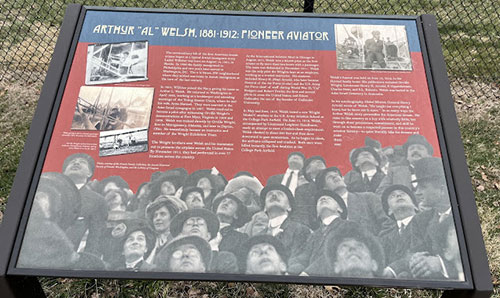
Arthur L. Welsh (1881-1912), born Laibel Welcher in Kiev, then part of the Russian Empire (now Ukraine), was a pioneering Jewish aviator who, although few have ever heard of him, became one of the earliest and most influential pilots in the history of powered flight.
Emigrating with his family to the United States as a child, Welsh rose from immigrant beginnings to become the first professional Jewish aviator in America and the first known Jewish airplane pilot in the history of heavier-than-air flight. He is best known for his role as the first flight instructor for the Wright Brothers and as a record-setting exhibition pilot who trained many early aviators, including future United States Army Air Corps commander Henry H. “Hap” Arnold.
Welsh’s career was cut tragically short on June 11, 1912, when he and his passenger, Army Lieutenant Leighton W. Hazelhurst Jr., were killed in a crash during an Army acceptance test of a new Wright Model C aircraft in College Park, Maryland, a site that would become America’s oldest continuously active airfield. His death came at the age of thirty, just two weeks after the death of Wilbur Wright of typhoid fever; his funeral was held in the Jewish community where he had been an active member; and his legacy as an aviation pioneer and a Jewish American figure endures in both aviation history and Jewish communal memory.
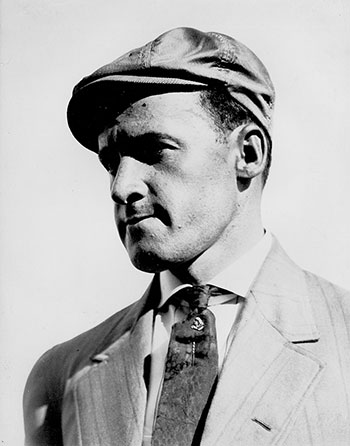
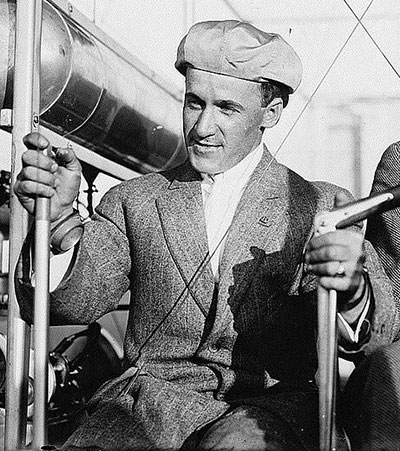
Welsh was born into a Jewish immigrant family as one of six children of Abraham and Devorah Welcher. After emigrating to the United States in 1890, the family settled in Philadelphia. Laibel spoke no English, but he quickly acclimated to his new country, attending public school and Hebrew school, where he received a basic Jewish education typical of Eastern European immigrant families of the era. His father died when he was about thirteen, and, soon after his mother remarried, he went to live with relatives in Washington, D.C., where the young Laibel excelled academically, particularly in mathematics and mechanics, and developed skills in athletics such as swimming.
Like many young Jewish immigrants seeking to assimilate and to pursue broader opportunities in American life, Laibel chose to change his name, and, upon joining the United States Navy at about age twenty, he adopted the name Arthur L. Welsh, reportedly believing that his birth name sounded “too Jewish” and might impede his success in the Navy or in American professional life. This form of assimilation was not uncommon in the era, as many immigrants sought names that sounded less distinctive or foreign in a period when discrimination based on ethnicity and religion was widely present in American society.
Welsh served honorably in the U.S. Navy for four years, with his tour of duty including Guantanamo, Cuba and serving aboard vessels such as the U.S.S. Hancock and U.S.S. Monongahela. A month after his discharge in 1905, he suffered a serious bout of typhoid fever and was hospitalized for four months, during which time he became intensely interested in the nascent field of aviation. At the time, the Wright Brothers had begun demonstrating the power and promise of heavier-than-air flight, and Welsh was captivated by what he saw as the embodiment of modernity, mechanization, and human daring.
After his convalescence, Welsh lived in Washington and worked as a bookkeeper for a gas company while pursuing his interest in flying. After seeing demonstrations of the Wright Military Flyer at Fort Myer, Virginia, in 1909, he wrote to the Wright Brothers seeking to join their operations. His initial written inquiry was not successful but, undeterred, he traveled to Dayton, Ohio, to meet Wilbur and Orville Wright in person. Although they were initially reluctant, given his lack of experience, the Wrights were eventually impressed by his persistence and offered him a position in the Wright Company’s fledgling exhibition team, an opportunity that placed Welsh among the first generation of professional aviators in the United States.
Welsh began his training in the Wright Flying School, initially in Montgomery, Alabama, where Orville Wright directly instructed him, and he soon demonstrated remarkable aptitude, progressing quickly from novice to capable pilot. Soon after, he was asked to help establish the Wright Company’s flight school at Huffman Prairie near Dayton, where he worked alongside other early pilots such as Frank Trenholm Coffyn and Ralph Johnstone. At Huffman Prairie he served both as an instructor and a test pilot, helping to train students who would become significant figures in aviation, most notably Henry H. “Hap” Arnold, a pioneering U.S. Army aviator and later a five-star general who helped to build and commanded the U.S. Army Air Forces that won World War II.
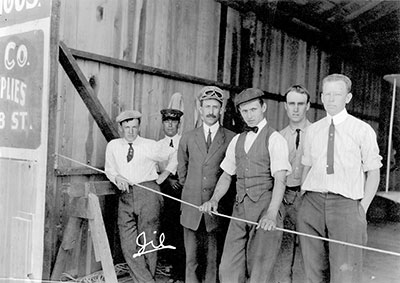
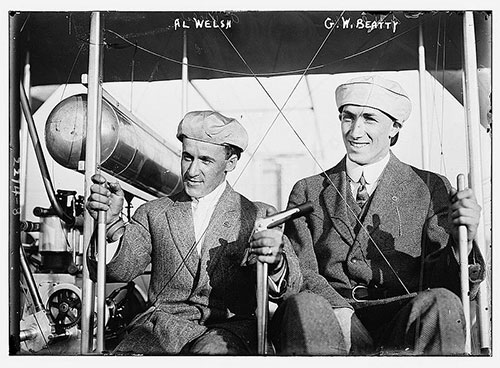
During 1910 and 1911, Welsh became known not only for his instruction, but also for his competitive flying and record setting, and he served as leading member of the Wright Exhibition Team that traveled the country demonstrating the capabilities of powered flight. In 1911, he set multiple flight records, including a new American two-man altitude record of 1,860 feet with student George W. Beatty on July 23, 1911. He won several prizes at aviation meets, including an important prize at the International Aviation Meet in Chicago in August 1911 when he won a $3,000 prize as the first aviator to fly more than two hours with a passenger aboard, a noteworthy achievement in an era when both aircraft performance and pilot endurance were being tested every day.
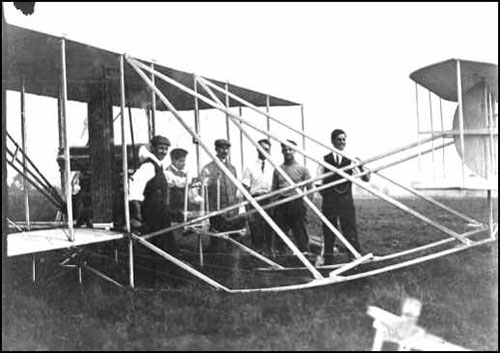
The Wright Exhibition Team, often called the Wright Exhibition Company or Wright Flying Team, was created by the Wright brothers as a practical and commercial extension of their breakthrough in powered flight. Its purpose was threefold: to demonstrate the reliability and controllability of the Wright airplane to skeptical audiences; to fulfill exhibition and contract obligations in Europe and the United States; and, by no means least, to generate income at a time when aircraft sales alone were still uncertain and sporadic. The team played a crucial role in transforming aviation from a laboratory curiosity into a public spectacle and a viable profession and Welsh served within that process as its most technically accomplished and trusted pilot.
The exhibition team originated in 1908-1909, when Wilbur and Orville undertook parallel demonstration campaigns, Wilbur in Europe, Orville in the United States, to prove the practical value of their airplane. These flight exhibitions, particularly Wilbur’s in France, revealed enormous public appetite for aerial demonstrations and, by 1909 and 1910, aviation meetings and exhibitions had become major events, offering prize money and appearance fees sufficiently substantial to attract professional pilots. The Wright brothers, who were cautious businessmen as well as inventors, recognized that exhibitions could serve as both advertising and revenue sources while also reinforcing their claims to technical superiority during ongoing patent disputes.
To meet this demand, the Wrights established a formal exhibition organization in 1910, based in Dayton and closely tied to the Wright Company and, rather than relying solely on themselves, they began training a select group of pilots at Huffman Prairie. Admission to this circle was difficult; the Wrights insisted on discipline, mechanical understanding, and absolute adherence to their methods of control, and, as a result, the ultimate team was small, elite, and technically conservative compared with some rival exhibition groups that favored speed and risk over precision.
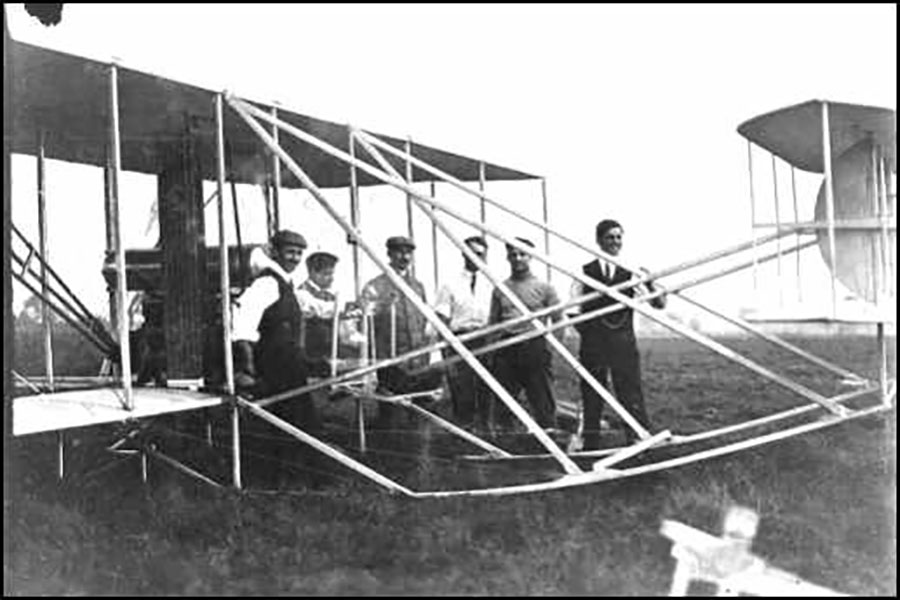
By 1910-1911, the Wright Exhibition Team included a multinational roster of pilots, reflecting the global reach of early aviation. Figures such as Orville Wright himself, Ralph Johnstone, James Davis, Frank Coffyn, and the French pilot Alfred (or, in some accounts, Duval) La Chapelle appeared alongside Welsh. The photograph exhibited here captures the team at a moment when it combined technical authority with international prestige.
Within this group, Welsh, who served as its leader, occupied a distinctive position. He was much more than a mere hired exhibition flier; he was also a test pilot and instructor, trusted to evaluate aircraft modifications and to train new aviators to Wright standards, and the Wright brothers relied on him to demonstrate advanced maneuvers before knowledgeable audiences, including military observers. His flights were noted for their smoothness and apparent ease, qualities that reassured spectators and potential customers alike that powered flight could be safe, repeatable, and practical.
Welsh’s role became particularly important as the Wrights sought military contracts. In the United States, skepticism about aviation persisted within the Army Signal Corps, and public exhibitions doubled as informal demonstrations of military potential. Welsh’s disciplined flying style, absence of showy recklessness, and evident technical competence made him an ideal representative of the Wright system, and contemporary accounts often singled him out as one of the most reliable pilots in the organization, a reputation that carried weight among engineers and officers who valued precision over spectacle.
The development of the Wright Exhibition Team also reflected broader tensions within early aviation. As exhibitions grew more competitive, pilots from other schools pushed for higher speeds, steeper dives, and more dangerous stunts. Wilbur and Orville Wright were steadfast in resisting this trend, emphasizing control and structural integrity, an ethos passionately embraced by Welsh. He was known to fly in challenging conditions, but never gratuitously; he adhered strictly to the limitations of the aircraft; and, although his conservatism sometimes made Wright exhibitions seem less sensational than those of rival teams, he was seminal in the Wright effort to reinforce their claim to technical maturity.
As such, it was Welsh’s combination of technical skill, teaching ability, and personal courage that earned him the respect of his peers and he was almost universally regarded by many in aviation circles as among their most reliable and skilled pilots. Henry “Hap” Arnold later wrote of him in his autobiography, Global Mission, that he “taught me everything I know, but he knew much more,” a testament to Welsh’s importance not only as an early aviator but as a teacher of future leaders in aviation.
In 1912, the Wright Company contracted to supply aircraft to the United States Army’s Aeronautical Division of the Signal Corps and Welsh was sent to the Army Aviation School in College Park, Maryland, as a civilian test pilot to conduct acceptance tests on the Wright Model C aircraft, a machine specifically designed for military use. On June 11, 1912, while conducting one of the required loaded-climb tests, an attempt to carry a substantial payload to a designated altitude, Welsh and his passenger, Lieutenant Leighton W. Hazelhurst Jr., were killed when their aircraft stalled and crashed shortly after takeoff. Welsh suffered a crushed skull and Hazelhurst a broken neck, and both died instantly.
Before the incident, all of the War Department's requirements had been met except a climb of 2,000 feet within ten minutes carrying a load of 450 pounds, and the accident occurred while Welsh was attempting to meet this government requirement in a machine contracted for by the War Department. The crash came so suddenly and unexpectedly that the two men were unable to take any action to prevent the crash, and, although seven army air men were among the score of spectators, reporters at the time noted that it was unlikely that the real cause of the machine's failure would ever be established.
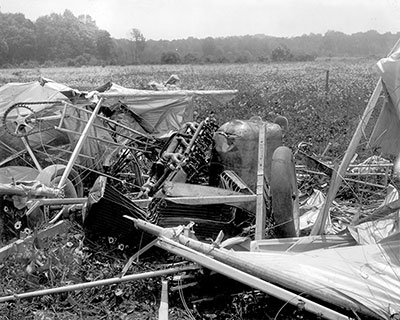
According to a report by the Tennessee Daily Times a day after the fatal crash, the structure of the plane was not the cause of the disaster, suggesting that Welsh was at fault:
Many new features were embodied in the machine, evolved as a result of Orville Wright's experiments at Kill Devil Hill, N.C. last summer. The Wright brothers always built comparatively slow aircraft, but the government required that the new machine should make forty-five miles an hour. In speed trials several days ago, 50.8 miles was attained. It was estimated that it was making about forty-five miles an hour when the fatal plunge came. The wings of the craft were aluminum instead of canvas, but in appearance it was much like the earlier machines. It (the wingspan) was narrower by one foot, but with a vertical rudder a bit larger. The six-cylinder engine was fifty horsepower, instead of thirty. The opinion was expressed tonight that the engine was in no way responsible for the disaster.
A board of inquiry formed by Secretary of War Henry L. Stimson reported in the June 29, 1912 issue of Scientific American that Welsh was at fault in the crash because, having risen to 150 feet and planning to dive at a 45-degree angle to gain momentum for a climb, he had made the dive too soon. Nonetheless, some aviation historians still argue that the test conditions and aircraft limitations were major contributing factors for the accident. Grace Berlowe (who would later make aliyah), the cousin of Welsh’s daughter, Abigail, described how the manner in which the flight tests were conducted that day haunted Welsh’s wife, Annie, until her death in 1926. Annie Welsh always believed that the War Department pushed too hard for tests that were sure to fail: “On the day of the crash, not only was Welsh carrying too much of a load, but he also carried his passenger and was expected to climb too quickly and too high when you consider the weight. Too much was expected.”
The response to Welsh’s death in the press underscored his significance in early aviation. The New York Times described him as “one of the most daring professional aviators in America,” and reports noted that both Orville and Katharine Wright postponed their return to Dayton after Wilbur’s death to attend Welsh’s funeral in Washington, reflecting both personal affection and professional respect. Welsh’s death was widely covered across aviation publications, local newspapers, and, notably, in the Jewish press, where he was recognized as a pioneering Jewish aviator.
The historical record notes several clear facts about Welsh’s Jewish origins and communal involvement, though detailed information about his personal religious observances is limited in surviving sources. Welsh was born into a Jewish family in Kiev and raised in Philadelphia and Washington, attending Hebrew school alongside public school, a combination that suggests a Jewish cultural and religious upbringing in his youth. The very existence of Hebrew school attendance at the time indicates that his family maintained at least some level of Jewish educational practice in childhood.
In Washington, Welsh became involved in Jewish community activities as a young adult. He attended meetings of the Young Zionist Union, a Jewish organization linked to Zionist ideals – that is, the movement for Jewish national revival in the land of Eretz Yisrael which was gaining momentum among Jewish communities in the early 20th century – suggesting that he embraced Jewish communal identity and cultural nationalism beyond mere cultural affiliation.
In 1907, Welsh married Anna (Annie) Harmel, whom he met at a Zionist Union meeting. Anna came from a prominent Jewish family in Washington; her father, Paul Harmel, served on the board of the Adas Israel Congregation and was a founder of the Hebrew Free Loan Association and the Hebrew Relief Society, and her mother was involved in founding the Jewish Foster Home in Washington and was a founding member of the Hadassah chapter in the city. Their wedding, officiated within the framework of an Orthodox synagogue, took place at Adas Israel synagogue in Washington, specifically in the synagogue’s then-new building (often identified today as the historic Sixth & I building), making them the first couple married there.
Their daughter, Ailene (sometimes spelled Aline), was born around 1910 and, while there is no specific documentation detailing her Jewish upbringing, she was Jewish according to matrilineal law and her early childhood took place within a Jewish home. Her later life, living in England, changing her name to Abigail, and expressing warm memories of her father’s community, reflects a continuing connection to Jewish identity, though detailed records of her personal Jewish practice are limited.
Welsh’s involvement in the Jewish community extended beyond his marriage, as he participated in Jewish life meaningfully and was recognized by Jewish communal institutions as one of their own. He remained associated with Adas Israel Congregation, which at the time was an Orthodox synagogue and center of Jewish life in Washington, D.C., and his funeral was held there, officiated by the synagogue’s cantor Joseph Glushak and attended by his family, synagogue members, and leading figures from both aviation and the Jewish community, including Orville and Katharine Wright. The mourners included friends, relatives, representatives of the army and navy, and members of Adas Israel, reflecting both his secular accomplishments and his identity as a Jewish member of the community. He was buried in the Adas Israel Cemetery on Alabama Avenue in Washington, D.C., further cementing his place within that community’s legacy.
Available sources do not suggest that Welsh was ever publicly the target of antisemitic harassment during his aviation career; in particular, there is no evidence that Wilbur or Orville Wright expressed antisemitic views, and Welsh’s professional relationship with them appears to have been mutually respectful. The fact that Orville and Katharine Wright attended his funeral during a period of personal mourning underscores the depth of their personal and professional regard for him.
Newspaper coverage of Welsh’s life and death acknowledged his Jewish identity, and the Jewish press and communal historians have since celebrated him as a pioneer and a source of pride. These posthumous recognitions, including exhibits by the Jewish Historical Society, commemorative medals, and memorial events, testify to his lasting place in collective memory both as an aviation figure and as a Jew.
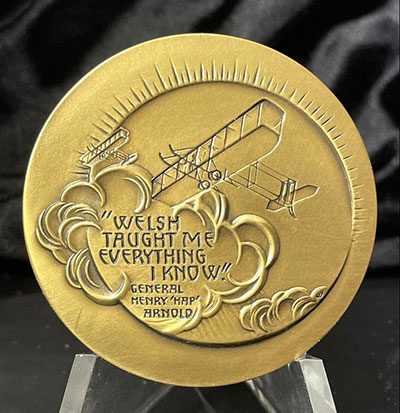
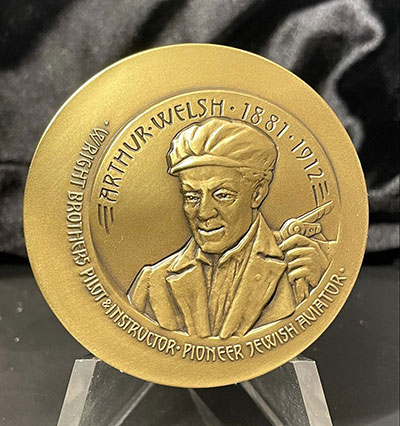
In 2012, various Jewish news sites ran features on Walsh as a “forgotten Jewish aviator,” recounting his life, death, Jewish upbringing, and his role with the Wright Brothers, and several Jewish community sites have published retrospectives marking his centenary and highlighting his Jewish heritage and aviation accomplishments. Organizations like the Jewish Historical Society of Greater Washington (JHSGW) have actively preserved and promoted his memory, including exhibits and ceremonies highlighting him as an important figure in Jewish American history. On the 100th anniversary of his death in 2012, the College Park Aviation Museum hosted events including speeches, exhibits, and remembrance gatherings focusing on Welsh’s contributions to aviation and his Jewish identity and the Jewish Historical Society of Greater Washington commissioned art medals and a commemorative sign honoring Welsh’s legacy at the Museum as part of a broader remembrance program.
Welsh’s life, though brief, stands at the intersection of American technological innovation and immigrant achievement. As a Ukrainian Jewish immigrant who rose to become a central figure in the early years of aviation, he embodied the aspirations of a new America, one in which the children of immigrants could contribute to the cutting edge of science, exploration, and national progress. His story resonates within both the Jewish American narrative and the broader history of early flight, reminding us that pioneers of the sky came not only from privileged backgrounds, but from diverse communities and humble beginnings.