 September 18, 2026
 Categories: Headline / Business/Finance / Money Matters
The Frum Community Has a McMansion Problem
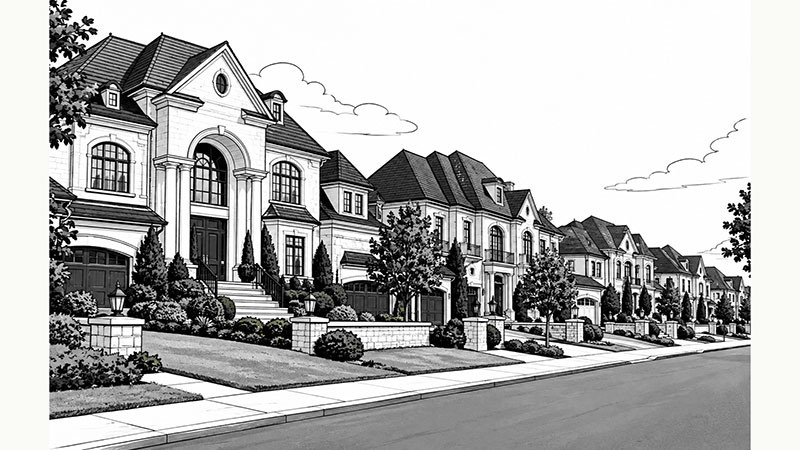


Harvey Firestone, the American businessman who founded the Firestone Tire and Rubber Company and became one of the first global makers of automobile tires, once said: "Why is it that a man, just as soon as he gets enough money, builds a house much bigger than he needs?... I do not know why I do it, the houses are only a burden. But I have done it, and all my friends who have acquired wealth have big houses… But in most cases, and especially with men who have earned their own money, the house is just built, and when it's done, no one quite knows why it was started."
That quote has stayed with me since I first saw it, especially while walking around various frum communities over Shabbos and noticing how grandiose so many of the houses have become. Some families can genuinely afford these homes without any strain, but many overextend themselves to buy a house far bigger than what they need. That decision has a domino effect on nearly every other part of their financial lives.
Some argue that a gigantic house brings a family closer together. It's a nice theory, but how often does that actually happen in practice, and what price is being paid to make it possible?
How We Got Here: According to the American Enterprise Institute, American homes have grown dramatically over the past century, expanding from 1,000 square feet in 1900 to about 2,600 square feet today. This is while the average household shrank from 4.6 people to 2.5. Americans now enjoy nearly five times as much living space per person as they did generations ago. The growth came in waves. There was an early surge in the 1920s tied to urbanization, with the real size creep era from 1970 through 2000, fueled by rising incomes, cheap suburban land, and a cultural shift toward privacy and specialized rooms.
The frum community has experienced this same trend, but on steroids. When I started my career, meetings with ultra-high-net-worth families took place in homes that were smaller and often fairly modest. Most meetings, even with clients who would be considered middle class, are now in far larger homes. This is anecdotal, but after twenty years in this business, I trust the pattern. You don't need to work in finance to notice it; just take a walk through many of our neighborhoods and the shift becomes obvious.
I want to be clear that I am a capitalist at heart. I believe people should use their money to enjoy the life they've built. However, far too many stretch themselves thin on their home. It is not uncommon in my line of work to sit across from someone carrying a million dollars of debt (and having "only" $800,000 does not put a family in meaningfully better shape). I also regularly meet people approaching retirement who are still carrying a substantial mortgage, with no clear plan for paying it down before the paychecks stop.
This isn't an argument against wealth, beautiful homes, or enjoying the fruits of one's labor. If a family can comfortably afford a $2 million home while saving adequately, funding tuition, giving tzedakah, and maintaining a healthy financial cushion, there is nothing inherently wrong with that choice. The problem arises when the house owns the family rather than the family owning the house.
Why It Hits Us Differently: General American housing trends explain part of the picture, but not all of it. Something specific happens in frum communities that accelerates this pattern.
Start with the fact that our communities are unusually visible to each other. We daven together, host each other for Shabbos and Yom Tov meals, and send our kids to the same schools. Houses get seen, discussed, and quietly measured against the house down the block, creating pressure that a family in a more anonymous suburb simply doesn't face.
There is also real value behind hachnasas orchim, hosting large simchas, and having room for a growing family to eat together. Nobody should feel bad about wanting space for that. However, a home built for a genuine communal purpose can slide into a home built to signal that a family has arrived, that a shidduch resume looks strong, or that a family can keep pace with a specific crowd. The line between the two is blurry, and few people stop to ask on which side of it they're standing.
Layer onto that the fact that frum families already carry some of the heaviest fixed costs of any community in America. Tuition alone can run into six figures a year for a family with several children in yeshiva, long before a single simcha or Pesach program enters the picture. A family stretching for a $1.5 million house while also paying full tuition is not making one hard financial decision; it is stacking two or three of the biggest expenses a household can carry, all at once, with almost no room left to absorb a bad year.
A Simple Rule of Thumb: There are longstanding guidelines for how much of your income should go toward housing. The traditional standard, the 30% rule, holds that housing costs including mortgage, utilities, insurance and taxes should not exceed 30% of gross monthly income. A more conservative standard is the 28/36 rule, under which housing alone should stay under 28% of pretax income, while total debt payments including car loans and credit cards should remain below 36%, since housing is rarely a family's only obligation. Once housing costs approach 50% of income, a family's financial flexibility can become dangerously constrained.
The Real Cost of a Big House: Overextending yourself to buy a large home, often described as being house poor, carries risks beyond the monthly mortgage bill. When too much income is locked into housing, you lose the safety net that protects a family through life's surprises. Even a strong income can lead to real trouble if a breadwinner burns out, gets downsized or slows down. Wealth becomes illiquid once it sits inside a physical structure, and property taxes, insurance and maintenance all scale with square footage, so an unexpected repair bill can wipe out savings in a single stroke.
The lifestyle costs are just as real. Capital poured into a massive mortgage cannot be invested for retirement, which does lasting damage to long-term wealth building. Living paycheck to paycheck to maintain an expensive property creates chronic stress that spills over into health and family relationships. Heavy fixed overhead also traps people in their careers, and large homes tend to come with empty rooms owners feel pressure to fill, often triggering a wave of high-interest debt just to furnish them. All of it feeds what is commonly called lifestyle creep, where spending rises automatically alongside income until former luxuries quietly become daily expectations.
The Case for Modest: Buying a more modest home is often the wiser financial move, since housing is typically a household's largest recurring expense, and a bigger house can consume wealth without a proportional gain in financial security. Consider two paths. A family buying a $1.2 million home carries roughly a $600,000 mortgage, while that same family choosing an $800,000 home might carry closer to $400,000. If the more modest home frees up an extra two to three thousand dollars a month and that money gets invested instead, the long-term difference is enormous. Investing $2,000 a month for 25 years at a hypothetical 7% annual return would grow to roughly $1.62 million, illustrating the enormous opportunity cost of choosing a more expensive home.
The jump from a $1 million home to a $1.5 million home may deliver only a modest improvement in daily living despite requiring far more capital. Choosing modest buys freedom to retire earlier, fund a child's education without strain, make a career change without fear, and direct resources toward goals that better reflect frum values. A family earning $300,000 a year may technically qualify for a $1.2 million mortgage, but qualifying for something and it being the smartest use of that family's resources are two very different questions.
Finding the Balance: None of this means the cheapest house is automatically the smartest choice. Location, school district, commute, property taxes and how long you plan to stay all matter and deserve real weight. The sweet spot tends to be the nicest home that comfortably meets a family's needs without compromising its ability to save and invest for the future. Paying a bit more for a good location and enough bedrooms makes sense, while resisting the pull from comfortable into luxurious.
In my experience, the best approach is to slow down, stay within sensible guidelines, focus on your actual values, and keep enough cash flow to comfortably support the other essential parts of living a frum lifestyle.
Before asking whether you can afford the house, ask what else that money could accomplish. A $400,000 house versus a $700,000 house isn't simply a $300,000 difference. It's potentially hundreds of thousands of dollars of retirement savings, investment capital, tuition flexibility, charitable giving, travel, or financial independence that you're choosing to put into your home instead.
Harvey Firestone built his big house and never quite knew why he started it. He at least had the honesty to admit the burden out loud. Our community would do well to ask the same question before the foundation is poured, not twenty years into a mortgage when we can't easily explain either.