October 2, 2026
 Categories: Featured / Parsha / Torah
The Holy Land Hit Job and Spiritualizing Statutes


Parshat Sh’lach – Shabbat M’vorchim
The Torah reading this week outside of Israel is Sh’lach; in Israel, we are going to be reading Parshat Korach. It seems that there was a time in the past when it was Sh’lach and Korach that were combined in this type of year (one in which Shavuot fell on Friday and Shabbat or just Friday), and we would return to reading the same sedra throughout the Jewish world two weeks earlier than we do now. I have no idea when and why the double sedra was changed to Chukat-Balak.
The Hebrew date of Shabbat M’vorchim ranges from the 23rd to the 29th of the current month. This time, Shabbat M’vorchim Tamuz is on the 28th of Sivan.
Because of the out-of-sync Torah readings, we find the following statistics for Rosh Chodesh bentching for Tamuz: In 62.72% of years, Sh’lach is M’vorchim Tamuz all over the world; in 10.53% of years, Korach is M’vorchim; and in 26.75% of years, it’s Sh’lach in Chutz LaAretz and Korach in Israel. Combining these numbers, we find that Sh’lach is Shabbat M’vorchim Tamuz in 89.47% of years and Korach only 10.53%. For Israel, the numbers are 62.72% and 37.28%. Sh’lach wins overall.
Note that the Sh’lach and Korach disparate readings happen not only when Shavuot is Friday (regardless of it being a 12-month or a 13-month year), but also when Pesach begins on Shabbat in a shana m’uberet, a 13-month (two-Adar) year. When Pesach begins on Shabbat in a 12-month year and we fall out-of-sync in the Parshat HaShavua readings, we get back together following B’har-B’chukotai, which we split in Israel to slow down the flow of weekly sedras. In a 13-month year, the only double sedra available for us to split is Matot-Mas’ei – hence, we are still out-of-sync in that kind of year for much longer.
And what about the Rosh Chodesh we announce this Shabbat? It is always two days in our fixed calendar because Sivan always has 30 days. Those two days can be Monday-Tuesday (as it is this year, a 28.57% occurrence) or Wednesday-Thursday (28.03%), or Thursday-Friday (11.51%), or Shabbat-Sunday (31.89%).
* * * * *
Sh’lach is the 37th of the 54 sedras, the fourth of 10 in Bamidbar. It is written on 198 lines in a Sefer Torah, giving it a rank of 25th – towards the bottom of the top half. It has ten parshiyot – seven open, three closed – slightly below the average of about twelve-and-a-half parshiyot per sedra. Watch this: Sh’lach’s 119 p’sukim give it a rank of 21st, putting it in 6th place in Bamidbar. However, its 1,540 words drop its rank to 27th overall (the bottom sedra of the top half), but its rank in Bamidbar goes up a notch to 5th. For letters, it has 5,820 of them, ranks 27th, and goes up another notch to 4th in Bamidbar. Sh’lach has shorter than average p’sukim, which explains the drop in rank for words and letters, yet the rise in rank within Bamidbar indicates that there are sedras in Bamidbar with even shorter p’sukim.* * * * *
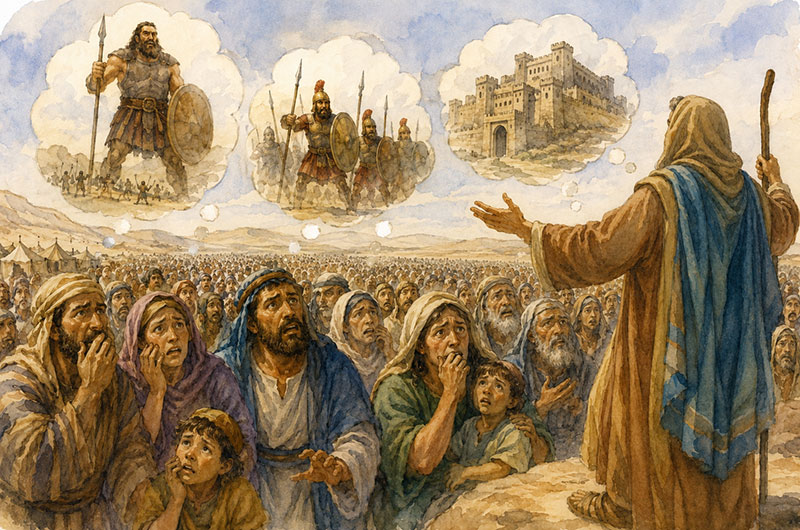
A distinct feature of Sh’lach (Korach has it too, and maybe no other sedra) is its content of story and mitzvah-topics. Specifically, Sh’lach is comprised of three p’rakim (chapters): Bamidbar 13, 14, and 15. Chapters 13 and 14 are totally dedicated to the story of the Meraglim, the spies or scouts that Moshe sent to “tour” the Land. Seventy-eight p’sukim of the 119 in Sh’lach – that’s just about two thirds of the sedra – deal with the whole story. This includes the names of the 12 prominent leaders among the people, one from each tribe; their itinerary; their return with samples of fruit; their first report; Kalev’s encouraging words (which regrettably fell on deaf ears); the further discouraging and panicking words of the other ten; the panic that ensued; G-d’s reaction and His plan to destroy the people; Moshe’s argument against destroying the people; the deaths of the ten meraglim who spoke diba ra’a about the Land; the reaction of some of the people who admitted that they had sinned and tried – against Moshe’s orders – to go into Canaan and were defeated by the Canaanites and the Amalekites. That’s a lot of detail, although there is more detail culled from Moshe’s review of the episode with the new generation poised on the threshold of the future Eretz Yisrael in Parshat D’varim. Again, here in Sh’lach, all this fills 78 p’sukim – two thirds of the sedra.* * * * *
Before I move on to the third perek of the sedra, I would like to make a couple of comments. Way back at the burning bush, the first encounter between G-d and Moshe, G-d expressed His intentions regarding the enslaved and oppressed super-family in Egypt. He told Moshe that He had heard the cries of the people and that He remembered His promises to the Avot. Hashem said he would go down to that land to save the people from the hands of the Egyptians and bring then up to a good and expansive land, a land flowing with milk and honey. A number of p’sukim later, G-d spoke of the people serving Him on the mountain. In the following sedra, Va’eira, G-d formalizes the prophecy to be told to the people by Moshe. G-d’s plan is to take, save, and redeem the people from Egypt, to take them to Him as a nation, to become their (our) G-d – and to bring them to the Land which He had sworn to give to Avraham, Yitzchak, and Yaakov, and to give that Land to all of us as a heritage. Had these words been for that generation only, we would not know about them; they wouldn’t be written in the Torah. But they are in the Torah and they tell us of G-d’s plan for all generations of the Jewish People. It is G-d’s will – always was – that His people should live a Torah life in Eretz Yisrael. Obviously, things are more complicated than expressed here, but the fact is that it is r’tzon Hashem, the will and desire of G-d, that a Jew keeps the Torah and lives in Eretz Yisrael. A Torah Jew either fulfills the mitzvah of Yishuv Eretz Yisrael by living in Israel – or, if he doesn’t yet live here, he at least knows that he should and that the reasons and excuses for not living in Israel should not remove from his heart the yearning to live in the Holy Land. When I told someone 45 years ago that I was making aliya, he said to me: “Are you crazy?!” That is Cheit HaMeraglim alive and well in our time. When people say, “It’s a lovely place to visit but I wouldn’t want to live there,” that is Cheit HaMeraglim in our time. When someone says, “We have everything we need for a complete Jewish life here in [fill in your favorite community]” – that’s Cheit HaMeraglim. I can go on and on (and I usually do). But I’ll stop for now. Except for one more thing: When you hear someone say words similar to the ones I listed in the previous paragraph, you have to object. You have to say something. We learn this from Kalev (and Yehoshua) who did not let the words of the Meraglim stand without rebuttal. Sadly, they weren’t successful, and the people still panicked and wanted to go back to Egypt – but they, and we, need to say what needs to be said, even if it is unpopular in certain circles.* * * * *
And then comes Perek 15. Forty-one p’sukim, including the three mitzvot counted from the sedra, a number of other mitzvot which are counted elsewhere, and another “episode.” The whole perek and its contents could possibly be studied on its own, but it seems pretty obvious that it is all to be understood in the shadow of the Cheit HaMeraglim. Let’s look at the topics of Bamidbar 15 one at a time. The first topic is the Menachot (flour and oil) and Nesachim (wine of libation) that were to accompany most korbanot. It is important to note that this topic is found elsewhere in the Torah and not counted among the Taryag mitzvot in Sh’lach. That entitles us to ask, why is it here? The parsha begins with “When you will enter the Land of Israel...” Take it as a message from G-d that, as angry as He was about Cheit HaMeraglim and as close as He got to destroying the people completely, and as serious as the consequences were for the Sin of the Spies, He still intends to bring us into Eretz Yisrael. The portion continues: “When you will offer korbanot in the Mikdash” – Yes, says Hashem, you will come to the Land and I will still accept your offerings. Don’t think that you will be entering the Land only because of promises I made to your Avot. It is you who will not only continue Temple service, but the Menachot and Nesachim will be “rei’ach nicho’ach laShem,” a pleasing fragrance to Hashem. What a comforting message to a people who were utterly depressed after the decree of their dying out in the course of 40 years. This is followed in the Torah by the mitzvah of challah. The message here might be: True, the manna will cease when you enter the Land, but there will be many mitzvot that will help you spiritualize the physical necessity of eating. Sources tell us that the ten meraglim wanted us to remain in the Midbar, fed by miraculous food and water, protected by Heavenly Clouds, clothes growing on our backs, shoes never wearing out – what could be better than that? The answer is a normal down-to-earth life that we are challenged to add sanctity to, not that everything should be heaven-fed to us. Next comes a review of the Korban Chatat for inadvertent sinning. Sometimes, it will be the errors of your leaders for which they will offer a Chatat on behalf of the whole community, and sometimes each person will be liable on his own and have to bring a Chatat Yachid. No mitzvot are counted here – so what is it doing here? Perhaps to give us food for thought. Who was faulted for the Sin of the Spies? The ten spies were struck dead in a plague. Maybe it was the leaders who panicked the people who are the guilty ones. But the whole adult male population was also punished. Makes you think. After this, we find the strange case of the wood-gatherer – an individual who publicly violated Shabbat and was executed for it. Another reminder that there are communal sins and individual sins. Finally, the sedra ends with what became the third passage of Sh’ma. The mitzvah of tzitzit is presented. Without going into too much detail, with challah representing mitzvot that have to do with food, tzitzit represent mitzvot related to clothes, another human necessity that is elevated by the Jew with the mitzvot of tzitzit, head-covering, and modesty in dress. In this tzitzit passage, we also find the untimed, 24/7 prohibition of not following the negative temptations of heart and mind. This is definitely a stand-alone mitzva, but it also can cause us to reflect on the Meraglim of way back then, as well as the same mindset that is sadly alive and well in our time. The final pasuk of Parshat Sh’lach, when said in the Sh’ma and with focused kavana, is a fulfillment of the mitzvah to remember the Exodus all the days of our lives. And not just the Exodus itself, but that it was Hashem who took us out. Sh’lach gives us a lot to ponder and a lot to act and improve upon, including mitzvot counted from this sedra as well as other mitzvot presented here in addition to elsewhere in the Torah where they are counted. Let me finish with a gematria – after all, this column is called Torah by the Numbers. At the beginning of the sedra, we find the names of the spies being sent to tour the Land. One pasuk declares: “L’matei Yehuda Kalev ben Yefuneh.” The numeric value of the pasuk is 363, very low for a full pasuk. I found a quote from Kalev later in the sedra, “Tova Ha’Aretz m’od” – the Land is very good. Gematria: 363. (Not bad, but not great, because Kalev actually said that the Land is very, very good – “m’od m’od.”) Shabbat Shalom and Chodesh Tov.