October 2, 2026
 Categories: Collecting / Arts
The Incredible Tale of Warder Cresson, AKA Michael Boaz Israel


Although almost entirely forgotten, Warder Cresson (1798-1860) stands as one of the most unusual and compelling religious figures of nineteenth-century America: an eccentric Quaker farmer who served as the first American consul to Jerusalem, underwent an extraordinary spiritual metamorphosis that culminated in his halachic conversion to Judaism, faced an insanity trial because of his conversion, and became a passionate Zionist half a century before Herzl’s publication of The Jewish State that launched the modern Zionist movement.
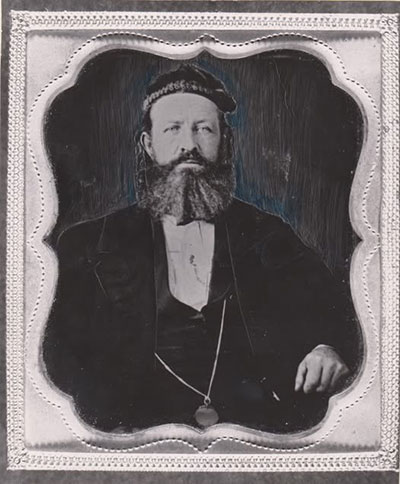
Born in Philadelphia to a well-established Quaker family, much of Cresson’s early adulthood was unremarkable, as he managed his farm and engaged in small-scale trades. He and his first wife, Elizabeth, also a devoted Quaker, had six children. However, his mind inclined toward millenarian speculation and he became increasingly dissatisfied with Quaker formalism, drifting into a form of spiritual wandering that took him through a succession of sects and visionary movements. Despite these shifts, Cresson’s family, ancestors, and entire upbringing were thoroughly Christian, making his eventual embrace of Judaism, and the fervor with which he embraced it, one of the most dramatic religious reversals in early American history.
Cresson’s spiritual restlessness began manifesting publicly in the late 1830s and early 1840s, when he produced a stream of pamphlets in which he lamented the spiritual decay of American society, predicted imminent divine judgment, and criticized the religious complacency of mainstream denominations. A particularly pivotal moment came in 1840, when he read a report about the early stirrings of Jewish agricultural settlement in Eretz Yisrael, an initiative led by Moses Montefiore following his relief efforts in the aftermath of the Damascus Affair. Cresson became convinced that the restoration of the Jewish people to their ancestral land was a necessary precursor to the redemption of humanity and that the material improvement of the Jews’ political and social condition was a divinely mandated task.
This transformation gathered speed when he began corresponding with American missionaries and British consular officials in Jerusalem, who described the small but reviving Jewish communities of the Old Yishuv. Although these descriptions were intended to elicit Christian missionary support, they had the opposite effect on Cresson: they ignited his admiration for Jewish perseverance; fashioned a deep sense that the Jews, not the Gentile nations, were the authentic bearers of G-d’s covenant; and led to his studying Hebrew and Judaic texts.
On May 17, 1844, President John Tyler appointed Cresson as the first U.S. Consul to Jerusalem, but Secretary of State John C. Calhoun formally rescinded the appointment on June 22, 1844 when the State Department, after receiving complaints about Cresson’s fitness, “reconsidered” the need to establish a consulate and informed Cresson that the Government would not proceed. The immediate grounds given were concerns about Cresson’s mental state based upon the receipt of sharply pejorative complaints centering on his unconventional religious behavior and what critics construed as religious obsession or fanaticism. Samuel D. Ingham, the former U.S. Secretary of the Treasury, wrote to Calhoun shortly after Cresson’s appointment, saying that Cresson had been “laboring under an aberration of mind for many years; his mania is of the religious species;” and that his appointment had become “a theme of ridicule by all who know him.” This Ingram letter is cited by historians as the reason for Calhoun’s reconsideration of the historic appointment.
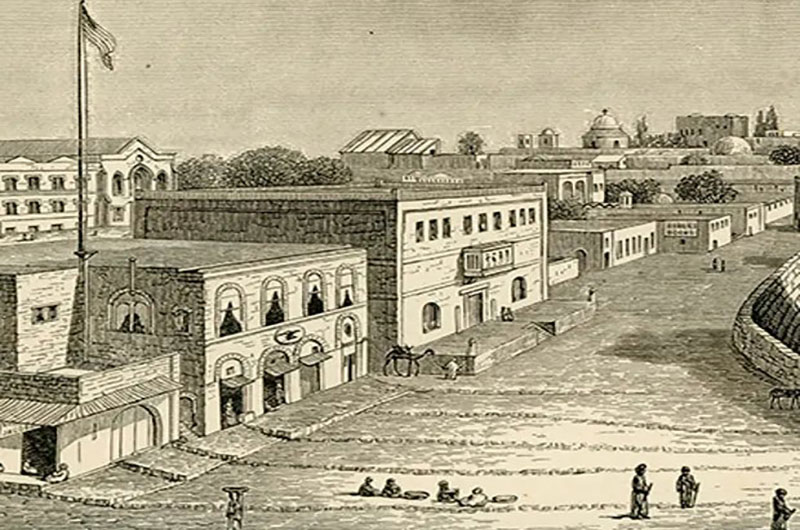
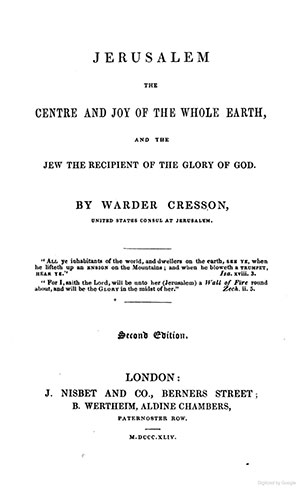
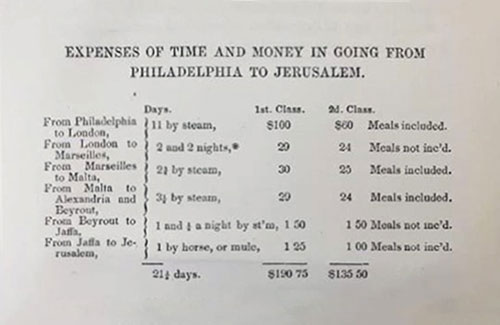
However, Cresson had already sailed, proceeding to Jerusalem in 1844, where he proceeded to Jaffa/Jerusalem, publicly displayed an American flag, created a consular seal, acted as if he were the U.S. consul. He exercised consul-like functions; and unabashedly declared war on the Christian missions, whom he believed were exploiting the poor Jews of Jerusalem, and proudly announced to the Jews of Jerusalem that he would ensure that they were under the protection of the American government. He wrote and published Jerusalem, the Centre and Joy of the Whole Earth, in which he waxed enthusiastic in euphoric terms about the ancient but neglected city of Jerusalem that most other visitors at the time viewed as dirty and dilapidated. Contemporary observers and later historians record that he continued to claim the office of consul and that the Ottoman authorities and local powers largely ignored him until the U.S. Minister in Constantinople ultimately confirmed that Cresson had no valid credentials.
Nonetheless, Cresson’s arrival in Jerusalem marked the beginning of the most consequential phase of his life. For the first time, he encountered living Jewish communities, Sephardi, Ashkenazi, Maghrebi, and others, whose daily struggles, piety, and social structures profoundly affected him. He visited the ancient synagogues, walked through the Jewish Quarter, observed communal institutions, and witnessed the grinding poverty of the Old Yishuv, observations that further convinced him that G-d’s hand was on the Jewish people and that their return to sovereignty was the true spiritual drama of the age.
Cresson’s internal transformation culminated in his circumcision (at age 50!) and formal conversion to Judaism in 1848. According to his later accounts and the testimony of Jerusalem rabbis, he underwent full halachic conversion under the supervision of the Sephardi rabbinical court, taking the Hebrew name Michael Boaz Israel ben Avraham. He began living fully as an observant Jew, adhering to halachic requirements that were entirely new to him and enormously demanding for an adult convert. From this point onward, his life can only be understood through the lens of Jewish observance and identity.
Cresson’s conversion became the subject of a major halachic dispute amongst the rabbis of Jerusalem. Rav Asher Lemel Levy (1798-1850) ruled in the spring of 1848 that a non-Jew who had arrived from Morocco for the purpose of conversion and who had undergone a bris milah and fully accepted the Jewish faith was still a gentile because he had not yet immersed in the mikvah and that, as such, he must perform one halachically prohibited act of work on Shabbat. When this ruling raised a significant uproar from other Jerusalem rabbis, Rav Levy addressed a halachic query to Rav Yaakov Ettlinger, the famed “Aruch Laner,” the most senior halachic authority in Germany and one of the most distinguished Talmud scholars of his day, who concurred with the other rabbis. R. Ettinger ruled that once the circumcision is performed, the convert is no longer considered a non-Jew, but it is immersion in the mikvah that actually confers the status of Jew upon him. As such, there is no problem with the convert observing Shabbat, and he is possibly even obligated to do so.
Several religious authorities have asserted that since the date of the conversion referred to by R. Levy precisely coincides with the exact date stated by Cresson in his memoir as the date of his circumcision, it was Cresson who was the convert at issue. They maintained that when spelled out in rabbinic Hebrew, the spellings of “Morocco” and “America” are nearly identical, which would explain why someone allegedly from Morocco – a Muslim country where there were no Christians, where all males are circumcised and which, in any case, boasted its own rabbinical courts – would have to travel to Jerusalem for his conversion.
Herman Melville met Cresson in Jerusalem, and many authorities claim that Cresson was Melville’s inspiration for the character of Nathan in Melville’s long narrative poem, Clarel: A Poem and Pilgrimage in the Holy Land (1876). Nathan is a Jewish figure associated with Jerusalem who embodies learned detachment, historical memory, and a quiet, ironic distance from Christian theological struggles representing the enduring continuity of Jewish life and intellectual tradition in Eretz Yisrael.
After returning briefly to America and then reestablishing himself in Jerusalem, Cresson married a Jewish woman, Rachel Moledano, a Sephardi widow from a respected Jerusalem family, and their marriage was performed according to halachic requirements, under rabbinic supervision, and with full communal recognition. This marriage separated him definitively from his children from his first marriage, all of whom remained Christian and were raised entirely outside Judaism.
Once he became Michael Boaz Israel, Cresson’s energies turned with intensity toward the welfare of the Jewish people – spiritually, materially, and politically – and he embraced a life of public Jewish responsibility. He viewed the Jewish people, and particularly the impoverished Jews of Eretz Yisrael, as the rightful heirs of biblical promise whose revival was essential to the redemption of the world, a conviction that led him to assume a role, part prophet, part advocate, part visionary, that placed him at the intersection of early Jewish agricultural experimentation, proto-Zionist financial planning, American philanthropy, and traditional Jerusalem life.
One of his most ambitious undertakings was his involvement with Jewish agricultural settlement. Influenced by Moses Montefiore’s early efforts to encourage Jewish self-sufficiency through farming, Cresson became convinced that the long-term future of the Jews in Eretz Yisrael required not only spiritual renewal, but also economic independence. To this end, he purchased a small tract of land in Emek Refa’im (in what is now Jerusalem’s German Colony) and attempted to establish a working farm, approaching the project with remarkable zeal, but little practical agricultural experience suitable for the climate and terrain of Ottoman Eretz Yisrael. Although owing to a combination of environmental challenges, Ottoman administrative burdens, insufficient equipment, and Cresson’s limited means, the farm never became truly productive, its significance far exceeded its economic results. For many Jewish residents of the Old Yishuv, Cresson’s farm was the first example they ever saw of a Jew attempting to cultivate land for the sake of Jewish restoration, placing him among the earliest figures to envision agricultural settlement as foundational to Jewish renewal in the land.
Cresson’s philanthropic work proved more successful. During his periods in America after his conversion, he became a tireless fundraiser on behalf of Jerusalem’s Jews, speaking to synagogues, Jewish benevolent societies, and occasionally Christian groups that were sympathetic to Jewish welfare. He wrote letters to newspapers, appealed to wealthy individuals, and composed pamphlets urging Americans, both Jews and Gentiles, to support the indigent communities of Eretz Yisrael. His appeals blended scriptural language with reports from the ground such that even critics acknowledged that he brought unusual visibility to the plight of Jerusalem Jewry at a time when American Jewish philanthropy for Eretz Yisrael was still in its infancy.
It was during one of his return trips to America in 1849-1851 that Cresson’s life took its most dramatic and legally consequential turn: the infamous “lunacy trial” which unfolded in Philadelphia. The trial stands as one of the most extraordinary and symbolically charged legal proceedings of nineteenth-century America, both for its intimate family drama and for the larger constitutional questions it implicitly raised about religious freedom, mental competence, and religious prejudice. The case arose in the aftermath of Cresson’s conversion to Judaism in Jerusalem in 1848, a decision that shocked his prominent Quaker family and placed him at odds with nearly every social expectation of his class, background, and nation such that by the time he returned to the United States to resolve property matters and prepare for permanent resettlement in Eretz Yisrael, his estrangement from his wife and children had hardened into open legal conflict.
The formal mechanism chosen by his family was a petition for an “inquisition of lunacy,” a civil proceeding under Pennsylvania law designed to determine whether an individual was legally insane and therefore incapable of managing his affairs. The petition was filed by Cresson’s wife, Elizabeth Townsend Cresson, together with their adult son, Jacob, and was framed as a protective measure; nevertheless, the substance of the family’s claim rested overwhelmingly on Cresson’s religious conduct and beliefs, as they argued that his repeated religious transformations over the years, culminating in his conversion to Judaism, demonstrated an unstable mind, and that no sane man would abandon Christianity, family life in America, and material security to embrace what they described as a marginalized and socially degraded faith.
In the spring of 1849, the case was first heard by a sheriff’s jury, a preliminary fact-finding body commonly used in lunacy proceedings, and this jury found him insane, a verdict that did not result in his confinement but effectively stripped him of control over his property. Cresson immediately challenged the decision and demanded a full trial before a court and a regular jury, asserting that the earlier verdict was the product of prejudice rather than evidence.
The retrial, which took place in May 1851 in the Philadelphia Court of Common Pleas, rapidly became a public sensation. Newspapers followed the proceedings closely, often with barely concealed fascination at the spectacle of a well-educated American gentleman defending the rationality of his decision to become a Jew. The trial lasted nearly a week and featured an unusually large number of witnesses, approaching one hundred in total, a remarkable figure for a civil case of the period. The courtroom was crowded and the proceedings were widely understood as a referendum on whether radical religious dissent could itself be construed as insanity.
Cresson was represented by Horatio Hubbell Jr., a respected Philadelphia attorney and militia officer known for his careful legal reasoning and his sympathy toward civil liberties. Hubbell, whose strategy was methodical and constitutional in spirit and conceded nothing about the popularity or conventionality of his client’s beliefs, argued that the law recognized no authority to judge the truth or falsity of religious convictions. Throughout the trial, Hubbell returned to a central principle: that religious belief, even when unusual or socially disfavored, could not in itself constitute evidence of mental disease, and he warned that to argue otherwise would place every religious minority at the mercy of majority opinion.
The family was represented by David Paul Brown, a prominent Philadelphia lawyer who framed the case in terms of mental instability rather than theology, though the distinction was often thin. Brown emphasized Cresson’s long history of religious enthusiasm, his prior affiliations with Shakers and millenarian movements, and statements attributed to him that suggested prophetic or messianic thinking. The thrust of the family’s case was that these patterns, taken together, revealed a disordered mind incapable of sound judgment. Witnesses for the family included relatives, acquaintances, and others who described Cresson as obsessive, impractical, and detached from ordinary responsibilities; some testified that he had spoken of divine missions or impending transformations in history, statements that were portrayed as delusional rather than metaphorical. Yet, even sympathetic observers noted that much of this testimony blurred the line between eccentric religiosity and genuine mental illness.
The defense countered with a wide array of testimony designed to establish Cresson’s coherence, rationality, and consistency of purpose. Physicians testified that he showed no clinical signs of insanity and was capable of reasoned conversation and self-control, and business acquaintances described him as competent in financial matters. Particularly striking was the testimony introduced from Jewish rabbinical figures familiar with Cresson’s life in Jerusalem, who testified that his conversion had been deliberate, informed, and accompanied by disciplined observance rather than fanatic excess. He was portrayed not as a dreamer detached from reality, but as a man who studied Hebrew texts, followed Jewish law, and lived quietly within the Jewish community.
One unusual episode, often remarked upon in later accounts, involved an attempt to use quasi-scientific methods to demonstrate insanity, including the examination of hair samples under contemporary theories linking physical characteristics to mental disease. This testimony ultimately backfired, as it failed to show any abnormality and underscored the speculative nature of the family’s case.
Cresson himself testified at length and made a powerful impression. Calm, articulate, and composed, he explained his religious journey as the result of conscience, study, and moral reflection. He passionately rejected the notion that religious transformation implied mental collapse and he proved that history itself was filled with individuals who had changed faiths at great personal cost. His testimony stood in sharp contrast to the image of derangement advanced by his family.
Underlying the trial was a profound current of antisemitism. Newspaper commentary of the era, reflecting mainstream societal bias, frequently described Judaism in derogatory terms, emphasizing the “degradation” of Jews in the Ottoman Empire or the supposed irrationality of embracing Jewish customs. One widely circulated editorial insinuated that Cresson’s conversion was “proof of Jewish influence over susceptible minds,” while another claimed that the “Jewish race” was inherently unsuited to attract converts except the mentally unstable.
The trial was presided over by Judge King, whose role proved decisive. In his instructions to the jury, he drew a firm legal boundary between belief and insanity and he made clear that the jury was not asked to judge the wisdom, truth, or respectability of Cresson’s religious opinions, but only his mental capacity. King’s instruction that religious belief, even when extreme or unpopular, could not be treated as evidence of lunacy unless accompanied by demonstrable inability to reason or manage one’s affairs effectively stripped the prosecution of its most potent rhetorical weapon. The jury, composed entirely of Christian men, deliberated and returned a verdict declaring Cresson sane, a decision that restored his legal autonomy. Contemporary newspapers recognized the broader implications immediately, with several editorials noting that the verdict affirmed the fundamental American principle that freedom of conscience could not be nullified by social hostility or theological contempt.
Although the case never reached a higher court, it assumed an enduring symbolic importance. Legal historians have noted that it articulated, in a practical courtroom setting, a doctrine that would later become central to American constitutional law: that civil capacity cannot be conditioned on religious conformity. In an era before the First Amendment was formally applied to the states, the Cresson verdict reflected an emerging consensus that courts had no authority to police belief, and the verdict constituted a powerful and important public affirmation of the legitimacy of conversion to Judaism at a time when antisemitic prejudice was widespread.
After the trial, Cresson returned permanently to Jerusalem, where he resumed life with his wife in the Jewish Quarter. His observance of Jewish law remained strict, and his letters describe his attachment to praying at the Western Wall and studying Torah with Sephardi scholars. Though not formally trained in traditional scholarship, he became a respected lay figure in local circles, valued for his devotion and his unusual ability to mobilize American concern for Jerusalem’s Jews. He developed a close relationship with several rabbinic leaders, particularly within the Sephardi community and, although he never held formal communal office, he became an intermediary figure between the Old Yishuv and Western visitors, sometimes smoothing misunderstandings, sometimes eagerly explaining Jewish practices, and often interpreting the needs of the community to philanthropists abroad.
By the time Cresson reached the final phase of his life in Jerusalem, his thought had matured into a coherent doctrine of Zionism and Jewish restoration. He did not use the political language that would later characterize Herzl, Pinsker, or the later Zionist Congresses, nor did he articulate a program of diplomatic activism, but he formulated and defended the essential premises of proto-Zionist ideology: that the Jewish people must return to the land of their ancestors; that they must rebuild agricultural life; that economic self-sufficiency, not dependency on chalukkah funds, was the key to communal revival; and that redemption would occur through natural historical development guided by divine providence. For a man born into a Quaker family in Philadelphia, these ideas reflected not merely intellectual speculation but a radical transformation of identity grounded in halachic conversion and lived observance.
He wrote repeatedly that Jewish dependency on chalukkah (charitable funds from abroad) was demoralizing and unsustainable and, while he admired the piety of the Old Yishuv, he believed that its survival required new economic structures. This view anticipated the arguments of later Zionists who, decades after his death, insisted that Jewish life in Eretz Yisrael must be rebuilt through labor, land, and agricultural enterprise. He also framed agricultural renewal as a spiritual act; tilling the soil was for him an expression of divine promise, a way of participating in G-d's unfolding plan for the restoration of Israel. His emphasis on land and labor as redemptive instruments placed him in a precursor role to movements he would not live to see; later Zionist agriculturalists, such as the early Bilu pioneers, would develop this idea far more systematically, but Cresson was among the first to embody it personally.
While some Jewish observers found his prophetic tone overly exuberant, they generally respected his sincerity and affection. American Jewish newspapers occasionally mentioned him, usually in favorable terms, viewing him as a rare example of someone who had embraced Judaism out of conviction and had settled among Jews in their historic land. The Occident, one of the leading American Jewish periodicals of the time, referred to him as “the devoted and zealous Israelite who from conviction embraced the faith of our fathers and cast his lot with the poor of Jerusalem.” Other notices acknowledged his fundraising and his attempts to bring American attention to the Old Yishuv’s hardships.
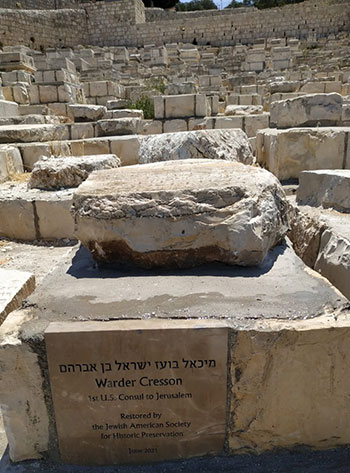

Cresson’s final years were peaceful but marked by declining health, but he nonetheless continued to attend synagogue, visit the Western Wall, and participate in community life as his strength allowed. He died in Jerusalem in 1860, and his burial took place in accordance with full Jewish law, with the Sephardi rabbinical leadership overseeing the funeral. On the day of his death, all the places of business in Jerusalem were closed out of respect and the entire Jewish community attended his funeral. He was laid to rest on the Mount of Olives, among generations of Jews whose graves looked down on the city he had adopted as his spiritual home, and his tombstone identified him by his Jewish name, Michael Boaz Israel. His death received modest but respectful notice in the Jewish press abroad; American Jewish newspapers mentioned the passing of a man who had “united himself to the house of Israel in faith and destiny” and noted his sincerity and lifelong commitment to Jewish welfare. Without descendants to tend to his gravesite (sadly, his three children with Rachel – Abigail, Ruth and David Ben-Zion – all died young), its location was lost to history for some five generations until his lost gravesite was rediscovered in 2013.
Cresson’s legacy is complex but significant, and his impact on later generations is subtle but durable. His writings contributed to early American awareness of the Jewish communities of Eretz Yisrael, and his advocacy foreshadowed the philanthropic networks that would later develop between American Jewry and the Yishuv. His emphasis on agriculture anticipated the foundational principles of the Zionist movement, and his story, one of the most dramatic examples of religious transformation in American history, continues to inspire scholars exploring the intersections of spirituality, identity, and national revival.
In the final assessment, Warder Cresson – Michael Boaz Israel – stands as a bridge figure between worlds: between America and Jerusalem, Christianity and Judaism, pre-modern tradition and emerging modern nationalism. His life was neither simple nor conventional, yet it embodied enduring values: the courage to pursue truth across boundaries, the willingness to embrace a community different from one’s own, and the belief that the Jewish people have a historic role to play in the moral and spiritual future of humanity. He lived and died with the conviction that Jerusalem was not merely a city but the center of a divine narrative to which he had bound his life. Thus, in that sense, his story belongs not only to the history of American religion or Jewish biography but to the wider saga of Jewish endurance, renewal, and return.