 October 23, 2026
 Categories: Collecting / Features On The Jewish World
The Judaism of Ferdinand Cohn
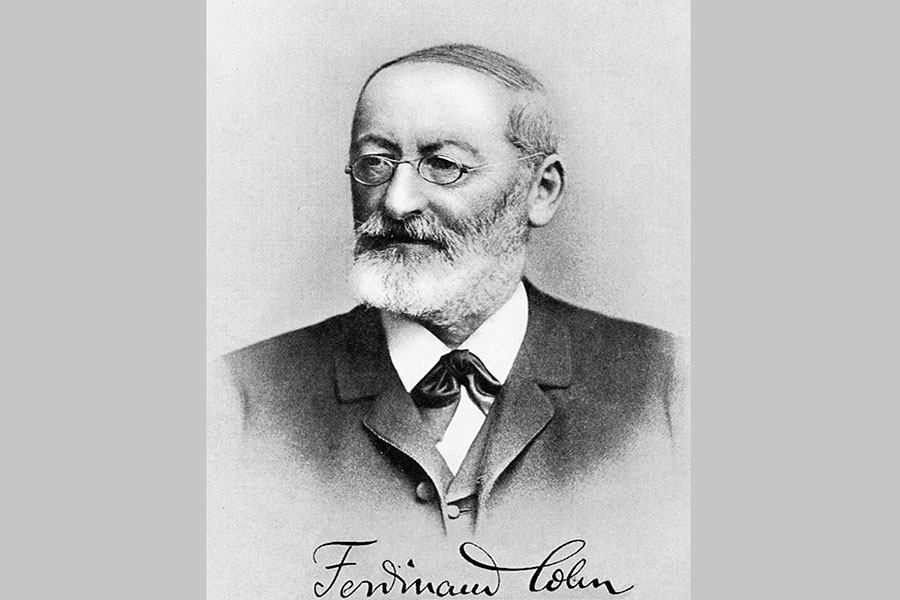


Everybody knows Louis Pasteur, but how many outside scientific circles know Ferdinand Julius Cohn?
Although Cohn (1828-1898) was not as famous as Pasteur and Robert Koch because he worked on the classification of bacteria, and thus did not attract as much public attention as those who worked on the relationships of microorganisms with human disease, his contributions were nonetheless on a par with theirs. Considered the father of modern bacteriology and among its most significant founders, he was a scientist whose work was transformational in the understanding of bacteria spores and the classification of microscopic life.
Cohn’s contributions include the systematic classification of bacteria. He was the first scientist to believe that bacteria should be classified as plants; he proved that the protoplasm in plant and animal cells was almost identical; and he discovered the formation and germination of spores in certain bacteria, through which he helped disprove the fallacy of spontaneous generation. He designed a classification system pursuant to which he was the first to classify algae as plants – and to define what distinguishes them from green plants – and to classify bacteria into four groups based on shape (sphericals, short rods, threads, and spirals), an ordering that is still in use today. He is also remembered for being the first to show that bacillus can change from a vegetative state to an endospore state when subjected to an environment deleterious to the vegetative state. A prolific writer, his journal, Beitrage zur Biologie der Pflanzen (“Contributions to Plant Biology”), contained the first essays on modern bacteriology; he published nearly two hundred research reports, papers, essays, and books during his lifetime; and he was also responsible for the publication of Koch's important work on the life cycle of the anthrax bacillus.
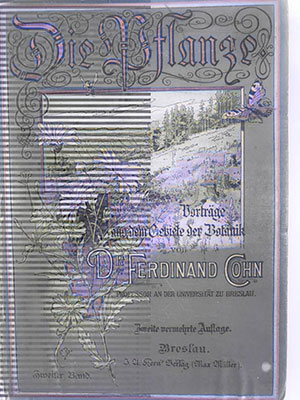
Born in the Prussian province of Silesia and spending nearly his entire adult life in Breslau, he bridged several worlds, including the world of early nineteenth-century Jewish emancipation, the rapidly advancing world of microscopy and biological research, and the transitional world of German Jewry negotiating between traditional observance and assimilation. His reputation as an investigator was established through his pioneering studies of bacteria, algae, and plant physiology, most famously his demonstration of bacterial heat-resistance through endospores, work that predated and supported Koch’s later germ theory and the medical bacteriology revolution.
While Cohn’s scientific contributions are well-documented and widely cited, his Jewish origins, his personal relationship with Judaism, and his connection – sometimes close, sometimes distant – to the Jewish community in Breslau are far less familiar to the public. Because he is often presented in textbooks as a “German” scientist without reference to his Jewish background, the Jewish dimension of his life merits careful, historically grounded examination.
Born in Breslau (now Wrocław, Poland), he was the eldest child of Issachar (Isak) Cohn, a prosperous merchant and industrialist and owner of a textile factory that enjoyed some regional prominence, and Minna Cohn (née Mendel). Both sides of the family were part of the established Jewish commercial class of Silesia, a group that had benefitted from the limited relaxations of Prussian restrictions on Jewish residence and economic activity in the late eighteenth and early nineteenth centuries. Archival records and contemporary biographical accounts confirm that the family was traditionally observant by the standards of educated, upwardly mobile German Jews of the early 1800s and that they belonged to the organized Jewish community of Breslau, which was then one of the most important kehillot in Germany, known for its strong rabbinic traditions and later for the seminal presence of Rav Abraham Geiger, Rav Manuel Joel, and others associated with the Wissenschaft des Judentums movement. This “Science of Judaism" or "the academic study of Judaism" movement was a 19th-century German scholarly group that applied modern academic methods, such as history and philology, to critically study Jewish texts, culture, and history.
Cohn spent his childhood in a home that observed the Sabbath and the Jewish festivals, kept a kosher household, and maintained regular synagogue affiliation. The Breslau synagogue records from the period show the Cohn family among the dues-paying members of the Gemeinde (community) and the family is listed in contemporary communal tax registers, an indication of communal membership and financial engagement. Although his father had attended a yeshiva but later decided to leave the Jewish ghetto, Cohn, a child prodigy who could read at the age of two, began school at four, received a secular education, and entered the Breslau Gymnasium (1835). Like many Jewish boys of his generation, however, he received elementary instruction in Hebrew and Jewish law, but there is no evidence that he ever undertook advanced yeshiva-style study. His upbringing corresponds to what historians call the “acculturated-traditional” pattern of the period: families that maintained recognizable Jewish practice within the home while embracing the German educational and cultural world outside the home.
As a boy, Cohn suffered a hearing impairment after a childhood illness, a condition that remained with him throughout life; yet, notwithstanding this significant obstacle, he demonstrated exceptional academic promise and he entered the Elisabet-Gymnasium in Breslau. However, due to his hearing difficulties, he transferred after several years to the Jewish school in Breslau run by the community, which had a strong secular curriculum and was known for producing university-bound Jewish students. His attendance at this Jewish school does not appear to have been primarily religiously motivated but, rather, it was a reflection of his parents’ desire for an environment better adapted to his physical limitations; the school, which maintained daily Jewish prayers and festival observance, ensured that Jewish practice continued to be part of his formative environment.
In 1842, at the young age of fourteen, Cohn matriculated at the University of Breslau, one of the youngest students ever to do so. As Jews were still not universally admitted to certain German universities, Breslau, where he was already a resident, was a natural choice; however, though he grew up in a period of partial liberalization of earlier restrictions on Jews, he was nevertheless barred as a Jew from the degree examinations at Breslau. After his petition for removal of the restriction was denied by the government, he went to the University of Berlin, where he earned a doctorate in botany at age nineteen (1847), after which he returned to Breslau, where he became associated with the University of Breslau’s scientific institutions, eventually attaining a professorship.
Throughout these early professional decades, his record of communal association reflects the increasingly secular orientation taken by many ambitious Jewish academics in mid-century Prussia. Cohn did not break formally with Judaism, remaining a registered member of the Breslau Jewish community all his life, but the available evidence does not indicate that he maintained strict Sabbath observer or continued a kosher diet in adulthood. Academic obligations, laboratory work, and a deeply assimilated cultural identity all seemed to contribute to a more relaxed personal practice, consistent with many Jewish scientists and intellectuals of his generation; nonetheless, it is clear from surviving correspondence that he retained a positive sense of Jewish identity and pride in his family Jewish origins.
The most explicit discussion of Cohn’s Jewish background may be found in the collection Ferdinand Cohn – Blätter der Erinnerung (“Leaves of Memory,” Breslau 1901) assembled and published by his wife, Pauline. That volume reproduces several of his letters and personal reminiscences and, together with standard reference works, is the basis for statements that he remained conscious of his Jewish background even though he was not a strictly observant Jew. Cohn said that he experienced what he called “the poetry of the old Jewish family life” – the Sabbath, the practice of new interpretations of the Torah, the commemoration of important events of Jewish history during the holidays – during his regular visits to his grandparents. He encountered the rules and obligations, but also the joy inherent in this tradition.
Cohn’s scientific achievements are numerous and foundational. In the 1850s and 1860s, he produced pioneering taxonomic work on algae, including the green alga Protococcus, which he used as a model to study the developmental cycle of simple plants. His botanical expertise naturally led him to microscopic life and, by the 1870s, he had become the leading authority on bacteria. His multi-volume Beiträge zur Biologie der Pflanzen (“Contributions to the Science of Plants”), published beginning in 1870, included the first robust classification of bacteria based on morphological criteria, and his most famous discovery, documented in 1876, concerned the bacterium later known as Bacillus subtilis. Cohn recognized that the organism produced highly resistant spores, which explained why attempts at sterilization by heating sometimes failed; this insight showed conclusively that bacterial “life force” did not spontaneously regenerate after boiling. A major blow to proponents of spontaneous generation and a decisive support to Pasteur and Koch, it placed Cohn at the center of one of the most important scientific debates of the century.
While his scientific biography is well known, Cohn’s Jewish biography is more complex because it is marked by the era’s characteristic mixture of affinity, distance, and cultural participation without overt religiosity. There is no evidence that Cohn ever held office in Breslau’s Jewish communal institutions, and, unlike some of his contemporaries, such as Heinrich Graetz, who also lived and worked in Breslau, Cohn did not publish on Jewish themes nor become involved in synagogue reform debates. Yet surviving communal records and contemporary press accounts show that he contributed financially to several Jewish charitable causes. The Allgemeine Zeitung des Judenthums, one of the major Jewish newspapers of the nineteenth century, mentions him several times in its reports on Breslau communal affairs; these references typically describe him as a prominent member of the local Jewish citizenry and occasionally as a donor at fundraising events for hospitals and poor-relief societies. His name also appears, for example, in lists of contributors to the Jewish Hospital of Breslau and the Israelitische Wohltätigkeitsverein; these were practical and humanitarian causes that appealed to many educated Jews of the period.
In 1861, Cohn wed Clara Breslauer, the daughter of a respected Jewish family of Silesia. Contemporary marriage records confirm that the ceremony was conducted in Breslau under Jewish auspices and officiated by the rabbinical leadership of the Breslau community. Documentation concerning the religious upbringing of their one daughter, Else, is limited, though it is clear that she was raised within the cultural world of the German Jewish bourgeoisie. She did not attend a specifically Jewish school, consistent with the practice of upwardly mobile Jewish families at the end of the nineteenth century, but she did remain officially Jewish and was listed in communal records as such. There is no evidence that the family ever participated in Orthodox synagogues; it is far more likely that they were affiliated with the mainstream Reform-leaning community that characterized German Jewry by the late nineteenth century, though even this affiliation appears to have been largely formal rather than intensely religious.
Cohn’s own Jewish practices in adulthood were those of a man fully integrated into German academic society and who, like many of his colleagues, regarded religion as a private matter. His laboratory work often required activity on the Sabbath, and his correspondence suggests that he did not consider himself bound by halachic observance in any strict sense. His dietary habits are not fully documented, but given the environment of university dining halls and laboratories, it is unlikely that he adhered to traditional kashrut outside the home. Nevertheless, letters written to friends affirm his continued consciousness of his Jewish heritage, and there is no indication that he contemplated baptism or conversion, something not uncommon among German Jewish academics seeking full social acceptance. Cohn, by contrast, remained formally Jewish throughout his life.
Blätter der Erinnerung, referenced above, contains personal reminiscences, selections of correspondence, and contributions by colleagues, including multiple letters and memorial notes demonstrating that Cohn remained connected to his family origin and the Jewish social world of Breslau. According to this work, Cohn chose to study the natural sciences rather than law or medicine partly because die Gesetz und mein Glaube (“the law and my faith”) prevented him from being admitted to certain careers, such as teacher and civil servant. As a Jew, he was formally disadvantaged as, for example, when he tried to become habilitated in 1850 and a year elapsed before he was permitted to take the oath and to teach. (In the 19th century, “habilitation” was a formal post-doctoral qualification that a scholar needed to be permitted to lecture independently at a university and to hold the title Privatdozent.)
Cohn supported Jewish education initiatives in Breslau through modest financial contributions, including donations to the Jewish school that he had once attended. The Breslau community, which by the mid-nineteenth century was one of the largest and most intellectually vibrant in Germany, included numerous scientists, philosophers, and physicians, and Cohn moved comfortably in these circles. He is recorded as having participated in at least two major fundraising galas, one for the construction of the new synagogue in Breslau (inaugurated in 1872) and another for the community’s poor-relief fund. The Jewish press occasionally referred to him as “The excellent Prof. Dr. Ferdinand Cohn of our community,” suggesting ongoing recognition of his status as one of Breslau Jewry’s most accomplished sons.
The formal Zionist movement began only in the 1890s, during the final years of Cohn’s life, so it is hardly surprising that there is no surviving record of his expressing support for or opposition to the movement. German Jews of his class and generation generally viewed themselves as patriotic Germans of Mosaic faith; Cohn’s worldview seems to have reflected this mainstream stance; and his general orientation appears to have been overwhelmingly German-liberal and scientific rather than political. Scholars who have surveyed the correspondence of Jewish scientists in late-nineteenth-century Breslau find no evidence that Cohn took any public position on Zionist ideas, and his name does not appear in early Zionist congress archives or early Mizrachi or Chovevei Zion documents. In the same vein, his travel patterns, which are documented through his scientific trips, focused almost exclusively on German scientific centers, Austria, and occasionally Western European conferences, and no reliable record indicates that he ever visited Eretz Yisrael or cared to. Unlike some Jewish intellectuals at the time who visited Eretz Yisrael out of cultural curiosity or philanthropic interest, if not Jewish interest, Cohn’s professional life was deeply rooted in his laboratory in Breslau and the German academies.
Cohn’s relationship with Jewish institutions extended beyond Breslau to broader German Jewish scientific culture. He occasionally corresponded with Jewish scientific colleagues such as Julius Sachs, although these exchanges focused on botany rather than Jewish affairs. He was aware of Jewish intellectual networks but did not participate in formal Jewish scholarly societies such as the Gesellschaft für die Wissenschaft des Judentums; this, too was consistent with the secular orientation of many Jewish scientists of the time. Yet, his Jewish identity was not invisible; several obituaries in Jewish newspapers emphasized that he was “a son of our people whose brilliance brought honor to German Jewry,” a formulation commonly used when Jewish scientists earned distinction without having left the Jewish fold.
Cohn, who was widely acknowledged by scientific organizations, was elected a member of the Leopoldina in 1864, one of the highest honors for a German scientist, and later became one of the founders of the German Botanical Society. Jewish organizations did not bestow formal honors upon him in the way they sometimes honored philanthropists or communal leaders, but Jewish newspapers regularly highlighted his international scientific recognition as a point of communal pride. His work combating the notion of spontaneous generation was occasionally framed in Jewish publications as evidence of Jewish contribution to the progress of world science.
Cohn spent his final years in Breslau, continuing his scientific writing and maintaining his professorial duties until shortly before his death. He was buried in the row of honor on the Lohestraße in Breslau, a major Jewish burial ground used throughout the nineteenth century; burial records confirm that the rites were Jewish; and the officiant was a rabbi of the Breslau community, likely Rabbi Dr. Manuel Joel, who was serving at the time, though the exact officiant varies among published accounts. His grave became one of the notable sites in the cemetery and, although the cemetery suffered partial destruction in the twentieth century, the memory of his burial there is well attested.
Contemporary obituaries in both the German scientific press and the Jewish press praised him extensively, and Jewish newspapers highlighted his Jewish origins, his lifelong affiliation with the Jewish community, and the pride his achievements brought to German Jewry. The Israelit described him as “one of the most distinguished Jewish scholars of our time,” emphasizing both his scientific stature and his Jewish identity. These sources made it clear that, in the eyes of contemporaries, Cohn remained a Jewishly proud and unbaptized figure whose accomplishments were recognized as contributions not only to science, but also to the public standing of Jews in German society.
Cohn’s scientific legacy remains secure; his classification of bacteria provided the first coherent framework for a field that would, in a matter of decades, revolutionize medicine and public health, and his demonstration of endospore formation was one of the pivotal discoveries that underpinned modern sterilization and laboratory technique. His editorial leadership of Beiträge zur Biologie der Pflanzen helped launch scientific microbiology as a discipline, and Robert Koch publicly acknowledged that he was influenced by Cohn. Today, Cohn, largely unknown to the public, is widely recognized in scientific circles as one of the founders of bacteriology and his work continues to appear in histories of microbiology.
Yet, his Jewish legacy deserves similar recognition. In the broader history of Jews in science, Cohn represents a crucial early chapter: he achieved world-class scientific renown at a time when Jews were only beginning to gain full civil rights in Prussia, and he did so while refusing to convert, even if doing so would have advanced his career and eased his acceptance in the broader scientific community. In assessing the overall trajectory of his Jewish life, one sees the pattern of a man who began within traditional Jewish practice and moved toward a secular scientific identity while never abandoning the Jewish community. He represented the peak achievements of the German Jewish liberal era before the disruptions that would soon befall the Jewish communities of Central Europe. In sum, his life exemplifies the intertwined narratives of scientific progress and Jewish modernity that served as a model for generations to come.
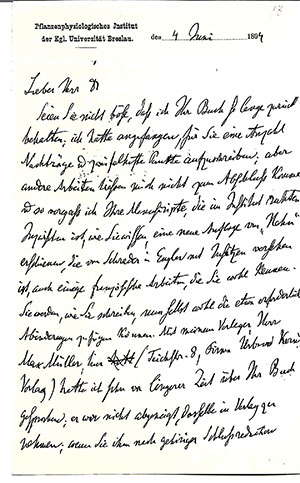
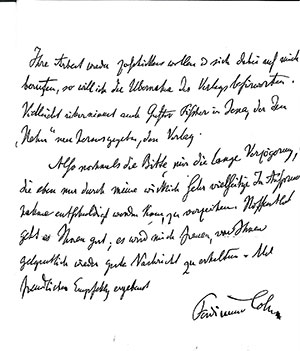
In this June 4, 1894 correspondence on his Pflanzen-physiologisches Institute, Breslau letterhead, Cohn writes to an unnamed doctor:
Don’t be angry that I kept the books for so long; I had started to mark down for you some appendices and doubtful points; but other work did not let me finish, and thus I forgot your manuscripts, which were in the Institute... I had spoken a long time ago to my publisher, Mr. Max Muller, about your book; he was not disinclined to publish it; if you want to send him the work after thorough final corrections and refer to me, I shall recommend acceptance. Perhaps Gustav Fischer in Jena... would publish your book. Therefore, again, excuse the delay; which can only be excused because of the very great and varied demands on me.
This correspondence is a strong and authentic reflection of Cohn in his final decade: he was an aging but still active scientific leader; generous with his time, even when overloaded; committed to elevating scientific scholarship; courteous and conscientious in his correspondence; acting as a mentor, reviewer, and facilitator; embedded in the German scientific publishing world; and still directing the scientific work of his Institute in Breslau. It is a valuable document because it illuminates the human dimension behind one of the founders of modern microbiology, an aspect often missing from purely technical biographies.
The letter Max mentions Müller (1823-1900) and Gustav Fischer (1845-1910). Müller was a German-born scholar of comparative philology, Sanskrit, and comparative religion who eventually settled in England, where he held a prestigious chair in comparative philology at the University of Oxford. He is best known for his work editing and translating ancient Indian and Asian religious texts (e.g., in the series Sacred Books of the East) and for being a founder of Western religious studies/comparative religion, and there is no known connection between this Max Müller and the kind of scientific publishing in which Cohn was involved. As such, the reference to Max Müller in the letter might be a coincidence or misremembering because it is extremely unlikely that Cohn would send a botanical/microbiological manuscript to the Oxford philologist for publication.
Fischer was a German bookseller turned publisher who founded his own publishing house in 1878 in Jena after acquiring a bankrupt predecessor firm and, under his leadership, the Gustav Fischer Verlag became one of the leading houses in medicine, natural sciences, and related scholarly fields. The firm had a broad scope, including medical texts, natural sciences, and social sciences, textbooks. Most appropriate for someone like Cohn trying to publish a scientific monograph or treatise.
In sum, our letter illustrates that senior scientists like Cohn acted as intermediaries between lesser-known researchers and major scientific publishers and that their personal standing mattered; that by the 1890s, scientific publishing in the German-speaking world had become institutionalized and that there were dedicated firms for natural-science monographs, journals, textbooks, not just local university presses; that even in a partly networked world, publication was not automatic and manuscripts could languish while a senior scientist “found time” to evaluate them; and that the network was social as well as scholarly, involving trust and personal recommendation with scholarly patronage remaining key. It represents one of the rare privately preserved traces of the informal patronage network that supported Jewish scientists in Germany at a time when institutional acceptance was not always guaranteed.