October 2, 2026
 Categories: Headline / Parsha / Torah
The Longest (Grimmest) Aliya & the Fruits of Redemption


Parshat Ki Tavo
This Shabbat (August 29, the 16th of Elul), we read Parshat Ki Tavo. Ki Tavo is always read on the penultimate Shabbat of the year. Nitzavim – alone, or combined with Vayeilech, as it is this year – is the Shabbat that brings us into Rosh Hashana. Ki Tavo is too tough a sedra to immediately precede Rosh Hashana. This is because of the Tochacha it contains. (More on the Tochacha later.)
Rosh Hashana this year is Shabbat and Sunday. Ashkenazim will begin saying Slichot on Motza’ei Shabbat or Sunday morning after next Shabbat, Nitzavim-Vayeilech. I mention this now because there are years when Rosh Hashana begins on a Monday or Tuesday, in which case Slichot begin a week earlier, following Ki Tavo, but not this year. More on Slichot next week IY”H. Just know that S’faradim (a.k.a. Eidot Mizrach) have been saying Slichot since the beginning of Elul. (This year, they began on the third of the month because they don’t say Slichot on Rosh Chodesh or on Shabbat.)
Now let’s look at Ki Tavo’s SedraStats:
● 50th of the 54 sedras of the Torah; seventh of the 11 in D’varim
● Written on 233 lines of a Sefer Torah (ranking 13th)
● 21 parshiyot (that’s a relatively high count) – 5 open (p’tuchot) and 16 closed (stumot)
● 122 p’sukim (ranking 17th; second in D’varim). Same as Vayak-hel and Va’etchanan. But Ki Tavo is larger than Vayak-hel and smaller than Va’etchanan.
● 1,747 words (ranking 16th – 2nd in D’varim), same as Eikev. (Eikev is a bit larger.)
● 6,811 letters (ranking 15th – 4th in D’varim).
● Ki Tavo’s p’sukim are longer than average for the Torah, but shorter than average for the Book of D’varim.
And here is a new stat inspired by the very short haftara we read this past Shabbat:
● The haftara of Ki Tavo has 22 p’sukim. The ratio of p’sukim in the sedra to p’sukim in the haftara is 5.5.
● There are six of the 613 mitzvot in Ki Tavo – three positive commandments and three prohibitions. To put the mitzva count into perspective, Pinchas also has six mitzvot; 22 sedras have more mitzvot than Ki Tavo and 30 sedras have fewer. Note also that the six mitzvot in Ki Tavo are in the first 19 p’sukim of the sedra. In fact, in the Vilna Gaon’s breakdown of Sefer D’varim, he includes the beginning of Ki Tavo with R’ei, Sho-f’tim, and Ki Teitzei, and counts 176 mitzvot in what he designates the middle section of D’varim.
That number is significant. The longest sedra – Naso – has 176 p’sukim. The longest perek in Tanach – T’hilim 119 – has 176 p’sukim. The longest volume of Gemara – Bavar Batra – has 176 blatt (double-sided pages). So our 176 fits with the other first-place holders for the largest concentration of mitzvot in the Torah.
* * * * *
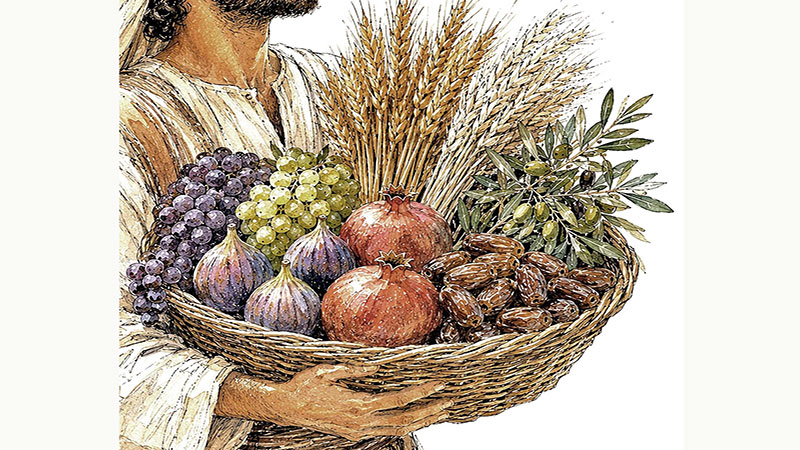
The sedra begins with the mitzva of bikurim – the first fruits. Anyone who grows any of the Seven Species (wheat, barley, grapes, figs, pomegranates, olives, and/or dates) is required to bring fruits from the first yield of his fields or vineyard to Yerushalayim, to the Beit HaMikdash, and give them to the kohen on duty. There is a ceremony for bikurim which includes a recitation of five p’sukim, as specified in Parshat Ki Tavo. The first four of those p’sukim are very familiar to us because they are borrowed by the Pesach Hagada as the core of the Magid portion of the Seder. The verses summarize the story of the formation of the Jewish Nation, beginning with Yaakov and his family going down to Egypt, being enslaved there, crying out to G-d, and being taking out by Him.
The bikurim-bringer also recites a fifth pasuk: “And He brought us to this place and He gave us this Land...” It is interesting to note that the Mishna in P’sachim that describes the flow of the Seder says that at a specific point, the child asks questions and the parent explains and answers according to the child’s level of understanding. The parent presents the p’sukim and analyzes them from the start until he finishes the whole portion. But the fact is, we only read and explain four of the five p’sukim. We don’t do as the Mishna says.
My answer to this question is based upon the exact wording in the Mishna. It says that the Seder leader explains “Ad sheyigmur” – until he shall finish it. That time is still in the future. The first four verses cover what has happened as of today, while the Complete Redemption is still to come. Pesach is the beginning. Shavuot – Yom HaBikurim – has not yet fully been realized.
* * * * *
Another set of numbers for Ki Tavo is remarkable – the number of p’sukim in each of the sedra’s aliyot. The 122 p’sukim in the sedra divide as follows among the seven aliyot: 11, 4, 4, 10, 22, 63, 8. Shishi is the longest aliya of all the aliyot in the whole Torah. It is more than half the number of p’sukim in the whole sedra. It is longer than five different sedras.
The reason for this is so it can contain the Tochacha, the strong words of reproach, within a single aliya, with something good included at the beginning and end of the aliya.
G-d has repeatedly told us in the Torah what He wants of us. What He requires of us. And that should be enough for us to comply. But obviously, it isn’t enough. He tells us of the many good things that will happen to us if we follow His Torah and mitzvot. And that should be enough. But we have proven over and over again that it isn’t enough. So He tells us in a number of places in the Torah what bad things will happen if we don’t follow Him. One of those places is in the second passage of the Sh’ma – something we say at least twice every single day. And you might think that would certainly be enough to have us stay in line.
But… in Parshat B’chukotai and again in this week’s Ki Tavo, we are hit over the head with a sledgehammer. That is the Tochacha. It is so painful to hear that the custom developed to read it in a low voice and quickly.
Our challenge is to follow HaShem and do His bidding out of love – Ahavat HaShem. Then the promises and warnings will be unnecessary, and the Tochacha, while remaining in the Torah, will not feel as painful as it does, and we will wonder why G-d had to use a sledgehammer in the first place.
* * * * *
This column is shorter than usual because my wife and I are in Netanya for a wedding and mini-vacation. But my wishes to you all for a Shabbat Shalom and a meaningful and successful Elul are as long as they can be.