September 11, 2026
 Categories: Collecting / Features On The Jewish World
The Nazi Denaturalization of Albert Einstein


In the early 1930s, the calm continuity of Albert Einstein’s life in Germany, where he had long taught, published, and engaged in academic pursuits, was shattered by the mounting thunder of antisemitism and the rise to power of the Nazi regime under the National Socialist German Workers' Party. By then internationally renowned, he soon became a target, and the events between the beginnings of Nazi rumblings and his forced denaturalization provide one of the clearest, most tragic illustrations of how one of modern physics’ greatest figures was uprooted by racial‑political terror.
From January 30, 1933, the very day that the Nazis seized power, Einstein’s German surroundings began to shift drastically. Though he was abroad at the time on a lecture tour in the United States, the regime’s antisemitic and authoritarian policies quickly reached into his Berlin home and, according to contemporary reports, the Gestapo “repeatedly raided” Einstein’s apartment in Berlin in February and March 1933, notwithstanding his physical absence. These raids, much more than mere harassment, bore explicit political and racial hostility, and Einstein, although a global celebrity, could not be shielded from the new reality: Jews, even of his stature, were treated with hatred and contempt.
Those raids were not isolated phenomena, but the opening salvos of a sweeping campaign. In early April 1933, the regime enacted the Law for the Restoration of the Professional Civil Service, effectively purging Jews and political opponents from civil service, public office, academia, and teaching positions. For Jewish academics, this meant that even if one survived personally, one’s livelihood, institutional affiliation, and intellectual community were being systematically dismantled and, for Einstein, perhaps the most famous Jewish professor, this signaled the loss not only of safety, but of standing, legitimacy, and belonging in a Germany that no longer valued his contributions or his humanity.
Well before Hitler’s rise to power, Einstein had not been oblivious to antisemitism and, as early as the early 1920s, he had already grown fearful of rising German nationalism. Following the assassination of his friend, the German foreign minister Walther Rathenau, on June 24, 1922 (just over two months after Rathenau signed the Treaty of Rapallo with Soviet Russia, a controversial pact that reestablished diplomatic and economic ties between the two states in the wake of WWI), he fled Berlin and went into hiding in northern Germany. In an August 1922 letter to his sister Maja, he wrote that “nobody knows where I am,” lamenting the political climate and anticipating “economically and politically dark times;” he explained that he was “earning [his] money mainly independent of the state” and described himself as “really a free man.” That letter reveals that, as early as 1922, he understood the dangers not only to him personally, but also to Jewish life in Germany generally and how these dangers already weighed on him emotionally and psychologically long before 1933.
By 1929, Einstein and his wife had increasingly spent time outside Berlin in their country home in Caputh, a sign, perhaps, of their desire for refuge from the rising political tension in the capital. Still, until 1933, he remained committed to Germany, to its scientific institutions, its colleagues, and its intellectual life. In the early 1930s, however, as the authoritarian and antisemitic tide in Germany rose, Einstein found himself increasingly imperiled not only in rights and reputation but in personal safety. The transition from political and institutional persecution to explicit threats against his life was swift, brutal, and deeply destabilizing.
But the calculus changed rapidly with the Nazi takeover. On March 28, 1933, while sailing on the S.S. Belgenland returning to Germany from the United States, Einstein learned that their Berlin home had been raided and that the political situation in Germany had deteriorated sharply. He wrote a now‑famous letter to his sister Maja, noting that upon docking in Antwerp he intended to surrender his German passport at the German consulate. In that letter, co‑written with his wife, Elsa, they expressed the utter despair of his family over the fate of their friends; Elsa wrote, “Oh my G-d, all of our friends either have fled or they are in jail,” and he concluded with a grim, desperate resolve: “We will now look for a hiding place for the summer.” That same day, upon their arrival in Antwerp, Einstein presented his German passport at the German consulate and formally renounced his German citizenship. His decision was not only personal, but also deeply symbolic: a renunciation of not only a passport, but of a homeland.
This traumatic severing of ties had profound personal and scientific consequences. Personally, Einstein lost his home, his property, and the sense of belonging to a community where he had lived and worked for decades; the regime confiscated his cottage in Caputh, seized his personal sailboat, and later converted his summer home into a camp for Hitler Youth, and his assets became vulnerable, not only as collateral for exile, but also as spoils for the regime. His renunciation rendered him stateless, or at least foreign, in the eyes of German law, a condition that affected not only him, but also many other Jews and political exiles. The sense of betrayal, the uprooting, the erasure of identity: these were no abstract consequences, but deeply experienced realities.
In 1933, shortly after the seizure of power by the Nazis, a pamphlet sanctioned by the Nazi propaganda apparatus titled Juden sehen Dich an (“Jews Are Watching You”) singled out prominent Jewish intellectuals, including Einstein, for public vilification. In Einstein’s case, the pamphlet included his photograph and beneath it the chilling legend BIS JETZT UNGEHÄNGT (“Not yet hanged”). This was no idle metaphor; within months, the regime murdered one of those named: the German‑Jewish philosopher Theodor Lessing, who was gunned down on August 30, 1933 while in exile in Czechoslovakia, in what is widely regarded as one of the first Nazi political assassinations beyond Germany’s borders. Lessing’s murder, in effect, a realization of the threat embodied by “not yet hanged,” turned general menace into concrete terror.
In the wake of Lessing’s killing, newspapers across Europe announced that a bounty had been placed on Einstein’s head, with some accounts reporting the sum as £1,000, a substantial figure for 1933, and another reporting that the price was as high as $5,000. Whatever the precise amount, the symbolic message was unmistakable: the regime had declared Einstein a “marked man,” a traitor to be hunted and murdered.
The danger became even more concrete when he planned to give a public lecture at Royal Albert Hall in London in October 1933 and British authorities had to intervene. According to contemporary reporting, Scotland Yard received an anonymous threat that “There is a plot to assassinate Einstein” at the meeting, a message that purportedly came from self‑described “members of the League of Gentiles against the Jewish war mongers.” Although British officials reportedly viewed the note with skepticism, they nonetheless deployed significant security, including special‑branch police and secret‑police officers who, reinforced by local police, surrounded the Hall, guarded all roads, and maintained high vigilance in the hours before the meeting. This extraordinary security precaution at a simple scholarly lecture underscores how dangerously politicized Einstein’s mere presence had become.
Aware that the threats had transcended the abstract and gone all the way to lethal, Einstein and Elsa took decisive action. After the Lessing murder and bounty reports, they fled, first to Belgium, then to England and, in September 1933, he spent three weeks hidden in a modest guarded wooden hut on heathland in Norfolk, provided by his friend and British MP Oliver Locker-Lampson. Photographs from that time show Einstein seated with guards, rifles in hand, a stark image of a scholar/pacifist reduced to fugitive status.
At various points, reports and anecdotal accounts recount Einstein responding to the bounty with a blend of irony and stoicism: when told the price on his head was significant, he is said to have touched his hair and wryly remarked that he had “no idea his head was worth so much.” In correspondence as well, he showed awareness of the danger, once writing that though he had no illusions about the risk, he expected to endure it “with serenity.”
This period of existential peril did not simply terrorize him, it also reshaped his worldview. A historian reflecting on that summer in hiding notes that the Norfolk hut was “a seismic moment” in Einstein’s life: until then, he had remained a pacifist and defender of disarmament but, afterwards, he concluded that when confronted with such brutal menace, the use of arms could be justified in self-defense.
The threats to Einstein’s life thus represented more than personal danger: they were a signal that for the Nazi regime, no Jewish identity, no prestige and no scientific glory provided immunity. In targeting Einstein, they demonstrated that “Jewish physics,” Jewish intellect, Jewish existence, were all to be regarded as mortal affronts to the state. The assassination of Lessing, the bounty, the published pamphlet, and the protective chain around Einstein in England all merged into a deliberate campaign of intimidation meant to silence and expel Jewish intellectuals. In this context, Einstein’s decision to flee Germany and ultimately never return was not simply a matter of career or citizenship but, rather, it was a flight for life.
The psychological burden must have been heavy indeed. For a man long identified with cosmopolitan ideals, academic freedom, and bridge-building across nations, to be forced into hiding, to rely on armed guards, to know strangers were openly invited to kill him, were surely shattering. Yet Einstein did not retreat into silence or despair; instead, he used his exile as a platform to warn the world and, in the years that followed, he became a vocal critic of the Nazi regime, a supporter of refugee rescue efforts and, despite his earlier pacifism, a figure willing to confront evil by any means necessary. He pointedly never again set foot on the Land of the Final Solution.
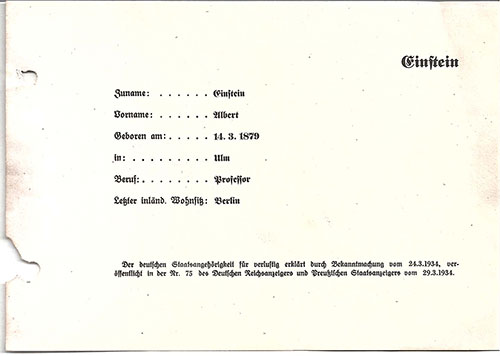
Exhibited here is a remarkable historical rarity: the original official printed document denaturalizing Einstein. It lists his surname, his first name (“Albert”), date of birth (“14.3.1879”), birthplace (“Ulm”), occupation (“Professor”), last place of residence (“Berlin”), and denaturalization notice (translated):
Declared to have lost his German citizenship by notice dated March 24, 1934, published in No. 75 of the German Reichsanzeiger and Prussian State Gazette of March 29, 1934.
This document is of extraordinary historical importance as one of the scarcer physical traces of how the Nazi regime officially stripped not only rank‑and‑file Jews of their citizenship, but also one of the most famous scientists in history. The document’s rarity stems from several factors. First, though many individuals lost citizenship under the 1933 “denaturalization law,” not every case generated a surviving printed certificate. The fact that one was issued for Einstein, with full biographical detail and formal language, suggests that the regime understood its propaganda value; by expelling a globally known Jewish scientist, the Nazis publicly demonstrated their racial policy and also sought to erase a figure who could challenge their narrative of German scientific superiority. That such a document survived, and entered the author’s collection, is remarkable, given that many such documents were destroyed, lost, or suppressed after the war.
The context of its issuance is equally significant. Its formal legal basis, the Law on the Revocation of Naturalization and the Deprivation of German Citizenship enacted on July 14, 1933, empowered Nazi authorities to revoke German nationality (Staatsangehörigkeit) of individuals who had been naturalized, but also more broadly to strip persons whose continued residence abroad or whose conduct was deemed disloyal to the Reich. Although Einstein was not, strictly speaking, a “naturalized Jew from the East” (he was born in Ulm, in the old German Empire), the regime used the law’s flexibility to target even longtime citizens or prominent figures, particularly if they were abroad and outspoken, precisely Einstein’s situation. As a result, on March 24, 1934 the bureaucratic machinery of expatriation formally branded Einstein “stateless,” a process completed with publication in the official gazette: issue no. 75 of the Deutscher Reichsanzeiger (and the accompanying Preußischer Staatsanzeiger) on March 29, 1934.
The “Preußischer Staatsanzeiger” appended the Reichsanzeiger’s notices, especially for individuals who had last residence or state ties in Prussia, which reflected Germany’s old federal structure under the Weimar Republic and even under the Nazi centralization. However, from 1933 onward, the Reich-level laws overtook regional citizenship laws, and publication in the gazettes had the dual legal and symbolic effect of legally stripping citizenship and publicly marking the individual as a traitor, enemy of the Reich, or racial outsider. According to exile‑archive historians, between 1933 and 1945, approximately 39,000 Germans were denaturalized under this law, organized in 359 publicly issued lists, with Einstein’s being among the earliest high-profile cases.
The standard procedure under the law was publication in the official gazette, which was the legally binding notification mechanism. Individuals themselves might or might not receive a personalized copy; for many refugees and exiles, the gazette served as the public confirmation of statelessness. Given Einstein’s prominence and the publicity surrounding his exile, it is likely (though, to be clear, I was unable to confirm) that copies of the gazette, or at least notice of the decision, reached him or his representatives via consular or diplomatic channels. As reported in contemporary press outside Germany, newspapers in Australia and elsewhere published on March 31, 1934 – two days after the gazette’s date – notices titled “Professor Albert Einstein Loses German Citizenship,” reporting that he was among 35 people stripped of citizenship for “disloyalty” and that their property had been confiscated.
The broader legal and political context is essential to understanding what the Einstein document represents. On July 14, 1933, the Nazi government passed the Law on the Revocation of Naturalization and the Deprivation of German Citizenship, which was originally targeted at Jews, particularly Eastern European Jews, who had been naturalized under the Weimar Republic, but its wording was intentionally broad: it allowed revocation of citizenship if naturalization was “considered undesirable,” or if a citizen abroad was deemed disloyal or had harmed “German interests.” The implementation of this law was explicitly racial and political: in the case of Jews, the criteria were determined “according to völkisch‑national (racial) principles.”
After the law’s passage, the regime systematically began to strip citizenship, and implementation took the form of publicly issued expatriation lists compiled over the years 1933-1945. According to modern archives, 39,000 Germans, including many Jews, political exiles, and critics, had their citizenship revoked under that law alone. For administrative and “international law” purposes, the publication of names in the official gazette (Reichsanzeiger and Prussian Staatsanzeiger) was the final and binding step that gave the regime not only legal cover, but bureaucratic legitimacy. Without a public naming, denaturalization could remain secret; with naming, the victim became officially stateless, and their prior rights, property, residence and civil standing were visibly nullified.
In later years, the regime expanded the mechanism. In 1941, for example, the Eleventh Decree to the Reich Citizenship Law declared that Jews who were living abroad would automatically lose their citizenship, which allowed mass denaturalization without individualized procedures, further bureaucratizing and dehumanizing the process.
The decision to denaturalize was not judicial in nature but, rather, administrative and political. Under the 1933 law, the authority rested with the Reich Ministry of the Interior, often in concert with foreign‑affairs authorities, who judged whether a person’s naturalization was “undesirable,” or whether their conduct called their loyalty into question. For prominent cases, like Einstein’s, publicity was part of the sanction: a public listing, confiscation of property, and elimination of all legal ties to Germany. Thus, our Einstein document belongs to a body of official state actions that used the veneer of legality to carry out racially motivated persecution, dispossession, social and civic exclusion and it constitutes an important primary source for how totalitarian regimes can weaponize bureaucracy to make persecution lawful while simultaneously hiding the human cost behind legalistic formalities.
After denaturalization, Einstein never returned to Germany. From his vantage in the United States, he resumed his scientific work, but the rupture was permanent. In a public statement on March 10, 1933 – before his formal expatriation – he had already made his position clear, declaring that he would no longer live in a country where “political freedom, tolerance, and the equality of all citizens before the law” had vanished. His renunciation, though deeply painful, was at once a personal act of self‑preservation, an official denunciation of the regime, and a symbolic stand for conscience and human dignity.
The impact on Einstein’s life and work was profound. On the one hand, he lost his home, property, nationality, and the life he had built in Germany; on the other, he gained exile but also a place in a broader intellectual community abroad, one that would shelter many persecuted Jewish scientists and thinkers, preserve their contributions, and allow them to continue working. The formation of networks of exile scientists, many of Jewish heritage, became a tragic yet vital chapter in 20th‑century science; in this sense, the denaturalization of Einstein was not only a personal tragedy but also part of a wider intellectual exodus, a “brain drain” whose consequences for German science, and for European Jewish life would echo for decades.
In later years after 1945, the newly established Grundgesetz (Basic Law) of the Federal Republic of Germany recognized the injustice of such Nazi-era citizenship revocations. Under Article 116(2), former German citizens who between January 30, 1933 and May 8, 1945 had been deprived of their citizenship on political, racial, or religious grounds, and their descendants, became eligible to reclaim German citizenship. That measure acknowledges, albeit belatedly, that the denaturalization carried out under the 1933 law and subsequent decrees was unlawful and constituted persecution.
In conclusion, the arc from the early warnings of 1922 – a letter in which Einstein already perceived the “dark times” approaching – to the finality of the 1934 denaturalization document, encapsulates both the personal tragedy of a great scientist forced into exile and the broader moral and political catastrophe experienced by Germany’s Jews and opponents of the Nazi regime. That arc also carries a broader warning about how seemingly ordinary legislation can be transformed into instruments of persecution, dispossession, and erasure.