 October 16, 2026
 The Permanent Knot


Parshas Va’eschanan
The words written in the Torah for the name of G-d uttered by Moshe when he beseeches G-d to enter Israel are “Hashem Hashem.” But we read them differently from how they are written. We read them as “Hashem Elokim.” The name Hashem conveys the meaning of the G-d of mercy (Shemos 24:6). The name Elokim conveys the meaning of black-letter law justice (Rashi, Bereishis 1:1, Shemos 22:7). In reading these two words as Hashem Elokim what we are saying is that it is only just that You G-d should have mercy on us. A parent who supports a child is doing so not only out of mercy but out of duty. The parent child relationship demands that the parent have mercy on the child. So too, the relationship between G-d and his creatures demands, as a matter of law, not only out of kindness, that G-d show us mercy.
The word “va’eschanan” comes from the word “chen” which means grace or favor. Moshe is teaching us that when we pray and ask G-d for favors, He will respond if we find favor, chen, in His eyes. The way to find favor in G-d’s eyes is not to come with demands, with an attitude of “You owe me.” G-d owes us nothing. He already gave us everything. He created us. To the contrary, we owe Him eternal gratitude and loyalty for bringing us here. We are beseeching Him for a matnas chinam, a handout, like a beggar at the gate (Rashi 3:23). When we pray we should not approach G-d like Pinchas did. Pinchas rose and demanded justice – “Vayefalel” (Tehillim 106:30). Rather, when we pray, it should be reflexive, as conveyed by the word “lehispalel.” We should be demanding justice of ourselves. And it is only just that we approach G-d with gratitude, not with expectations.
Chazal tell us (Chagigah 13b) that Yechezkelwas denied an audience with G-d because he believed that G-d was in his debt, whereas Moshe was given an audience because he believed G-d owed him nothing. Indeed when Moshe beseeched G-d to spare the people of Israel after the sin of the golden calf, he asked G-d to draw on the credit of Avraham, Yitzchak and Yaakov (Shemos 32:13), not on his own credit, because he truly believed he had none. And so G-d responded to Moshe’s request, because by admitting that he had no credit, Moshe found chen in G-d’s eyes (Shemos 33:17).
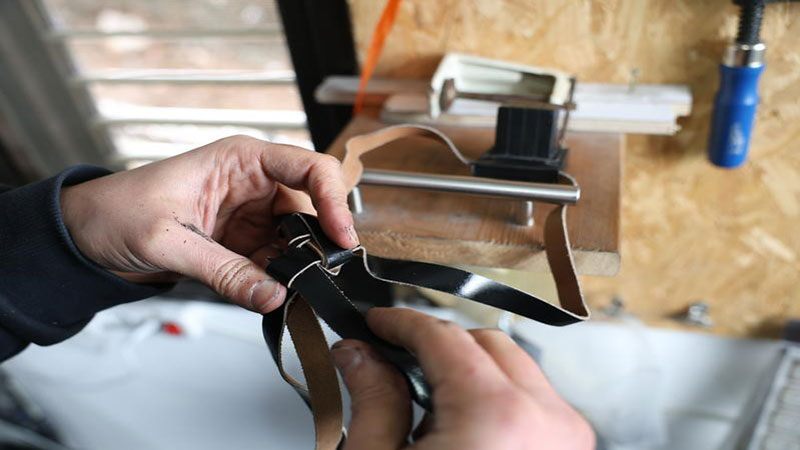
Moshe continues and tells G-d that he has already begun to show his greatness to Moshe (3:24) and therefore He should continue to do so. He should not stop now. Moshe is referring here to the time when he asked G-d to show him His glory, when entreating G-d to forgive the Jews for the sin of the golden calf (Shemos 33:18). G-d responded by passing by and showing Moshe the knot of His tefillin (Berachos 7a). This knot symbolizes the tie between G-d and His people. G-d’s tefillin are a mirror image of our own. In ours, we include the words “G-d is one” (“Hashem echad”). In His tefillin, He includes the words “Who is like you, Israel” (“goi echad”) – only one nation on earth. So, Moshe asks, please continue to show me this special relationship and let me cross into the land of Israel.
“Please let me cross the Jordan and see the good land, the good mountain and the Levanon,” Moshe asks (3:23). What made the land “good” for Moshe was that he could fulfill mitzvos that can only be performed in Israel, like the bringing of tithes – terumos to the kohen and ma’asros to the levi, as well as pe’ah, leaving over crops for the poor, and the Biblical requirement to separate challah, etc. And what made Jerusalem the most coveted place in Israel for Moshe was that there were mitzvos that one could perform only in Jerusalem like eating portions of the sacrifices, the eating of ma’aser sheni and visiting the Temple three times a year. And the choicest place in Jerusalem was the Levanon, from the word “lavan,” white, which refers to the Temple which whitewashes the sins of Israel.
But G-d cuts Moshe short. “Enough!” he says. “Do not speak to me anymore about this.” You, Moshe, were the one who asked me, at the time of the golden calf when I threatened to obliterate the people of Israel and turn you into a great nation (Shemos 32:10), to end your life rather than the life of the Jews. “No!” you protested, rather “blot me out from the book that you have written.” And now you want to cross over to the Land? Don’t you realize what will happen if you do? Knowing you, you will immediately build me a Beis HaMikdash. A Temple built by you Moshe, the man of G-d (33:1), will be like the third Temple to be built by Me Myself, and such a temple will never be destroyed. I would then have to exact punishment from the people themselves rather than from the sticks and stones of the Temple. You didn’t want me to do that then and you wouldn’t want me to do that in the future. So please, don’t talk to Me about this anymore.
“Do not add to the word that I am commanding you and do not subtract from it” (4:2). Any human tampering with the divine Torah to, so to speak, improve it, or update it to modern sensibilities undermines the basic tenet of Judaism, which is that the Torah is the word of G-d. As such, any attempt to change it reduces it to the human domain with all its vagaries. The prefix “ve” in between the Hebrew words “Lo sosifu… ve’lo sigreu” means that adding leads to subtraction. After all, idolatry started with adding the sun and the moon as creations worthy of gratitude in addition to G-d and they ended up as items worthy of worship thereby subtracting from G-d’s exclusivity.
The nations will hear about these chukim and say, “Surely a wise and discerning people are this great nation.” It is the unexplainable chukim, like sha’atnez, that will earn the nations’ admiration of Israel, not the logical mishpatim. Adhering to a prohibition like sha’atnez,which has kept the Jews alive, but makes as little sense to the laymen as the chemical formula of a live saving medication, earns the respect of the nations because it is a secret formula that neither they nor us nor could ever have invented.