 October 23, 2026
 Categories: Headline / Perspectives / Op-Eds
The Rosh Yeshiva Who Taught Us How to Think
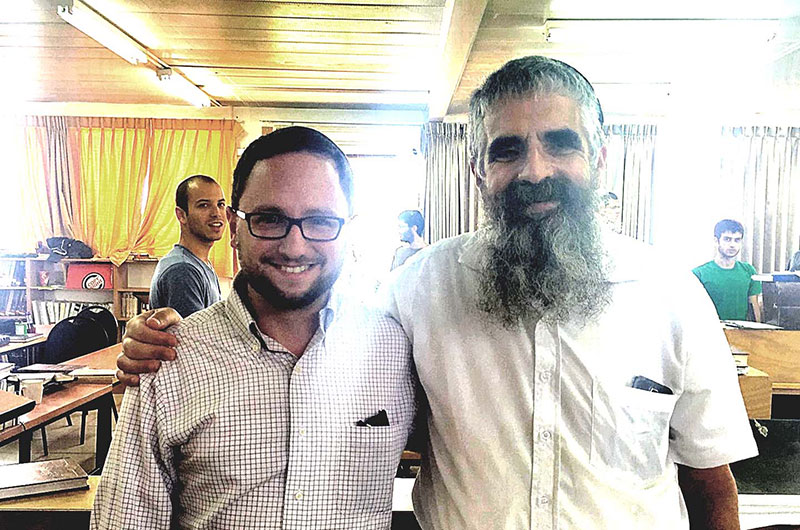


When Rav Yuval Cherlow announced this week that he would be stepping down as rosh yeshiva of Yeshivat Orot Shaul after nearly three decades, I found myself reflecting on how profoundly he has shaped my religious life and the lives of so many others.
Rav Cherlow is not a household name in American Jewish circles, but he should be. He is one of the most important religious thinkers in the Israeli Religious Zionist world: a posek, an educator, a public intellectual, and one of Israel's foremost Jewish ethicists. He has served on government committees addressing some of the most difficult moral questions of our time – medical ethics, military ethics, the ethics of intelligence and technology – bringing Torah into rooms where it is rarely heard. His retirement from the yeshiva offers an occasion to introduce him to a broader audience, and to reflect on what he represents.
What first drew me to Rav Cherlow was the way he answered halachic questions online. He was among the first rabbis to embrace the internet as a platform for Torah, publishing responsa as early as the 1990s. But these were not ordinary responsa. Every ruling stood behind an idea. Before explaining what to do, he explained what the Torah was trying to accomplish. His answers were clear, direct, and rooted in common sense – yet one always sensed the depth of learning standing behind them. Through thousands of published responsa, he made Torah accessible to people who might never open a volume of Talmud, or who were simply too embarrassed to ask a local rabbi their question.
Rav Cherlow also offered a religious synthesis I had been searching for. As an American student, I was deeply shaped by Rabbi Joseph B. Soloveitchik and the world of Modern Orthodoxy he built. At the same time, I was drawn to Rav Kook and the ideals of Religious Zionism. Too often, these are presented as competing paths. Rav Cherlow showed that they could enrich one another. He combined intellectual rigor with spiritual expansiveness, commitment to halacha with religious idealism, and full engagement with modernity with genuine faith in the redemptive significance of Jewish history.
It was only when I arrived at his yeshiva that I understood how deeply that synthesis shaped his educational vision. The most remarkable thing Rav Cherlow accomplished was creating space for students to become themselves. In an age when religious communities often reward conformity, he encouraged independent thinking. When students brought him questions, he rarely gave a simple answer. Instead, he would sketch the relevant sources, explain the underlying values, and then challenge the student to continue the thinking. His goal was not to create followers. It was to cultivate mature Jews capable of taking responsibility for their own religious lives.
He built the yeshiva in that image. Students encountered teachers influenced by chassidism, by Brisk, by practical halacha, by Rav Shagar, and by academic textual analysis. The goal was not to determine which approach was correct. The goal was to broaden horizons and to convey that Torah is vast, confident, and capacious enough to contain many paths.
That lesson profoundly shaped my own rabbinate. I have come to believe that a healthy community should draw from many traditions: the intellectual rigor of Lithuanian Torah scholarship, the spiritual depth of chassidism, the rootedness of Sephardic tradition. That conviction traces directly back to what I absorbed in Rav Cherlow's beit midrash.
His vision of Religious Zionism was equally distinctive. He believed that Torah must address not only the private lives of Jews but the challenges of a sovereign Jewish society. He frequently asked what halacha should look like when Jews operate police forces, courts, hospitals, intelligence agencies, and governments. Classical halacha developed largely under conditions of exile. Jewish sovereignty creates new religious responsibilities – and he took those responsibilities seriously. It is no accident that so many graduates of his yeshiva entered public service, the military, education, and communal leadership. He modeled a Torah that belongs not only in the beit midrash but in the public square.
His ethical seriousness was never abstract. He has served on Israeli government committees grappling with some of the hardest questions of our era: the ethics of medicine, of military conduct, of intelligence work and emerging technology. He is the person the state turns to when it needs a Jewish moral framework for its hardest questions. Yet his ethics always began with the particular, the individual, the person in front of him. I remember a story about him interrupting a shiur mid-sentence and rushing to his laptop after learning that an anonymous question submitted online had accidentally been published with the questioner's name attached. He stopped teaching to fix it immediately. His concern was not for his own reputation. It was for that one person – a stranger whose privacy and dignity might have been compromised. That same instinct is what makes him so valuable in a committee room. He never loses the human being inside the policy question.
What I find myself appreciating most, now that some years have passed, is his authenticity. In the speech announcing his retirement, he explained that one of the reasons he was stepping down was that he no longer felt he was growing as he wished. He spoke openly about wanting to continue learning, exploring, and challenging himself. It was a striking admission from someone who could easily have remained in place, admired and respected, for many more years. Yet it captured something essential about who he is. Even at seventy, he remains committed to becoming rather than merely being.
Just as striking was the humility with which he said it. Even while expressing hope to continue teaching at the yeshiva, he immediately qualified that hope: only if the new roshei yeshiva wanted him there. This is the same humility that has always allowed him to listen carefully, to change his mind when necessary, and to remain genuinely open long after many others would have stopped searching.
In the coming year, Rav Cherlow will spend time in North America before returning to Israel. I suspect many communities and institutions here will discover what his students have known for years. I count myself fortunate to be among them.
May he continue to bring Torah, wisdom, integrity, and hope to the Jewish people for many years to come.