 September 25, 2026
 Categories: Features / Books / Book Reviews
The Torah Behind the Table
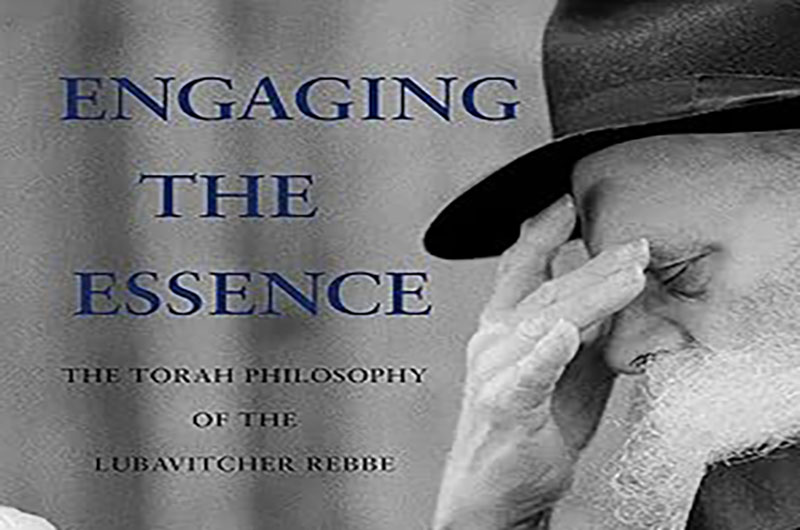


Title: Engaging the Essence: The Torah Philosophy of the Lubavitcher Rebbe
By Rabbi Yosef Bronstein
Maggid Books, an imprint of Koren Publishers Jerusalem
On Thursday we marked the Lubavitcher Rebbe's 32nd yahrzeit. He left behind one of the largest bodies of Torah any Jewish leader has produced, roughly 70,000 pages of talks, discourses, and letters across four-plus decades of work. Inside Chabad, that Torah is studied without pause. Outside it, in our own world, it has gone largely unread as philosophy. We have felt the Rebbe's reach throughout our own communal life and read almost none of his Torah. Engaging the Essence: The Torah Philosophy of the Lubavitcher Rebbe, published by Maggid Books, an imprint of Koren Publishers Jerusalem, means to change that, and after the year we have had, the Torah inside it is worth more than usual.
The author is an unlikely guide, which is the point. Bronstein is not a chasid. He teaches Jewish philosophy at Yeshiva University and heads a beit midrash in Efrat, a talmid of Rabbi Michael Rosensweig formed in the Litvish tradition, and he says it without hedging: he did not grow up with chasidism and does not call himself one. His charge is that our side of the study hall has badly underrated what sits across it, a body of chasidic thought whose existential depth we never troubled to take seriously. With a Chabad chavruta beside him, he set out to correct that.
He is not the first from our world to look closely. Eulogizing the Rebbe in 1994, Rabbi Aharon Lichtenstein of Yeshivat Har Etzion said, "The Rebbe's primary quality was caring," a concern that reached past his own movement to the whole of the Jewish people. Bronstein takes the tribute as true and then asks what lies beneath it. The caring, he argues, was the visible face of a philosophy, and behind the warmth so many of us have felt from his shluchim stood a rigorous body of thought. The emissaries and the campaigns we admire were that thought enacted, applied theology, and the theology is the part our world has skipped.
We know the Rebbe in a personal register, too. A grandparent who kept a letter of blessing in a drawer. A dollar received in a Sunday line to pass on to tzedakah. That closeness was real, and for most of us it was as far as the relationship ever went. It was also the front door to a house of ideas we never walked past, a systematic philosophy documented across more than a thousand sources. Bronstein walks us in.
The library has a center, and it speaks directly to the moment we are in. Dira ba’tachtonim means a dwelling for G-d in the lowest world, this physical one, the one that can feel furthest from Him. The Sages pictured this world as a corridor we pass through to reach the banquet hall beyond. The Rebbe refused the picture. The corridor, he taught, is itself the place we are meant to build. He went further still, teaching that the Divine Essence is found not in the soul's heights but davka in the lowest places, the body, the material, the ordinary Jew. The lowest holds the highest. For a people that has spent recent years in something near the lowest, that is no comfort. It is a claim, and a demanding one: this world, this moment, is exactly where G-d means to be at home, and the building is our work.
This is where the book earns a non-chasid's evening. Bronstein gives its middle to the parts of the Rebbe's Torah that bear on a life. There is simcha, which the Rebbe placed at the very center of engaging the Essence, joy not as a mood but as the force that breaks through barriers nothing else can move. There is bitachon, which Bronstein renders as trusting and jumping, the audacious confidence that lets a young couple settle in a town with no minyan and expect G-d to meet them there. There is hashgacha, the conviction that no detail of a life is an accident, and an ahavat Yisrael the Rebbe refused to qualify. There is the role of women in our generation, which the Rebbe called the greatest challenge facing Orthodoxy and met by embracing classical Jewish femininity while drawing new vistas for women out of old sources. There is his insistence that the deepest secrets of Kabbalah be opened to every Jew and not guarded for an elite, the wellsprings carried out to the street. These, Bronstein says, are the chapters that reached his Yeshiva University students.
He also gives a full chapter to the Land and the State of Israel, and no one will read it this year as history. The Rebbe loved the land and its people and its soldiers and refused to gamble their lives. He saw the state's very founding as the means by which G-d, in His kindness, had saved millions of Jewish lives, even as he declined to commit to it as the beginning of the redemption. For more than 25 years he argued against trading territory for the promises of hostile neighbors or the guarantees of the United Nations, grounding the stance not in messianic theology but in the plain halacha of defending a border town, since in his reading all of Israel had become a border. After everything, the chapter does not read like an archive. It reads like a position paper.
The book does not flinch from the hard subject of the Rebbe's messianism and the split it caused, and it handles the matter as a scholar should, setting out what the Rebbe said and how his chasidim divided over it without rushing to a verdict. It establishes that the Rebbe never explicitly declared himself Mashiach. Bronstein is equally candid about his own limits: he worked from the Hebrew of the talks rather than the original Yiddish, and stayed with the ideas instead of the streets of Crown Heights. For a reader who has felt the pull of the Rebbe's world and wondered what generates it, the ideas are exactly the point.
We have all sat at one of the Rebbe's tables without knowing whose Torah set it. The answer is an idea, that this lowest world, our own corner of it included, is meant to become a home for G-d, and that the building is ours to do. This past week, having thanked the Rebbe again for the people he sent, we might finally read the Torah he sent them to teach.