 August 28, 2026
 Categories: Torah / Halacha & Hashkafa / Headline
The Torah of Your Mother: Discipline, Guidance, and Self-Care


Chulin – Daf 93
In our Gemara on amud beis, Rabbi Yochanan instructs Rav Shaman Bar Abba that though a particular food is permitted, he should still refrain from eating it, quoting the end of the verse in Mishlei (1:8), “And do not abandon the Torah of your mother.”
What did Rabbi Yochanan mean by “Torah of your mother?” Rashi interprets this as his custom – minhag. Since he had a custom to be stringent and not eat this meat, Rabbi Yochanan said he should honor that, even though it was permitted. Rabbeinu Gershom interprets “Torah of your mother” as the rabbinic enactments. In this case, Rabbi Yochanan was instructing Rav Shaman Bar Abba to abide by the enactments made by his local rabbinic authorities.
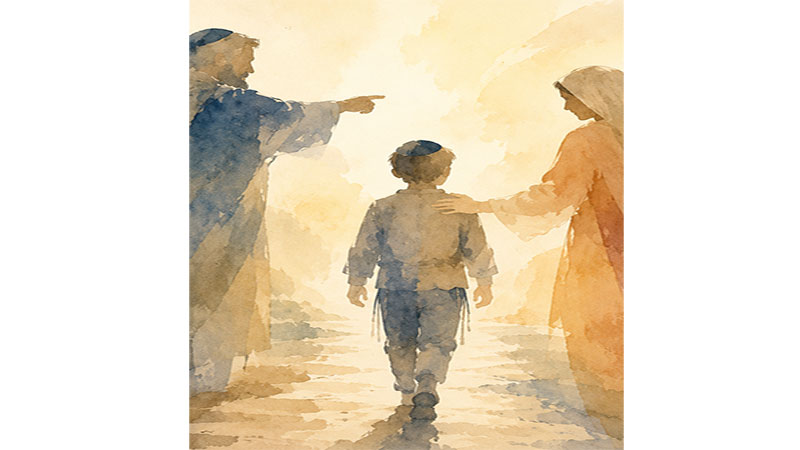
The full verse reads as follows: “Hear, my son, the mussar (discipline or moral instruction) of your father, and do not cast aside the Torah of your mother.” “Torah” here can literally mean Torah, or it can mean instruction and guidance. The simple reading of the verse is to take discipline from your father, such as correction and rebuke, while also taking guidance and instruction from your mother. The construct is that the father stands for moral instruction, focusing on refraining from wrongdoing and/or rectifying transgressions, while the mother offers guidance regarding what should be done, possibly including practical wisdom and advice (see Ibn Ezra, ibid.).
After this analysis, we can see the connection between “Torah of your mother” and custom or rabbinic enactments. Similar to practical wisdom and advice, customs or rabbinic laws are intended to direct a person toward positive behaviors that are less about abstaining from prohibitions and more about behaving proactively.
On a deeper level, a person’s instructions from his father and mother are more meaningful because parents are more specifically tuned in to the capacities and inclinations of the child. Kedushas Levi (Lech Lecha) says that every child contains aspects of both parents’ souls.
Tiferes Yosef (Likkutim, Shas, Succah) offers a remarkable idea. A father represents the aspirations for his child, pushing long-term achievement and sacrifice, regardless of short-term discomforts, while the mother is focused on comfort and soothing for the child and represents self-care. The verse exhorts a person to balance both imperatives. On one hand, he must be relentless and make painful sacrifices for a higher purpose. While this is ideal, a person cannot always operate this way and must make concessions for human frailty and personal care. According to Tiferes Yosef, this is the guidance of the verse: Listen to your father’s discipline and strive for devotion to the highest degree, but do not abandon your mother’s guidance; that is, do not completely discount the need to take care of yourself.
Truth: The Foundation of the Soul
Daf 94
Our Gemara on amud aleph discusses the prohibition of intentionally misleading another person. This is called geneivas daas – literally, stealing knowledge. Although the halacha has many details, the basic prohibition is when one intentionally misleads another person in order to profit. The profit does not have to be financial; it could be good will, such as the cases discussed in our Gemara, where a person was led to believe that an extraordinary honor or favor was done, when in fact the person did the act for other reasons.
There is a remarkable Rabbeinu Yonah (3:184) that states the following: “One who fools his fellow, saying that he did him a favor or spoke favorably about him, but he did not do [so], our Rabbis, may their memory be blessed, said (Chulin 94a) [that] it is forbidden to deceive (literally, steal the thoughts of) people. And note that this was more weighty among the Sages of Israel than theft. For lying is certainly [a cause of] great guilt. And we have been obligated about maintaining careful boundaries when it comes to truth because [truth] is from the foundations of the soul.”
It is noteworthy that Rabbeinu Yonah states that geneivas daas is worse than theft; presumably, the rationale is that it corrupts the soul in a foundational manner. To a spiritual person, the spiritual world is more real than the physical. Money, like other physical things – even life itself – is finite and comes and goes. However, ideas and thoughts, especially truth itself, are the way the soul connects to G-d and becomes eternal (see Rambam’s introduction to Perek Chelek). A corruption of truth is a corruption in connection to G-d.
From a psychological point of view as well, mental disorders often involve an overly defended ego. This means that there are feelings or ideas, especially conflicts, that are so difficult to face consciously that they are repressed and denied. The person is not living in reality. Instead, he is altering reality to fit what feels better. This, on a small scale, happens to everybody. At times, denial is a healthy defense, such as not wanting to think too much about how we’re all going to die in the end. On the other hand, if a person is constantly denying what he is feeling and thinking because it is too painful to face, he will end up not managing reality. Because reality does not care about what one believes or what he feels – after all, it is simply reality. And when one is not closely connected to reality, he will make mistakes, both big and small. This is true in relationships as well as professionally.
That is why the habit of lying is destructive and corrosive to the foundation of the soul.
Reading Backwards: The Blessing Hidden in the Curse
Daf 95
Our Gemara on this daf discusses the prohibition of eating meat that was left unsupervised. Though this prohibition is rabbinic, Meshech Chochma on Devarim (28:31) sees a hint from one of the verses of the prophecies and curses of doom: “Shor’cha tavu’ach l’einecha v’lo tochal mimenu, chamorcha gazul milfanecha v’lo yashuv lecha, tzon’cha nesanos l’oyvecha, v’ein lecha moshia” – Your ox will be slaughtered before your eyes and you will not eat of it; your donkey will be seized from before you and not returned to you; your sheep will be given to your enemies and you will have no one to save you. The implication is that even if you saw the animal slaughtered and therefore it is permitted, you still will not be able to enjoy it, as your enemies will seize it.
The Chida (Nachal Kedumim, ibid.) notes that this verse, when read backwards, is a blessing. It’s easier to see the effect in Hebrew, but I’ll also try to translate it backwards, though the English backwards is not the same:
Moshia lach, v’ein l’oyvecha nesonos tzon’cha, lecha yashiv v’lo milfanecha gazul, chamorcha mimenu tochal, v’lo l’eincecha tavu’ach shor’cha – There is a savior for you, and your sheep are not given over to your enemies; it will be returned to you, and not taken from before you; your donkey, you will eat from it, and your ox will not be slaughtered before your eyes.
This is not just something clever. Often, the redemption is somewhere within the tragedy. The final stanza of the final kinah, Eyli Tziyon, compares the suffering of Zion to the throes of a woman in labor. It is not compared to the suffering of a person being tortured, because torture has no redemption at the end. However, the pains of labor are a harbinger for the new life and new opportunity that is emerging.