October 2, 2026
 Categories: Features / Collecting
The True – And Unrecognized – Hero of The Six-Day War: Levi Eshkol
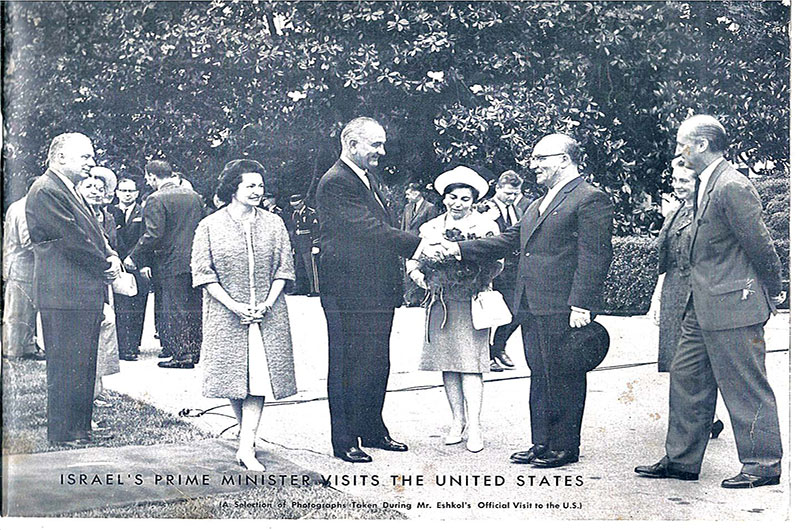


Levi Eshkol (1895-1969), born Levi Shkolnik in the small Ukrainian town of Oratov, emerged from humble beginnings to become one of Israel’s most consequential, yet least celebrated, leaders. His early years were steeped in the rhythms and hardships of shtetl life under the Russian Empire, where Jewish communities were simultaneously vibrant in culture and vulnerable in politics. His father, a grain merchant with modest means, instilled in him a deep appreciation for Hebrew scholarship and the Zionist writings circulating among young Jews in the Pale of Settlement, and as a child he absorbed both the religious traditions of his family and the burgeoning political consciousness that gripped Eastern European Jewish youth in the early twentieth century. By the time he was a teenager, he was already active in Zionist circles and drawn to the pioneering ethos that emphasized manual labor, agriculture, and the building of a homeland through practical effort.
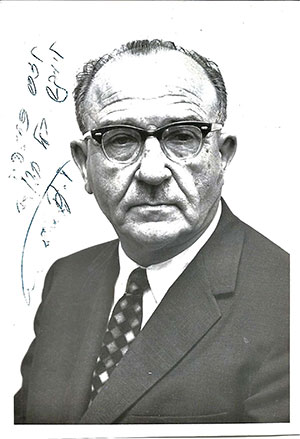
In 1914, at age nineteen, he left the uncertainties of Eastern Europe for Eretz Yisrael, then under Ottoman rule, arriving there as part of the Second Aliyah alongside the idealistic agrarian youth who would lay the foundations for the developing Yishuv. He worked as a laborer in vineyards, fields, and construction projects, eventually helping to found Degania Bet, the sister settlement to Degania Aleph (known as the first kibbutz), and his fellow pioneers quickly noticed traits that would define him throughout his life: calm intelligence, a dry humor delivered with a disarming softness, an ability to mediate conflicts, and an instinct for organization that made him indispensable even when he remained personally unobtrusive.
Eshkol’s early work in agriculture naturally led him toward broader organizational roles in the Histadrut, the central labor federation, and during the 1920s and 1930s he became one of the key figures behind agricultural cooperatives, credit organizations, and infrastructure projects. His role in the development of Mekorot, Israel’s national water company, was especially significant because securing water resources was one of the Yishuv’s most pressing challenges, requiring complex engineering, long-term financial planning, and delicate negotiations with British authorities. Eshkol could speak to the surveyor, the engineer, the banker, and the farmer, and each one thought he was speaking as one of their own, a rare administrative fluency that laid the groundwork for his later success in government.
Less publicly known is Eshkol’s early involvement in the Haganah, where he played a critical role not as a battlefield commander, but as one of the architects of the supply, budgetary, and logistical systems that enabled the pre-state defense forces to grow into a disciplined organization. He helped to procure weapons, organize clandestine workshops, and develop funding channels that were essential during the 1936-39 Arab Revolt and the struggles of the 1940s and, although he never tried to present himself as a military man, those who served in the Haganah understood how crucial his work was. His logistical genius was a form of strategic leadership that tended to escape public attention but proved foundational for the future Israel Defense Forces.
During the 1940s, Eshkol spent significant time abroad, particularly in the United States, raising funds for defense and settlement. These trips strengthened the financial basis of the Yishuv and broadened Eshkol’s international connections, laying the groundwork for his later diplomatic rapport with American officials.
After the establishment of the State of Israel in 1948, Eshkol became director-general of the newly formed Ministry of Defense under Ben Gurion, in which capacity he mastered the intricate details of military procurement, supply chains, and budgetary oversight during the War of Independence and in the years that followed. Ben Gurion relied heavily on his administrative ability, but as was often the case with Israel’s founding father, reliance did not translate into affection. Ben Gurion valued results but distrusted those who might one day serve as rivals and, although Eshkol never displayed the flamboyance or hunger for power that Ben Gurion feared in others, his competence itself was threatening to a leader who disliked sharing authority.

Eshkol served next as Minister of Agriculture and then as Minister of Finance, a position in which he demonstrated extraordinary fiscal skill in balancing national priorities during a period of austerity, mass immigration, and economic instability, overseeing the integration of hundreds of thousands of immigrants, the development of new towns, and the expansion of infrastructure. His budgets were careful, sometimes painfully frugal, but he understood that the new state required firm economic grounding while, at the same time, he navigated the internal politics of Mapai, forging relationships across factions and strengthening his reputation as a moderate, conciliatory figure who sought unity without sacrificing principle.
One of the most remarkable episodes of his career occurred in 1964, when he approved the transfer of Ze’ev Jabotinsky’s remains to Israel, a decision that reflected his deep commitment to democratic pluralism and national reconciliation. Ben Gurion had vehemently opposed honoring Jabotinsky, whom he still viewed as a terrorist through the lens of the bitter ideological battles of the 1930s, but Eshkol saw Jabotinsky as a major Zionist thinker whose followers, led by Menachem Begin, represented an essential segment of the Israeli public. By permitting Jabotinsky’s reburial on Mount Herzl, Eshkol implicitly recognized Begin as a legitimate opposition leader within a mature democracy rather than as a residual figure from a paramilitary past.
Eshkol’s ability to diffuse tensions served him well in 1965, when the long-simmering dispute between Ben Gurion and the Mapai leadership erupted over the Lavon Affair. Ben Gurion demanded a full inquiry into the 1954 failed covert operation in Egypt and accused party leaders of covering up wrongdoing. Most of Mapai, exhausted by the controversy and skeptical of Ben Gurion’s motives, sided with Eshkol and, when Ben Gurion broke away to form the Rafi party, Eshkol not only survived, but he strengthened his authority within the labor movement. He then undertook one of the most ambitious political projects in Israel’s early history: uniting Mapai with Achdut HaAvoda and Rafi’s remnants into a broader electoral alignment, which required delicate negotiations among leaders like Yigal Allon, Golda Meir, and others whose rivalries stretched back decades. Eshkol thereby achieved what many had considered impossible, forging the Alignment (Ma’arach) Party that would dominate Israeli politics for years.
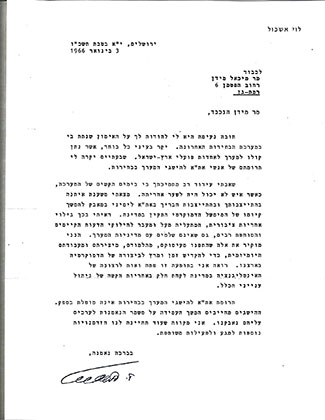
On June 26, 1963, Eshkol succeeded Ben Gurion as prime minister. In this January 3, 1966 correspondence to Michael Medan on his personal letterhead (though he was then PM), he writes:
It is my pleasant duty to thank you for the dedication that you extended to me during the campaign in this past election. Every voter who lent his voice to the Ma’Arach party for the unity of the workers of Eretz Yisrael is dear to me. The contributions of the people in facilitating the achievements of the Ma’Arach in the election are so precious to me.The sixth Knesset started with Eshkol's Alignment forming the thirteenth government on January 12, 1966, about a week after our letter was written. His style contrasted sharply with his predecessor’s, as he preferred collaboration over confrontation, steady management over dramatic gestures, and institutional consistency over personal centralization. Many Israelis initially underestimated him, seeing him as a transitional figure who lacked Ben Gurion’s forceful personality, but those who worked with him soon realized that behind his modest demeanor was a leader who understood the machinery of government more deeply than nearly anyone else. His mastery of budgets, personnel, and long-term planning gave him a level of control that was subtle but effective, and he was particularly attuned to defense issues, aware that Israel’s precarious geopolitical environment required sustained investment even when the public grew weary of military spending.I drew great encouragement from your letter during the difficult days of the campaign, when no one could imagine how it would turn out. I found strong support from your stabilizing effect and from the support of comrades at my side for the continuation of the democratic government instituted in the State. I saw in this the revelation of communal responsibility that rises above and beyond strongly-held existing differences of opinion, even amongst those who do not entirely support the Ma’Arach government. I hereby honor those who turned from their jobs, their studies, their creative activities, and from their daily work to designate time and energy to the fortification of democracy in our land. I see this phenomenon as an opening and a sign for the intelligentsia in the State to take part in the difficult responsibility of conducting the affairs of the community.
There can be no doubt regarding the importance of the contributions made to the accomplishments of the Ma’Arach in the election. These accomplishments obligate the continuation of the steadfastness regarding the preservation of value for which we fought. I hope that there will be additional opportunities for contact and for joint operations.
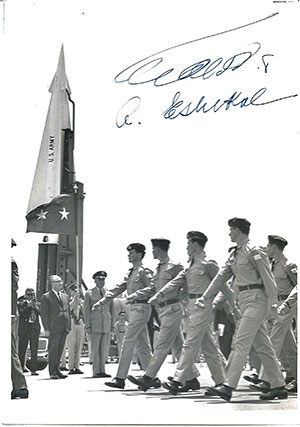
Throughout his premiership, Eshkol pursued a policy of significantly increasing defense expenditures, an immensely unpopular stance during a period of chronic inflation, rising taxes, and stagnant wages. Israelis expected economic relief and greater investment in civilian infrastructure, but Eshkol insisted on diverting even more funds to the army, air force, and navy. He authorized the expansion of reserve forces, the development of new armored brigades, and the acquisition of advanced French aircraft, most notably the Mirage III, and he approved the construction of emergency airfields, the stockpiling of ammunition and spare parts, and the strengthening of intelligence capabilities. These expenditures placed an even greater strain on the already-stretched national budget and generated harsh criticism from nearly every political direction; op-ed writers demanded that he “put bread before tanks,” labor leaders accused him of sacrificing social services, and opposition politicians mocked him as a “caretaker of generals.”
Yet, Eshkol remained unmoved, often explaining privately that Israel’s security required readiness not on a scale visible to the casual observer but on a far greater scale that could withstand a sudden, multi-front threat. In cabinet meetings he warned that the Middle East was entering a new era of instability due to the rise of Pan-Arab nationalism, Soviet involvement, and Egypt’s growing military cooperation with Syria and, although he spoke without drama, the clarity and seriousness of his analysis impressed senior officials. Yitzhak Rabin would later reflect that “Eshkol had the rare quality of seeing the strategic picture without being a military man. He understood that preparation was everything.”
As the security environment deteriorated in 1966-67, Eshkol’s leadership style was misunderstood by many Israelis as hesitation. The rising tensions with Syria, the increasing entanglement of the USSR in Arab military planning, and the heightening of Palestinian guerrilla activity put enormous strain on the government. The public wanted decisive gestures, and younger military officers, led by Chief of Staff Rabin, believed that Israel needed to assert its deterrence through force. Eshkol, however, worried that a limited strike could trigger a full-scale war with unpredictable consequences; he repeatedly told the cabinet, “A war we will win, but it is the number of graves that we cannot know.”
Despite his caution, Eshkol was far from passive. He authorized increased reconnaissance patrols, approved retaliatory operations under certain conditions, and instructed the Mossad to strengthen intelligence cooperation with Western governments, but he also pressed the United States for clarity on its security commitments, fearing that Israel might be drawn into a conflict without great-power backing. Eshkol valued American support not only for its weaponry, but also for diplomatic shielding, and he worked quietly to improve relations that had been rocky under Ben Gurion.
By the spring of 1967, Eshkol’s foresight was vindicated when Egyptian President Nasser expelled the United Nations peacekeeping force from Sinai, massed troops along Israel’s border, entered into a military pact with Jordan, and closed the Straits of Tiran to Israeli shipping, launching Israel into a state of acute crisis. Public anxiety soared, schools rehearsed air-raid drills, families dug improvised shelters, the press demanded decisive action, and opposition politicians accused Eshkol of hesitating in the face of existential danger.
Inside the military, however, confidence in Israel’s readiness was high, precisely because of the military investments and strategies that Eshkol had pushed through during the previous years. The IDF was at its peak level of training, equipment, and mobilization capacity; the air force had rehearsed the preemptive strike plan that would later become Operation Focus; the armored corps had undergone extensive restructuring, focusing on rapid maneuver warfare; and the reserves had been recently expanded and well supplied. However, although Eshkol knew the army was ready, he feared that launching a preemptive strike without international support would jeopardize Israel diplomatically, and he spent agonizing days consulting with the Americans, especially President Johnson, trying to determine whether Israel could count on at least tacit approval if it struck first. American assurances were slow and ambiguous, leaving Eshkol politically vulnerable at home, where public opinion demanded immediate action.
This period saw one of the most difficult crises of Eshkol’s career: the so-called “stammer speech” on May 28, 1967. Under intense pressure, exhausted and emotionally strained, Eshkol stumbled during a radio address meant to reassure the public. Opponents used the moment to claim he was unfit for leadership, but the narrative of incompetence was unfair; those who knew him insisted he was simply fatigued and rattled by the knowledge that the fate of the country rested on his decisions. Under these circumstances, the political pressure escalated rapidly to bring his political enemy, Moshe Dayan, into the government; Dayan, who, with his famous eyepatch and aura of battlefield daring, represented to the public a reassuring symbol of strength. Recognizing that refusing to appoint him would risk fracturing national unity and decrease his already sinking public popularity, Eshkol grudgingly, but pragmatically, ceded the Defense Ministry to Dayan. The timing of this appointment, just days before the war, and the dramatic shift in public sentiment that followed, ensured that Dayan, and not Eshkol, would become the war’s singular iconic figure.
Yet, the military that Dayan commanded on June 5, 1967 was almost entirely the product of Eshkol’s policies, including his budgetary decisions, his weapons procurement, his training cycles, his expansion of intelligence networks, his logistical planning, and his operational directives for a rapid, preemptive strike, all of which had been put in place in the face of broad opposition by the Israeli public and government leaders long before Dayan’s return to the government. Years later, Rabin would admit that “the army won the Six-Day War with the budgets and preparations of the Eshkol years,” an assessment echoed by Ezer Weizman and other key figures.
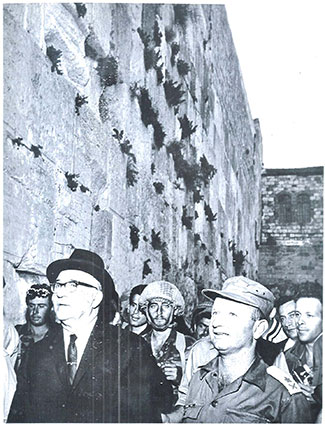
After the war, Eshkol was as concerned with the consequences of victory as with the victory itself, understanding that Israel now faced a new existential question: what to do with the territories captured from Jordan, Egypt, and Syria. He favored what might be called cautious pragmatism, believing that territorial adjustments were needed for defensible borders, but he also sought to explore the possibility of a negotiated settlement. He became the first Israeli prime minister to initiate internal discussions about territorial compromise, though he was well aware that Arab governments were not yet prepared to negotiate.
His cabinet minutes from July and August 1967 show a man deeply aware of the moral and demographic implications of ruling over a large Arab population. As he told one minister, “We did not seek to be masters over another people, and we must consider carefully how to build our future in a way that preserves our democracy.” To be clear, he did not oppose settlement entirely – for example, he approved some strategic settlements in the Jordan Valley, which he believed essential for security – but he opposed rapid expansion or ideologically driven settlement before a clear national policy could be defined.
His attitudes toward the Palestinian population were complex but not dismissive. He favored improving living conditions in the newly occupied territories and initiated the first programs to restore water and electricity systems, reopen schools, and resume municipal salaries. His concern extended to the delicate question of Jerusalem; he backed the reunification of the city under Israeli administration while also resisting proposals for mass expropriation of Arab property; he approved urban projects that critics say reshaped East Jerusalem, but he also insisted that Arab neighborhoods remain connected and that municipal services be improved. Although history shows that many of his post-war decisions did not age well, his emphasis on coexistence was unmistakable.
Notwithstanding his emphasis on keeping the Israeli military strong and prepared, he was not blind to Israel’s major economic challenges during the mid-1960s, when Israel’s rapid industrialization and demographic growth placed enormous pressure on its young economy. Eshkol, who had built the treasury almost from scratch, knew that inflation, foreign debt, and uneven development between the center and periphery threatened social stability, and he championed investment in the development towns, Be’er Sheva, Dimona, Kiryat Gat, and others, insisting that “the future of Israel depends on what happens in the Negev and the Galilee.” He was a strong believer in balanced growth; not only military strength but also agriculture, education, and infrastructure. When critics complained that too much money was being poured into what one Knesset member called “sand and stones,” Eshkol replied, “It is the sand and stones that protect us, because they are where our future citizens will live.” He continued to push economic reforms, including improved pension systems and public health expansions, and he supported the establishment of new universities and research institutes, believing that “the brain is our greatest natural resource.”
Drawing on his background in the kibbutz world, he took a holistic approach to development, believing that immigrant absorption required not only housing, but also cultural accommodation, language instruction, and employment. Interviews with immigrants from the 1950s and 1960s often recall him visiting transit camps quietly and without press, sometimes sitting on a mattress in a tin hut to ask new arrivals from Morocco or Iraq about their challenges. Such encounters, unpublicized at the time, reveal a dimension of Eshkol’s leadership often eclipsed by the drama of war and diplomacy.
Moreover, his cultural vision extended beyond immigrant absorption. Eshkol believed strongly in public libraries, archives, and academic research as national priorities. He supported the Hebrew Language Academy and frequently peppered his speeches with biblical phrases or Yiddishisms that amused reporters, and he was a voracious reader, mostly history, agriculture, economics, and military memoirs. He believed that the Jewish state had a special obligation to nurture the transmission of Jewish learning in forms accessible to the broader public. Though not outwardly pious, Eshkol possessed a quiet respect for Jewish scholarship and understood that Israel’s identity rested not merely on territory or security but on the continuity of its ancient texts and traditions.

It was in this spirit that, in a remarkable May 25, 1964 letter, exhibited here, written on his prime ministerial letterhead, Eshkol expressed support for a new initiative involving a young Rabbi Adin Steinsaltz, whose ambitious project to create a vocalized, punctuated, and accessible Hebrew edition of the Talmud had begun to attract attention. Writing to Mr. Becker, a member of the Histadrut Executive Committee, Eshkol explained:
A group of young scholars, amongst them specifically the young Rabbi Steinsaltz, has begun the great work of dotting and punctuating his Hebrew explanation of the Talmud Bavli.This letter, little known outside specialist circles, offers an illuminating glimpse of Eshkol’s worldview. He saw no contradiction between modern statecraft and the nurturing of classical Jewish learning; to the contrary, he viewed them as mutually reinforcing pillars of national renewal. His willingness to encourage the establishment of an advisory committee for the publication of Talmudic works reflected an instinctive understanding that the state should support the organic work of scholars and cultural visionaries. It was characteristic of him that he approached even this cultural endeavor with administrative precision and an eye toward institution-building. In its combination of modesty, respect for tradition, and quiet leadership, the letter reveals a dimension of Eshkol often overshadowed by the dramatic events of his premiership.This important work, which is directed toward facilitating the understanding of the values of Talmudic literature, both Babylonian and Jerusalemite, and opening it to many Israeli circles, was brought to my attention and to the attention of other public servants.
Permit me please to invite you to be a partner in this mitzvah in order to encourage activists, to lend a shoulder (i.e., to help), and to let us benefit from your advice and spiritual assistance to activate and promote their work.
To promote this idea, and to found an institute to publish Talmudic works for this purpose, I suggest that an advisory public committee be established. Because of my travels to the United States, to my great sorrow I will not be able to attend this meeting. The Speaker of the Knesset, Mr. Kadesh Luz, agreed to my request that he head this committee.
It is my honor, therefore, to invite you to the office of the Knesset Speaker on Tuesday, 22 Sivan 1964 (June 2, 1964) at 3:30 p.m. (in Jerusalem).
I hope that you will honor me through your active participation.

Similarly, in the June 3, 1965 correspondence on his prime minister letterhead exhibited here, Eshkol thanks Charles Raddock, author, newspaperman, managing editor of the leading anti-communist newspaper in America and officer of the World Press Syndicate, for sending him a copy of Raddock’s magnum opus, Portrait of A People: The Story of Jews from American to Modern Times. Eshkol writes that “I have always felt that books on Jewish history in the English language are a primary requirement for the hundreds of thousands of our fellow Jews who have only a vague knowledge of this basic and vital foundation for Jewish continuity.”


Eshkol’s relationships with world leaders were pragmatic. He maintained close ties with Lyndon Johnson, who admired his modesty and directness; LBJ once said after meeting him: “He is as tough as sandpaper and as gentle as a prayer.” The two men found common ground in their backgrounds as rural farmers, and their conversations often began with crop prices before turning to military aid.

On the Soviet Union, Eshkol was analytical, not ideological. He feared Moscow’s growing influence in Egypt and Syria and believed that the Kremlin was encouraging Arab escalation while, at the same time, he was moved by the plight of Soviet Jewry. He supported diplomatic efforts to pressure the USSR to allow Jewish emigration and encouraged American Jewish organizations to keep the issue alive; in 1966, when asked about the future of Soviet Jews, he responded with unusual emotion: “A spark cannot be extinguished forever. One day they will come home.”
One of Eshkol’s last major political battles was over the question of electoral reform. He favored a mixed system that would preserve proportional representation but introduce regional elements to strengthen the bond between elected officials and local communities, and he believed that Israel’s political fragmentation hindered effective governance. Though these reforms did not pass in his lifetime, they reflected his long-term thinking.

The years after Eshkol’s death saw a gradual reevaluation of his leadership. For a time, his legacy was overshadowed by the military figures of 1967, but historians began to highlight the breadth of his achievements: stabilizing the economy, integrating immigrants, building infrastructure, strengthening ties with the United States, guiding the country through the pre-war crisis, managing the first months of occupation, and shaping Israel’s long-term strategic posture. A new generation of scholars argued that the Six Day War might not have been as decisive or as well-managed without the groundwork he laid. Recent historiography paints him as one of Israel’s most important state-builders; less dramatic than Ben Gurion, less eloquent than Eban, less charismatic than Dayan, but more balanced, more collegial, and arguably more democratic. Eshkol’s “politics of moderation,” once dismissed as weakness, is now seen by many as a deliberate attempt to build consensus in a deeply divided society. He was a builder in every sense: physical infrastructure, economic foundations, and social cohesion, and he believed that statehood was an ongoing project requiring humility and perseverance.
Yehi zichrono baruch.