 September 25, 2026
 Categories: Featured / Parsha / Torah
The Two Trumpets
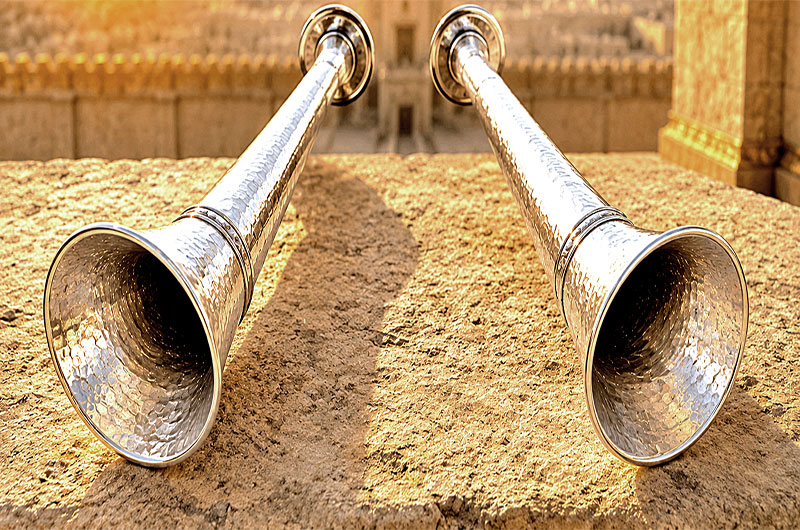


In Parshat Beha’alot’cha, we learn in detail of the formation of the camps of Israel as we traveled through the wilderness, including the resting periods and resumption of our journeys. Hashem commands Moshe to make two silver trumpets (Bamidbar 10:1ff) for the purpose of summoning the multitudes of Israel and initiating the travel of the various camps. This is an interesting juxtaposition, because the trumpets are intended to address the nation in two distinct measures: the multitude (in Hebrew “eda”) suggests unification into a single body whereas the word for camps (machanot) emphasizes the division into subgroups.
Rashi says that when it was necessary to summon the elders to sit in judgment as the Sanhedrin, the trumpets were used to call throughout the assembled multitude. He notes that when it was time to issue the decree to all the different camps that make up Israel, there was a beit din for this as well – three distinct voices issued the decree: Hashem, Moshe, and the two trumpets together. (Rashi attributes this reading to a beraita, an uncanonized Mishnaic statement.)
The Vilna Gaon, in his commentary on the book of Yona, notes that when the people of Nineveh do teshuvah to avert the destruction of their city, the navi emphasizes that they repented “from the great to the small,” and also that the king descended from his throne. (Yona 3:5-6). He explains that often when someone is “great,” i.e., successful and important, it is difficult for him to recognize that he has done something wrong and to count himself among the penitents of the community. There is a tendency to want to blame the “small” – the ignorant and foolish – for the problems of society, and for the leaders and the wealthy individuals to set themselves apart and above the others. For this reason, the Vilna Gaon says, the Yerushalmi in Rosh Hashanah emphasizes the blowing of the shofar and its repetition. The first call is a general warning and reminder to people to repent, but the second call is specifically oriented towards the “great” and the mighty, who might have thought the first sound of the shofar did not apply to them. In the Beit HaMikdash too, according to the Yerushalmi, there were two trumpets alongside the shofar to further accentuate this point.
The Vilna Gaon also notes the language of the Zohar on our parsha, which sees in the details of the travels of the camps of Israel a reflection of the movement of angelic camps in the heavens above. According to this reading, the two trumpets are conduits for a Divine decree that animates the universe, setting not only the tribes of Israel but the heavenly hosts in motion. Yet there are clues found in the text that Hashem initiates this motion through the attribute of His Mercy. For one thing, although the musicians in the Mishkan are usually the Levi’im, these trumpets are always blown by Kohanim. By the logic of the Zohar, Levi would signify judgment while the Kohen channels mercy.
Similarly, the trumpets are made of silver and not gold or copper – again connoting the attribute of Mercy. These two trumpets are also played as the daily Tamid offering is being prepared and the Levi’im are singing and playing their instruments, but once again the trumpets are blown by Kohanim as part of the essential daily service. Here the Mishna in Tamid makes it explicit that the intent is to include in the offering the fulfillment of the obligation of the “great” alongside those less illustrious. So, we find as a common theme for these trumpets that they break down the divisions between people, and in particular that which sets the mighty apart from the common folk. We find that they also serve as conduits for Divine Mercy in the universe.
Finally, the Vilna Gaon accentuates this last point by citing the aforementioned Zohar as well as Sifri (again on our parsha) to teach that the trumpets signaled not only the time of departure but also, by virtue of their specific calls (tekia, terua), the direction the camps were to travel in. But the travel was only ever initiated to the east or to the south. This is because in ancient Jewish tradition, these directions are associated with the right side and with Mercy and kindness, whereas the north or west might connote judgment and affliction. There is some more nuance in the commentary of the Vilna Gaon on this specific point and on how the navigation was performed in practice, and there is also more to be said on the connection of directions with Divine Attributes, something we may perhaps explore further at another time.
There is one final point which highlights a notable affinity between this account of the two trumpets and the haftara for Beha’alot’cha. This is one of the few haftaras that are read twice every year, both times when we are thinking about the Menorah.
In this week’s parsha, we receive the command to raise up its candles, and of course on Shabbat Chanukah we are very involved with the mitzvah of lighting candles. But in the vision of Zecharia that is the climax of the haftara – in a detail that is perhaps often lost in the poignant description of the heavenly Menorah that he witnesses – the golden Menorah and its everlasting tank of oil are flanked by and supplied by two olive trees. The navi emphasizes that one stood to the left and the other to the right of the Menorah.
Zecharia learns through prophetic revelation that this strange array signifies the restoration of the Beit HaMikdash and its preservation as a vehicle for the spiritual edification of all, with the lowly stone raised up to the top of the mountain and everyone united in service – the great and the small together. The two olive trees that feed the two golden pipes that fill the golden reservoir of oil represent the Divine Bounty that fills the universe when the Temple service is performed, whereby goodness and blessing flow into the world from both the side of Mercy and the side of Judgment. The two golden pipes from the vision of Zecharia directly mirror and echo the voices of the two silver trumpets that Moshe was commanded in our parsha to build.