 October 9, 2026
 Categories: Featured / Parsha / Torah
Time Out


Parshas Vayikra
G-d called Moshe and spoke to him from the Ohel Moed (1:1).
The opening sentences of Vayikra tell the story of how the Torah, which had already been given to the people a Sinai, was now imparted for a second time with a focus on the laws of korbanos.
Originally G-d wanted to transmit the Torah and all of its laws directly to the people. But the people beseeched Moshe to relay G-d’s words to them for if they continued to listen directly to G-d, they feared they would die (Shemos 20:16).
But if Moshe was to act as G-d’s communications agent, how would the people be sure that he was conveying G-d’s words exactly as he heard them without editing them, as Korach claimed later on? To allay that concern, G-d promised Moshe that the people would hear G-d’s voice calling Moshe and by virtue of that, they would believe that Moshe was faithfully conveying what G-d told him, no more, no less (Shemos 19:9). This is the meaning of the words “Vayikra el Moshe, va’yedaber Hashem eilav” in our first pasuk. The people heard G-d’s voice summoning Moshe to the Ohel Moed time and time again. But they did not hear what He said to Moshe. That was reserved for Moshe’s ears only to be passed on by him to the people. Since they heard the voice of G-d ordering him to go to the Ohel Moed, they knew that Moshe was entrusted by G-d to pass on only what he was told, no more and no less, otherwise G-d would never have called on Moshe again.
“When an adam brings an offering mikem [from yourselves], he should bring it from cattle, sheep or goats” (1:2).
Here the Torah is talking about a voluntary offering (Rashi 1:2). The word korban is derived from the word lehitkarev, to draw close. Human beings feel the need to be close to G-d because if left to their own devices, they feel unmoored. How does one bridge the gap between G-d and man? One does it in the same way as humans do to each other, by bringing a gift as a token of appreciation.
The most meaningful gift one can give G-d is the recognition that whatever wealth we may have accumulated in life comes from him. It is not our own strength and personal power that made us wealthy but it is G-d that gives us the power to be prosperous (Devarim 8:18). It is only a humble person who can make this admission. That is why the Torah uses the word “adam,” which is derived from the word adamah, earth, rather than the word ish or isha which denotes self importance (Rashi to Rus 1:1). It is remembering that we come from earth and will return to earth that leads us to the realization that any success we may achieve comes from Him. Prosperity in the days of the Torah was measured by the number of heads of cattle one owned. The most effective way to internalize that our success comes from Him is to give back to him one of the prize possessions he gave us.
The word “mikem” signifies that the korban is a substitute for us. If G-d would throw the book at us for every violation we are guilty of, like a human judge, we would never survive. So He allows us, so to speak, to transfer the blame to an animal, whose life may be taken anyway for human consumption, in lieu of taking our lives. But the korban works only if we appreciate this clemency and accompany the korban with a sincere desire to atone for whatever it was that placed distance between G-d and ourselves.
That is also the purpose of leaning one’s hands on the animal (1:4). We are told that on Yom Kippur, Aharon the kohen gadol leaned his two hands upon the head of the living he-goat and confessed upon it all of the sins of the people of Israel (16:21). Semichah then is a form of confession. Without confession, the korban is a thoughtless gift for which one receives the lowest level of forgiveness. With confession the korban becomes a heartfelt gift for which one receives the highest level of forgiveness.
We are told that if the Korban Olah that we bring is a sheep, it must be slaughtered on the north side of the altar. The north side of the altar is where the Shulchan, the table which symbolized wealth, sat. Like the table, the sheep also symbolizes wealth. It provides its owner with expensive wool, and generally renders one wealthy, which is why it is referred to in the Torah as “ashteros tzon,” from the word “osher” which means wealth (Rashi to Devarim 7:13). The word tzafon (north) come from the word tzafun, which means hidden. When we are wealthy, we tend to hide G-d’s contribution to our success and attribute it all to our own efforts. To atone for this ungratefulness, the sheep must be offered up in that self-congratulatory place called the north, in full admission that it is G-d who gives us the strength to succeed.
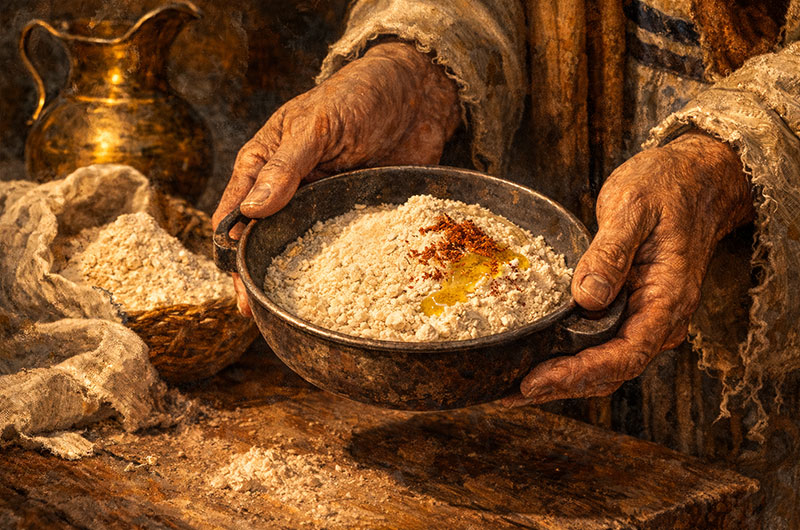
A poor person who also seeks the need to get close to G-d but who cannot afford an expensive korban may bring a Korban Minchah made up of a small measure of fine flour mixed with oil and spice (2:1). In contrast to the wealthy person whom the Torah calls adam, a poor person is called nefesh, a soul. The sacrifice of a poor person who takes his own bread out of his mouth is dearer to G-d than the sacrifice of a wealthy person who takes money out of his pocket. It is as if such a poor person has sacrificed his own very existence, his nefesh, to G-d.
Today, in the absence of the Temple, our prayers are a substitute for the korbanos.
Why is the afternoon prayer called Minchah and not Tzoharayim, which means afternoon? Because, the afternoon prayer, like the Korban Minchah, is G-d’s favorite. G-d listens and responds to the Minchah prayers just as he did when Eliyahu beseeched Him in the afternoon to send down a heavenly fire and consume the sacrifice in the showdown with the prophets of the Ba’al. The Minchah prayer is time taken out of one’s working day just as the Korban Minchah is food taken out of one’s mouth. And after all, time is money.