 October 16, 2026
 Categories: Headline / Book Reviews / Arts
Walking a Fine Line
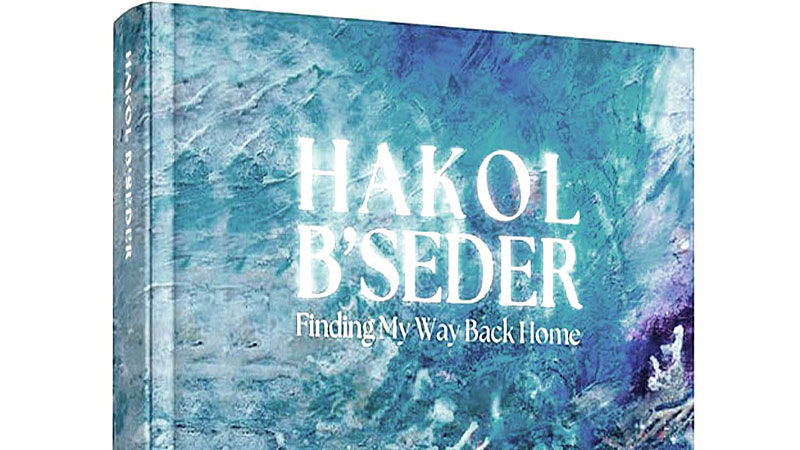


Title: Hakol B’Seder
By: Bari Mitzmann
Menucha Publishers
There’s a meme that circulated during Covid depicting a dumpster engulfed in flames, captioned with the phrase “it’s fine, I’m fine, everything is fine.” It was the perfect combination of dark humor, irony, and the desperate desire to pretend that everything was okay during a time of deep fear and uncertainty. The meme went viral, spawning its own merchandise such as T-shirts, plushies, stickers, and desk toys, and soon the crafting community joined in as well, giving birth to a crochet pattern for an “emotional support dumpster fire”; a squat and smiling yarn mascot that remains a best seller on Etsy.
Although the dumpster fire and its accompanying mantra became popular during Covid, its underlying message, the desire to pretend that everything's okay when it’s obviously not, is nothing new. When someone asks, “how are you,” we rarely stop to consider the question; the automatic answer is “fine.” We share an unspoken societal contract, a combination of politeness, self-protection and sometimes shame, that prevents us from revealing that we are anything other than “fine.”
Hakol B’Seder by Bari Mitzmann is the memoir of a young woman’s journey through a profound crisis of both faith and mental health. Unlike other memoirs about observant Jews who struggled with faith and chose to leave, Mitzmann did the opposite. “The answer would not be trading in the Judaism I was living for nothing, but rather trading it in for what it could become... a Judaism that was about connection and relationship, rather than judgment and alienation.” Compounding Mitzmann’s personal struggles was her very public persona as a popular Instagram influencer known for showcasing cool tzniusdik outfits while also sharing parsha sheets and resources for mental health assistance. At the height of her existential crisis, she chose not to share her spiritual breakdown with the thousands of followers who looked to her as a source of Torah authenticity and inspiration, opting instead to uphold the social contract of “fine” but definitely not “fine.” “Safe to say,” says Mitzmann, “I felt like a fraud.”
Mitzmann divides the book into twelve chapters corresponding to the Hebrew months of the year, skillfully weaving together how the spiritual lessons contained within the Jewish holidays helped her radically alter and reestablish her relationship with Hashem and reclaim her mental health. In order to fully understand the nature of Mitzmann’s transformation, it is important to also understand how her struggle with anxiety at a very young age became entangled with her feelings towards Yiddishkeit. In the introduction to the book, Mitzmann recalls being about six or seven years old and learning about the “scales,” which are the symbol of the month of Tishrei. She learned what we all learned, that Hashem places our good deeds and bad deeds on opposite sides of the scale and our goal is to ensure that the good side always outweighed the bad. As an anxious, self-professed Type A child, Mitzmann took this lesson seriously, so seriously that in her mind, if she missed one mitzvah, she had tipped the scales the wrong way and was going to Hell. This faulty thinking created a one-dimensional G-d of fire and brimstone, one who would smite her down for every infraction. “The Judaism I built for myself wasn’t a complex, nuanced religion with a Hashem who loved me and cheered me on. My Judaism was ruled by an uncompromising accountant.” She assumed that everyone thought this way, that her thinking was normative, that this was the definition of religion, that this was the G-d that everyone worshipped, and so this was the G-d that followed her into adulthood, and at the beginning of 2020 this was the G-d that Mitzmann wanted to step away from. In the throes of an acute religious breakdown on a Shabbos, Mitzmann’s husband ran to get a local Rabbi to talk her off the proverbial ledge, and one of the first things he told her after she described her religious experiences and viewpoints was “that wasn’t normal.” She had been expecting the usual speech, some iteration of what she calls “toxic emunah” which she describes as “the unhelpful platitude that ‘if I just had a little more emunah, things would work out and I would live happily ever after, anxiety-free.’” Much to her surprise, she received empathy and validation, and it was this initial conversation that ultimately began her mental and spiritual recovery.
Although Hakol B’Seder is primarily about the intersection of Judaism and mental health, much of Mitzmann’s book also speaks to anyone who is looking for ways to strengthen their connection to Judaism. In her chapter for Sivan called Naasheh V’Nishma: Creating Meaning and Actualizing Potential, Mitzmann reminisces fondly about the first time she stayed up to learn on Shavuos night, describing it vividly through physical sensations – “the bitter smell of coffee – the sky changing from black to grey to blue – the surreal feeling of walking home in daylight, dreaming, while the world comes awake.” She knew (as all women know) that once she had a family this would change, and while speaking to other women about Shavuos, a pervasive sentiment that women expressed was feeling bad that their only association with the holiday was cheesecake and stress. Mitzmann decided to do something about it and began hosting a yearly women’s kiddush in her home on the second day of Shavuos where she served light snacks and gave a quick dvar Torah. Looking back at what she started, Mitzmann reflected, “I am proud that instead of only lamenting my Yom Tov situation, I harnessed the power of naaseh and did something about it… this lesson goes beyond Shavuos… it taught me about my own potential to create change.” At this point in her life Mitzmann was already on her way to better mental health, but even while she was struggling, throughout the book there are examples of her deep desire to help others and generate connections. At the beginning of Covid, shortly after her existential crisis, she realized that Pesach was coming and that some people would be spending the chag alone. She quickly compiled a six-page Haggadah handout based on the teachings of Rabbi Eliyahu Kitov and the notes she had taken in school and downloaded it to about five hundred people. She named these handouts “Hakol B’Seder,” and the meaning was twofold: First, that everything we need to reexperience the arc of slavery to redemption is in the Seder, and that the Seder is actually structured to be therapeutic; and second, hakol b’seder literally means “everything is fine,” which of course it wasn’t, it was a total dumpster fire, but the sentiment was a wish for the future.
Another chapter that resonated was Kislev – Owning Up or Being Owned: Navigating Consumerism with Purpose, where Mitzmann discusses the dichotomous nature of being a frum social media influencer. She comments that on Chanukah we celebrate the victory of the Chashmonaim over the Greeks, which was essentially the battle between spirituality and materialism, ruchnius and gashmius. And yet, “we are becoming defined by what we are buying into rather than what we spiritually value.” Further on in the chapter she talks about the disconnect between wanting to use her social media presence as a way to spread awareness about mental health and spirituality but also needing to lean into the consumerism aspect of her IG page in order to financially keep her platform going, and often the brands and items she showcases are very pricey. “Ironically, it’s the consumerism aspect that allows me to continue to set aside time to invest into the spiritual ‘influencing’ aspect of it.” Ultimately, she hopes that people will associate her with being a mental health advocate and not a retail goddess. “Now that’s an influence I’d like to have.”
With each chapter, Mitzmann reveals a little bit more about herself, and we learn that not only did she experience anxiety, she also had panic attacks, Lyme disease and peripartum depression. She shares that although she has seen a profound change surrounding the topic of mental health in the frum community, stigma and shame still persist. She relates that she was once speaking to a room full of women of varying ages about mental health, and while the teens and their moms nodded knowingly, there was one older woman in the audience shaking her head disapprovingly. Having grown up in the generation right above Mitzmann, I can attest that not only was mental health not discussed in the frum community, it was barely addressed by the medical community as well. I remember as a young teen going to the pediatrician for a persistent stomach ache, and after a lot of poking and prodding the doctor sent me home with the diagnosis of a “nervous stomach,” though how he knew this was a mystery to me for not once did he even ask if I was nervous. A few years later, as a newlywed in a rigorous graduate program, I was diagnosed with stress-induced IBS. My husband and I still laugh at the doctor’s treatment plan which he earnestly wrote down on a lined sheet of paper and handed to me like it was a homework assignment. 1) Reduce stress. 2) Drink eight cups of water. 3) Get eight hours of sleep. I kept that piece of paper for a long time, and the older I got, the more I realized the absurdity of it, the assumption that “being stressed” was controlled by a spigot, and I could turn it off at will, if I just tried hard enough. I’m the mom in the room nodding when Bari Mitzmann talks about mental health.
In Rabbi Reuven Boshnak’s haskama for Hakol B’Seder, he comments that it is cathartic to write down our struggles, tragedies, and triumphs, for not only does it help the writer clarify and solidify their thoughts, but it also helps anyone who reads it as well. He quotes Rav Kook from Mussar Avicha 1, “One cannot fulfil one’s obligations unless they write a book of their own.” Rav Kook teaches us that in order to truly understand ourselves, we are obligated to write down our personal insights and emotional struggles in order to achieve the highest level of personal growth. Mitzmann mentions that after she wrote the book, she showed it to a few people and someone recommended that the manuscript undergo clinical editing by a mental health professional in order to remove any parts of the book that could be triggering to other people and would simultaneously protect Mitzmann from revealing too much of herself to the public. Mitzmann comments that participating in the clinical edit revealed to her how much she had grown since she initially wrote the book, and that she found the editing experience itself to be “quite healing.”
Although mental illness transcends race, sex, age, geography and religion, multiple studies from reputable sources such as Psychology Today and the American Psychiatric Association confirm that the incidence of mental disorders is underreported in the Orthodox Jewish community. Unsurprisingly, the reasons they cite are ones that most of us know well: stigma, shame, and the potential impact on shidduchim. Allowing mental illness to go untreated has multiple consequences, which is why this book is so important.
Bari Mitzmann’s objective in writing Hakol B’seder was singular – not to titillate, not to garner sympathy, and not to attract more Instagram followers, but simply to let anyone who was struggling with similar challenges know that they were not alone. Mitzmann also emphasizes that, as with any other chronic illness, mental health issues are never totally eradicated; there are flares and setbacks, but thankfully, she now has the tools to navigate them and regain her equilibrium and say, “Even if I fall, I’ll be okay.” In the last paragraphs of the book, Mitzmann reflects on her journey, and while she is proud of the book itself, “it’s the growth that these pages reflect that I feel is the true accomplishment.”
The book’s title Hakol B’Seder began as a wish, masquerading as reassurance, a phrase she could offer up at a time when neither she nor the world was b’seder – and the intimate journey chronicled in these pages transformed that wish into a new reality. Today, when Mitzmann says “hakol b’seder,” it is no longer a facade or a reflex, but an authentic truth she can proudly claim as her own.