


 November 20, 2026
Categories: Headline / Columns
Walking in Jerusalem


When we first arrived here for the year, we knew that car prices in Israel were significantly inflated as compared to the U.S. Since leasing a car for a year was very expensive, we were advised that we should buy a used car and sell it at the end of the year. That would both limit the costs and also minimize one’s liability in the unfortunate case of damage to the car. (Others suggested that we do a car swap, but that apparently is questionably legal, albeit relatively common.)
So we went about looking for a car that was big enough for a family of six and in reasonably good shape but also used. We almost bought one car but when we took it to a mechanic, he strongly advised against it, so we passed on it.
Then we turned around after a couple of weeks with no car and realized that we didn’t really need one. We had a huge park basically in our backyard, a makolet across the street, a major supermarket a 15-minute walk away and a dozen shuls within walking distance. We were walking our little kids to gan and our bigger kids (4th and 7th grade) were taking buses to school with their friends – Israeli kids are independent! And basically, anything we would need in Jerusalem was just a bus ride or two away.
So we decided to try out life without a car. And in the months since, we have found our decision consistently vindicated, for several reasons.
First of all, and anyone who has lived in a city knows this, having a car is efficient until you need to park it. While Katamon doesn’t have the alternate side rules of Manhattan and has somewhat more space on the streets, it is still a real hassle and one cannot simply pull up in front of one’s house like in a suburb.
Moreover, driving in Jerusalem, and especially in Katamon, is no small feat. (It’s not quite the Old City or Meah She’arim, but sometimes it seems pretty close.) You have two-way streets with parking on both sides that cannot possibly fit more than one car, which leads to crazy backups as cars try to barely scrape by within an inch of one another. And don’t get me started on the occasional bus-truck stare down that can freeze traffic for minutes on end. Maybe it shouldn’t be surprising, but streets laid out for a small neighborhood before 1948, which has since grown tenfold, can’t support a large driving population.
And the truth is, Jerusalem has a fairly good bus system. When the buses aren’t stuck in traffic, they can take you basically anywhere in Jerusalem. We have gone to the Kotel by bus, and I made it up to Givat Ze’ev to meet someone, and it’s reasonably easy to get to the center of town.
But the best part of not having a car is the walking. Despite being a fairly large and sprawling city, Jerusalem is also relatively walkable. On Sukkot, when we visited the President’s open sukkah, we walked there, with kids in tow – 25 minutes. There are multiple eateries, bakeries, makolets and stores, and certainly shuls and schools, all easily walkable.
When the little ones are not in tow, there are even more options. When not in my office at Hebrew University’s Mount Scopus campus (more on that below), I’ve spent a fair amount of time either working or meeting with colleagues within walking distance of my home. I often walk to the National Library of Israel, a beautiful site that serves both tourists and researchers well and where I’ve been working 2-3 days a week (stay tuned for a future article on the topic). It’s walkable in under a half-hour, and during rush hour about the same time by bus, so I have a choice, depending on weather and mood and my preference for reading or listening to a podcast. Both the Hartman and the Van Leer Institutes are easily walkable, and I’ve gotten coffee multiple times with colleagues in the Emek Refaim area, although the area is currently in a state of desolation due to the light rail construction.
(In theory, when they finish building the leg of the light rail to Baka, and connect it to the other lines, it will be easy to get to the center of town, the main bus and train stations, the Kotel, and more. They are even supposed to complete an intercity train station within walking distance. But it’s not clear to me if these projects will be completed in 3 years, as scheduled, or if we’re actually talking about a 10 – 20-year odyssey.)
Of course the value of walking goes beyond only the efficiency of getting places without having to park a car or wait for a bus. There are also the health benefits of regularly walking places, rather than resorting to a sedentary lifestyle that the suburbs lull one into. It is energizing and refreshing to be outside – maybe a bit less in the hottest parts of the summer or coolest parts of the winter, but certainly during the majority of the year, with its comfortably warm climate. Even in the fall, when Israelis think it’s freezing, a body conditioned on New Jersey weather experiences it as a mild, cool day.
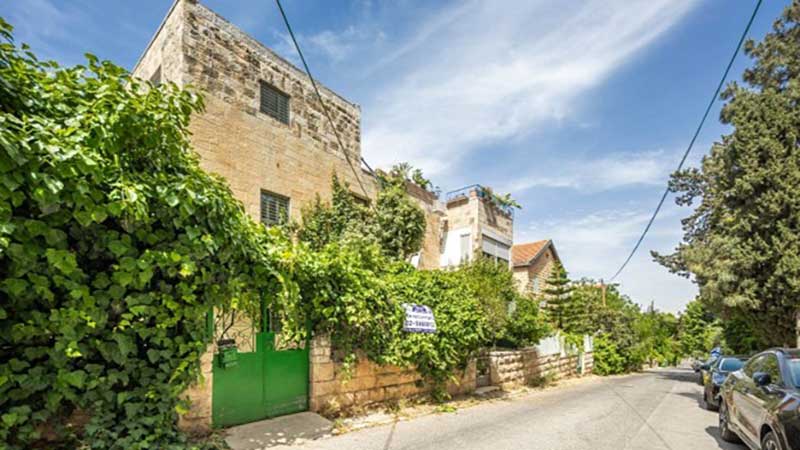
And Jerusalem is simply a beautiful city – the combination of classical Jerusalem stone and a decent amount of trees and plants (certainly in Katamon) really works. There are so many cultural, historical, and religious landmarks that one just passes by on a regular basis. It is great to be able to step out and read the signs about which historical figure lived in this house, or learn about what this street name signifies, which can only really be done on foot.
I will admit that there are two scenarios in which it would be helpful to have a car. The first is traveling to other communities for Shabbat, which we hope to do from time to time. This past Shabbat, for example, we went to good friends of ours in Raanana. It is not really practical to take a city bus and then an intercity bus for several hours with a crying toddler, so a car is pretty necessary. Luckily, there is the option of the CityCar, a Zipcar equivalent, where you rent a car for a day or two without paying exorbitant car rental prices. (Their policy is that the cars can’t be driven on Shabbat, and therefore one does not pay for Shabbat as part of the rental.) It’s not cheap but it’s a reasonable option for an occasional intercity adventure, and it’s well worth it.
The other place where a car would be helpful is for my commute from Katamon to Har Hatzofim, Mount Scopus, for Hebrew University’s Humanities campus. I’m generally there two days a week, and there is no direct or efficient bus from our home. It’s a twenty-minute drive without traffic (up to an hour at rush hour), but by bus it usually takes at least an hour. I have been splitting these four weekly trips between getting rides with local colleagues (a huge percentage of Hebrew University faculty lives in Baka) and finding the optimal bus line that doesn’t get stuck in local traffic and includes 20 minutes of walking to the stop. Not ideal, but manageable.
As with everything, not having a car has its tradeoffs. But it certainly seems like we’ve made the right decision to go carless. As Jerusalem improves its public transportation further, this should become an even clearer preference. For now, we are happy to get the sechar halicha, the merit of walking, in Eretz Yisrael. As Rabbi Yochanan says: “Whoever walks four amos in Eretz Yisrael is assured to make it into the World to Come” (Kesubos 111a).