September 11, 2026
 Categories: Headline / Perspectives / Op-Eds
We Need Not Walk Alone


The outside world can be deeply corrosive to our religious values, and so we have a core value and survival strategy of insularity... staying apart. While the Charedi sector (Yeshivish and Chasidish) is more strict and the Modern Orthodox value interaction up to a point, it is safe to say that proactively and deeply engaging with the non-Jewish world is not a priority. Sometimes we do it (for business, legal issues, etc.) but much of it is bedi’eved… we do it if we have to, and carefully.
While the Orthodox Jewish world makes up only one-quarter of one percent of the U.S. population, we are actually growing and have flourishing, vibrant neighborhoods and institutions. So, do we need the outside world? Let’s think about that.
Most of us know community members who have been successful – sometimes remarkably so – often in businesses that are active in broader society. And we also know that they often share with our community! So there is a benefit. We also know (from a 2024 survey) that Orthodox Jews are knowledgeable and thoughtful in their political decisions. That survey showed that issues affecting the Jewish community are far more important (85% say this guides their vote) than a candidate’s political party (26%). That survey concluded that Orthodox voters are aware of what’s going on out there and vote accordingly. We are not passive (insulated) when it comes to voting.
Another example is Jewish education. Many studies cite the cost of Jewish education as the biggest issue confronting the community. But we are out there. The OU’s Teach Coalition is succeeding in making Jewish day schools and yeshivas more affordable, better funded, and more secure. This success derives from significant interaction and dialogue with the non-Jewish community.
I am sometimes reminded of a classic song, “You’ll Never Walk Alone,” from the 1945 musical Carousel. Despite our successes, the events of October 7, the ongoing war, and growing antisemitism often make it feel like we are increasingly alone in a challenging, dangerous world. So, have attitudes on more aggressively interacting with the non-Jewish world changed?
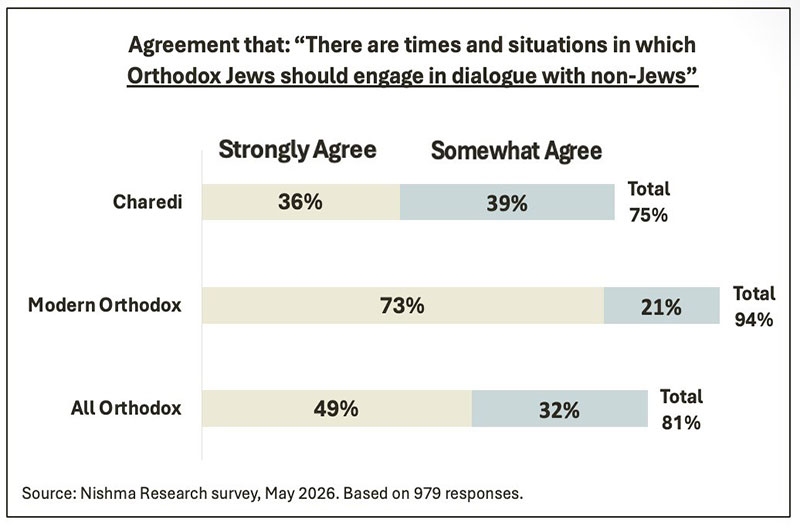
Indeed, a new survey of the community shows that an overwhelming majority of Orthodox Jews are open to dialogue and collaboration, where appropriate, with non-Jews. When we asked “Do you agree that there are times and situations in which Orthodox Jews should engage in dialogue with non-Jews?,” 81% of all Orthodox Jews agreed.
But when and why should we dialogue? Interestingly, combating antisemitism ranked as the #2 reason and Israel advocacy ranked as the #3 reason. I was surprised that the most often cited reason to interact with non-Jews was civic, political, and legal issues affecting the community. As the report stated: “The strongest theme is working with non‑Jews on government, policy, and public‑sphere questions that affect Jews and their neighbors alike. Areas such as local/national politics, zoning, education funding, school vouchers, security funding for houses of worship, general public policy issues, social services.”
We Orthodox Jews believe in gederim – fences, or boundaries. So, we need to think about which ones are needed at this time. I would like to share with you some thoughts from members of our community, and my hope is that these thoughts will guide us in this important decision… how we interact with the non-Jewish world. (OK, I said “how” and not “whether.” That’s my personal view.)
Say ‘OK’ Before We Say ‘No Way’
Quite a few people expressed a general broad approval and willingness to dialogue with non-Jews, with comments such as:- “Everything except theological/religious discussions.”
- “If we do not engage and are very separate then it leads to more contempt since we are not viewed as being part of society. We should dialogue about everything and anything.”
- “Anything involving the secular world. I think we do ourselves a disservice to only look at the world through one lens. Our connection to Judaism should be strong enough that engagement with the secular world won't lead us astray or collapse our belief system.”
- “No specific situation in mind, but I think we generally benefit as a community when we have a broader view of the world and the realities on the ground. I usually find more ways that dialogue is helpful than hurtful. I can't think of many times I've found dialogue to be harmful.”
Show Who We Are
Some see dialogue as an opportunity to portray Orthodox Jews as “nice, normal, friendly people”:- “Professionally, 99.9% of my co-workers are not Jewish. Some of my neighbors are not Jewish and I always engage in friendly conversation. There are enough reasons why people have negative views towards Jews. Being unfriendly or unprofessional should not be a reason.”
- “(We should dialogue on) any occasion that presents itself. For example, a Black friend, in conversation when visiting us, said, "Are there any poor Jews?" She had never met one. I was able to show her our multiple tzedakah boxes, two of which serve the poorer Jews in our community. Then my friend was fascinated to hear and talk about mitzvot, acts of chesed, the kosher food pantry, etc. She had a lot to share with me, too!”
- “Any opportunity to create a Kiddush Hashem should not be passed up. It could be many kinds of situations that can't just be listed.”
Issues of the Day: Israel and Antisemitism
Of course, antisemitism and Israel are clearly areas where we need to engage in dialogue:- “The entire Jewish community needs to learn and be trained on how to explain when criticism of Israel becomes antisemitic. They need to be able to teach people the tropes. They also need to be willing to explain the impact of aggressive anti-Israel expression.”
- “If there is a pro-Israel rally, go there and be proud. I bought a shirt at Amazon that has the U.S. and Israeli flags on the front, and they are bound together. People see me wearing it and they smile at me. Be proud, be strong, and don’t be afraid to engage.”