 October 9, 2026
 Categories: Halacha & Hashkafa / Torah
What Difference Does It Make as Long as You Get There?


Menachos – Daf 13
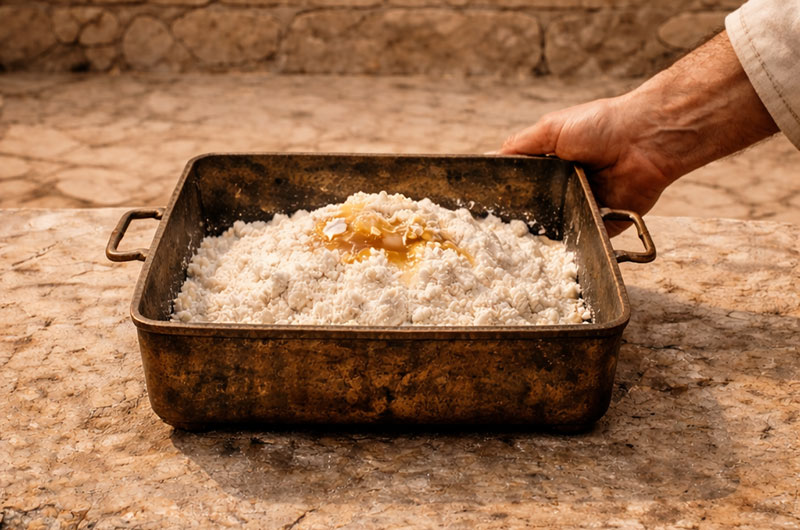
Our Gemara on amud beis discusses the parallels of the sacrificial rituals of an animal versus a Korban Mincha. For example, the handful of flour that is taken from the Mincha for the altar is parallel to slaughtering, as it activates the sacrifice. The Gemara wonders how placing the handful of flour in the vessel is comparable to accepting the blood in the vessel.
At first, the Gemara considers them not parallel, declaring: “If we say that the meal-offering is piggul [invalidated due to intent to eat it outside the prescribed time or place] because the placing of the handful into a vessel is comparable to the collection of the blood of a slaughtered offering into a service vessel, one can ask: Are these rites in fact comparable? There, in the case of animal offerings, the blood enters the vessel by itself, whereas here, the priest takes the handful from the meal-offering and casts it into the vessel.”
At this point in the reasoning, there is a logical disconnection between passively accepting an outpouring of blood versus actively placing the handful inside.
However, after some give-and-take, the Gemara declares the opposite: “What difference is it to me if the permitting factor enters the vessel by itself or whether one takes the item and casts it into the vessel?”
We must ask what accounts for this 180-degree U-turn – from finding placing the handful into the vessel as dissimilar and logically unmatched to receiving a pouring, and then declaring it to be really the same thing?
I would suggest the following explanation. At first, the Gemara’s reasoning was that accepting the pouring out of the animal’s blood is a humbling process that induces meditations about mortality and the endpoint of matter returning to G-d. This must be passive in order for us to truly digest and accept our vulnerability and temporality in comparison to G-d. Placing a handful simply does not induce the same state. However, the Rabbis relented to a softer stance. Though perhaps not as perfect a meditation or repentance, the person, after all, still has a goal of sacrifice and service. Metaphorically speaking, the goal is to end up with the item in the holy vessel. What’s the ultimate difference how it got there? In other words, the person’s goal is humility and return to G-d; how he gets there, while it might be significant, is, with the right intentions, ultimately insignificant.
(While not precisely the words of the Rama, the basic idea is adapted from Toras HaOlah II:24.)
The Tzitz and Object Relations
Daf 14Our Gemara discusses the power of the tzitz to render impure matters acceptable for sacrifice, and its limitations according to some, such as whether it is limited to material for the altar or even sacrificial food. How do we understand this power of the tzitz, and what lessons does it teach about our nature?
Rav Hirsch, whose commentary on Vayikra is spectacular at highlighting the symbolic content of sacrificial rituals, explains as follows (Shemos 28:38):
The tzitz has the power to purify the objects, but not those engaged in the practice on an individual level. The wording of the verse is “avon hakodoshim,” the sin of the sacred material, and the derash is “the sin of the sacred material, hakodoshim, but not those who declare it sacred, makdishim” (Menachos 25a). Because the forehead of the Kohen Gadol, who represents the entire service of the Sanctuary, bears the inscription “Holy to Hashem,” explicitly declaring that G-d – in the full sense of His free, personal Being – is the sole One to whom the Sanctuary is dedicated, and toward whom all sacred objects are directed, this inscription is capable of removing any cloud of distortion that might affect the sacred objects regarding their orientation to the One G-d.
But that is only if the defect is purely objective, inherent in the object itself, and confined within the narrow circle of the Sanctuary. Only offerings that ascend the altar – that is, sacrificial elements such as blood, the handful, and the fats, which are offered directly to Hashem – are included. It does not apply unequivocally to items eaten, such as meat, where the relationship to G-d is mediated and the priest or owner who consumes the offering stands in the foreground.
Likewise, in communal offerings fixed to a specific time – including the daily Minchas Chavisin of the Kohen Gadol and the bull of Yom Kippur, since the Kohen Gadol represents the community – impurity is considered set aside. This principle is grounded not merely in the idea of communal offering, but in the defining feature of fixed time (see Temurah 14a). Indeed, any offering fixed to a time is, in a broader sense, a communal offering. (And I believe Rav Hirsch is saying that the community itself is also objectively godly as a totality, as opposed to the individual, who is subject to subjective distortion that is too bounded to earthly matter for the tzitz to purify.)
Tum’ah, representing death and the vacuum of G-d’s life-force, brings impurity. But humans have free will, and when it comes to our loss of connection to G-d, we must also reach out and cannot receive blanket dispensation. We see that certain powers of community and/or places that have been set aside as objectively sacred by G-d have a special, sweeping, intense power, such that the awareness of G-d – in an absolute form as inspired by the tzitz – can rise above impurity. Unfortunately, our subjectively generated distortions do not get repaired by this broad function; for that, we must internally rectify.
Tefillin Without Shema – Did He Get the Yoke?
Daf 15Our Gemara on amud beis discusses the principle that a person may bring his offering today and the accompanying libations from now until even ten days later. We have a teaching from Gemara Berachos (14b): “Anyone who recites Shema without tefillin, it is as if…he has offered a burnt-offering without a meal-offering or a peace-offering without libations. Despite the fact that he fulfilled his obligation, his offering is incomplete.”
The Pesach Einayim (ibid.) asks: Why is this a problem, since we learned in our Gemara that one does not have to bring the libations concurrent with the sacrifice?
One answer he offers is that without the wine, one cannot perform the Levitical song that goes along with the sacrifice. So, there is a qualitative loss, much like reciting Shema without tefillin may be technically fulfilling the obligation, but is subject to a qualitative loss without enacting the acceptance of the yoke of Heaven through symbolic action.
The Torah (Bereishis 9:7) describes an interlude whereby Noach planted a vineyard. The narrative, plus the commentary, point in the direction of criticism of Noach for indulging in getting high.
Perhaps Noach was traumatized by the utter destruction that he witnessed and sought to cope with those feelings, though this was not necessarily an appropriate form of self-medication. This could be the lesson itself: Drink to celebrate and rejoice, not to deal with sorrow.
Sefer Daf Al Daf offers an idea based on our Gemara: Noach meant well and wanted to complete his sacrifice by offering libations, which is allowed at a later date.
I suggest that we can use this peshat to develop another answer to the Pesach Einayim’s question. The Gemara in Berachos was obliquely referencing Noach’s sin. He had good intentions, but his acceptance of the yoke of Heaven was not complete, and his desires led him astray. So too, if one negligently recites Shema without donning tefillin, he is not in the correct state of acceptance of the yoke of Heaven and may not succeed in his spiritual endeavor, just as Noach’s attempt fell short.