October 2, 2026
 Categories: In Print / Headline / Perspectives / Op-Eds
What Kind of Socialist Is Zohran Mamdani?
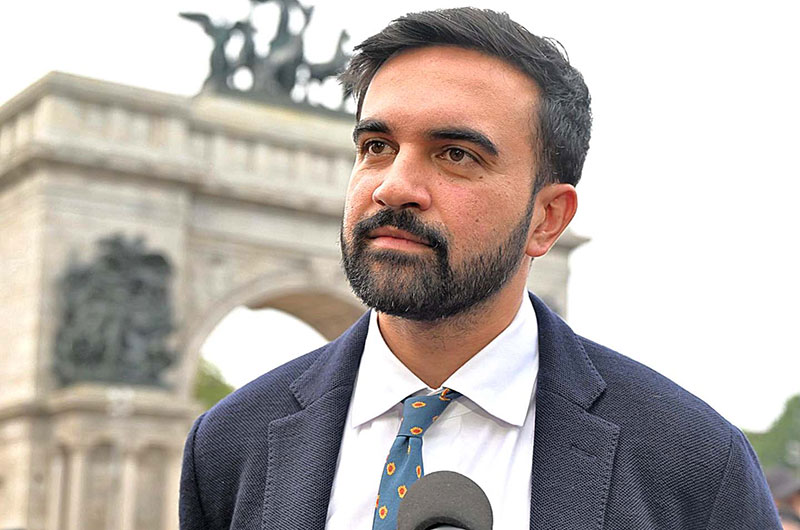


If Zohran Mamdani wins the New York City mayoralty election next month – as now seems tragically likely – there will be no shortage of talk and commentary about his being a socialist and the most left-wing mayor in Gotham’s history. Fair enough. But what’s bound to be missing, at least in the mainstream media, is a serious discussion of what kind of socialist he is, where he stands on today’s radical spectrum, and why his ascent is so significant – and menacing.
Mamdani isn’t an ordinary, old-school socialist. He is both a celebrated member of Democratic Socialists of America (DSA) and at once a product and avatar of the international intersectional left – a revolutionary movement that has overtaken and reshaped the DSA. Its twin goals are to tear down the American political and economic system in order to rebuild it along Marxist lines and to eradicate Israel in order to replace it with a Palestinian state stretching from the Jordan River to the Mediterranean Sea.
A theory first advanced in American law schools to describe overlapping forms of discrimination, intersectionality has mutated into a race-and-gender-obsessed worldview that essentially divides humanity – and countries – into categories of oppressor and oppressed. Western nations, heterosexual white men, successful minorities, law-enforcement agencies and institutions – you name it – they are all designated as oppressors; everyone else, as their victims. Within this bizarre binary system, Jews are regarded as privileged; Israel, the one Jewish state, as an outpost of Western imperialism. Muslims, in contrast, are generally considered victims of “imperialism,” along with the world’s 57 Muslim nations.
Over the past decade, intersectionality has fused with Marxism and postcolonial dogma – a creed that interprets every global disparity as a legacy of Western conquest and dominance – creating a transnational movement cloaked in the language of social justice and human rights. What began as arcane academic theory and campus jargon now defines the rhetoric of global NGOs, parts of the United Nations system, and left-wing political parties from London to Los Angeles.
Intersectionality links domestic racial activism with global anti-Israel agitation under the banner of “decolonization.” The IDF is branded an oppressor abroad, and the NYPD is denounced in the same light at home. The DSA’s platform calls for defunding police and abolishing prisons, while demanding an end to military aid to Israel. In both cases, not only are the protective institutions of free societies portrayed as illegitimate, but the societies themselves – the ways in which they are structured and governed – are condemned as inherently racist and unworthy of existence.
Intersectionality is so radical and so ideologically twisted and tangled – as shown by the spectacle of “Queers for Palestine” marching in solidarity with gay-hating Hamas terrorists and Iran’s medieval ayatollahs – that it can make an observer nostalgic for the odious, but simpler, identity politics of the Obama era.
Mamdani is the first major American political figure to emerge from an intersectional, postcolonial, Marxist milieu. He embodies its worldview in his campaign themes, alliances, and policy goals – and in his refusal to condemn chants of “Globalize the intifada!” Repeatedly accusing Israel of committing genocide in Gaza, he has vowed to exhaust every legal means to arrest Benjamin Netanyahu if he visits New York.
The intellectual pedigree behind Mamdani’s rise makes his near-certain takeover of City Hall all the more remarkable – and revealing. His mother, Mira Nair, is an Indian-born, internationally acclaimed filmmaker whose work views the world through a distinctly postcolonial and feminist lens. His father, Mahmood Mamdani, is a leftwing Columbia University professor of political science, anthropology and African studies, born in India and raised in Uganda after his family’s emigration.
An important figure on the postcolonial left for decades, Mahmood Mamdani has called Israel an apartheid state, championed the BDS movement, and portrayed America as the fountainhead of global evil. At a 2022 panel promoting one of his books, he claimed Hitler’s inspiration for the Holocaust came from Abraham Lincoln, insisted there is “no difference between nationalism and colonialism,” and argued that the Allied powers in World War II were just as racist as the Nazis. He has described America as the “genesis of what we call settler-colonialism.”
In his 2004 book, Good Muslim, Bad Muslim: America, the Cold War, and the Roots of Terror, he wrote that Islamist suicide bombers should not be seen as terrorists, but “as a category of soldier.”
His latest book, Slow Poison, revisits Uganda’s history under Idi Amin, seeking to recast one of Africa’s most brutal dictators as a populist nationalist resisting Western domination. Such outrageous revisionism reflects a broader tendency on today’s left: to rationalize or excuse tyranny and terrorism when It targets the West.
That ideology explains why Students for Justice in Palestine – whose Bowdoin College chapter Zohran Mamdani founded – and the DSA both condemned the recent Gaza cease-fire agreement. Their goal isn’t peace in the Middle East unless it involves Israel’s annihilation.
For American Jews, the danger is direct and immediate. By labeling Jews as “white” and Zionism as “settler-colonialism,” the intersectional left erases Jewish peoplehood and denies Jews the right to self-determination anywhere on the planet and most especially in their ancient homeland. On campuses and in city streets, that message has translated into harassment, vandalism, and physical assaults.
In short, Zohran Mamdani’s attention-getting campaign promises – free buses, free childcare, government-run grocery stores – are not what makes him dangerous. His Communistic musings about seizing properties owned by “bad landlords” aren’t even what is most threatening. The real threat lies in his ideology and what it represents: the arrival of the intersectional left in political power. His triumph in New York City will be celebrated not only in DSA headquarters but in the anti-Israel corridors of the United Nations and in Islamist circles that share the movement’s hatred of Western society.
A Mamdani administration won’t merely mismanage budgets; it will weaken the institutions that safeguard ordinary, law-abiding citizens – especially the police and the public schools that nurture gifted students – while emboldening enemies of the free world. His expected victory in America’s greatest city – home to the largest Jewish population outside Israel – will be a milestone in the intersectional left’s long war against Western civilization itself.
Put differently, Zohran Mamdani becoming mayor will mark the transformation of America’s most international city into the capital of international intersectionality. His election will make the middle-finger insult to the Jewish community that was Columbia’s appointment of his father as Herbert Lehman Professor of Government – named for the financier and Democratic statesman who was New York’s first Jewish governor and later its United States senator – pale by comparison. Mamdani’s election will be, in effect, a giant Drop Dead! message to Jews – to those, at least, who believe in the Jewish people and in Israel’s right to survive and flourish.
(That he is expected to win a sizable portion of the Jewish vote is utterly shameful and almost unfathomable – a subject, suitable for study by psychiatrists and psychologists as well as political scientists, that is beyond the scope of this essay.)
What is most troubling about Mamdani’s ascent is what it portends: that radical leftwing candidates armed with grassroots networks and intersectional coalition-building may offer Democrats a viable new path to power. If his campaign succeeds, it will almost certainly energize broader efforts within the party to push for sweeping ideological and operational shifts. Future anti-Israel candidates are likely to be embraced by Democrats because of – not in spite of – their hostility to the Jewish State.
Whether Mamdani’s victory becomes a local aberration or a national template remains to be seen. Urban chaos under his rule could provoke a backlash against the far left. Time will tell.
In the meantime, how to confront – and defeat – the ideological menace Mamdani embodies may well prove to be the greatest political and moral challenge of our time.