October 2, 2026
 Categories: Headline / Columns
What the Torah Asks of Us in the Days After Yom Kippur
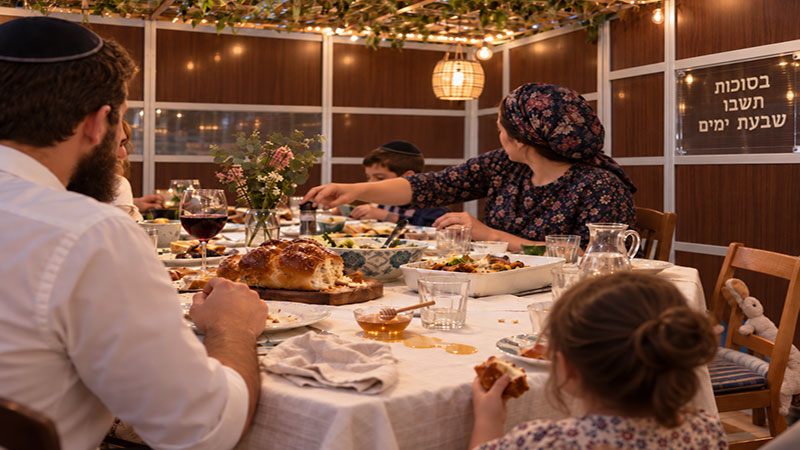


The sukkah goes up fast. Usually, the house still smells a little like the meal that broke the fast. By the next afternoon somebody is outside with a drill and last year’s mats, trying to remember which pieces go where and discovering which wall panel warped over the summer.
We are used to this, so it is easy to miss how odd the sequence is. A person spends Yom Kippur fasting, stands through Ne’ilah, says things about his life that he does not usually say out loud. Four days later the Torah tells him to go eat supper outside.
The language of the mitzvah is “baSukkos teishvu shivas yamim” – dwell in sukkos for seven days, so that the generations will know that Hashem caused Bnei Yisrael to dwell in sukkos when He took them out of Mitzrayim (Vayikra 23:42-43). Chazal take “teishvu” quite literally. Many of the halachos of sukkah are based on that verb, and the interpretation that comes from it: teishvu k’ein taduru. Live there the way you live at home. For seven days a person makes the sukkah his keva and his house arai. Meals move outside. So do learning, conversation, sitting around, and, when weather and circumstances allow, sleeping.
That is an unusual form for a mitzvah. The mitzvah keeps absorbing things that would have happened anyway. You can be fulfilling it while eating soup, listening to your child tell a story, or sitting at the table after everybody else has gone inside.
The timing of Sukkos makes this stranger still.
The Vilna Gaon asks why we commemorate the ananei hakavod in Tishrei. The clouds accompanied Klal Yisrael when they left Mitzrayim, which happened in Nissan. Why wait six months?
His answer goes back to the Eigel. After the sin of the Golden Calf, the clouds departed. Moshe came down with the second luchos on Yom Kippur. On the next day he gathered the people and commanded them about the Mishkan. The materials were brought over the following days, and on the fifteenth of Tishrei the work began and the clouds returned.
So, the clouds we remember on Sukkos have a history. They had surrounded Klal Yisrael before the Eigel. Then they were gone. By the time they came back, the first luchos had been broken, Moshe had spent another forty days on the mountain, and Yom Kippur had entered Jewish life as the day on which Hashem forgave them.
The next project was the Mishkan.
The Midrash calls it Mishkan HaEdus, the Mishkan of testimony, because it was a testament to the forgiveness of the Eigel. The Midrash gives a mashal of a king who loved his wife, became angry with her, and left. Her neighbors told her that he was never coming back. Eventually he returned to the palace and ate and drank with her. The neighbors finally understood that the relationship had been restored when they smelled the spices coming from inside.
So too, it writes, Moshe asks how the nations will know that Hashem has forgiven Klal Yisrael. Hashem tells him that He will cause His Shechinah to dwell among them. The Mishkan will make the reconciliation visible for all to see.
The proof, in that mashal, is remarkably ordinary. The king is back in the house. They are eating together.
There is something very familiar about that stage of a repaired relationship. People in the middle of repairing something serious describe that stage to me often. The important conversation may already have happened. Someone apologized. The apology was accepted. Both people know that the relationship is going to continue. Still, for a while, every interaction carries the weight of what happened. The person who caused the hurt may keep returning to it: Are you really okay? Are we really okay? Do you know how sorry I am? He can mean every word and still have trouble giving up the role of the person who is apologizing. Staying in that role is often the safer position. As long as he is still apologizing, he does not have to find out whether he has actually been received back.
The other person may genuinely have forgiven him and still find that the rupture is somehow present in the room every time they talk.
Then, at some point, they’re having dinner. They complain about traffic. Something makes them laugh. One of them gets mildly annoyed about something that does not matter very much. Somebody asks for the salt. And suddenly they realize that twenty minutes have gone by and neither of them has thought about the conversation that once seemed to fill every inch of the relationship. Nothing special actually went on; it’s just that we feel like us again.
That kind of return is not appropriate in every situation. Some injuries require distance. Some relationships need firm boundaries, and some should never return to their previous form. But when repair is wanted and possible, forgiveness can precede the return of ordinary life.
The same gap can exist after Yom Kippur.
A person can do real teshuvah and still remain in the posture of the person who sinned. He goes back over what he did, examines whether his regret was sufficient, wonders whether he meant his vidui enough, wonders whether Hashem really forgave him. Sometimes the continued intensity itself begins to feel religious. If I still feel terrible about it, perhaps that proves that I am taking it seriously.
Not everyone leaves Ne’ilah feeling that anything has been resolved. And even when a person believes that his teshuvah was real and that Hashem has forgiven him, there may still be something to learn about living before Hashem after forgiveness.
The calendar moves quickly into that question. Yom Kippur ends, the work of the Mishkan begins, the clouds return, and the mitzvah of the fifteenth of Tishrei is teishvu. Dwell here.
The people under those returning clouds were carrying the Eigel in their history. They had stood at Har Sinai, and they had also broken something terribly important. Yom Kippur did not erase that history. The returned clouds surrounded the people who had lived through it.
A few days later, we build our own sukkos and move ordinary life inside.
A person comes in hungry. He may be tired from building the sukkah and tired from Tishrei already. He may still be carrying something he said in Al Cheit. He may have a resolution he is not sure he can keep. He may be thinking about something much less consequential, like whether there is enough chicken for everyone or why nobody remembered to bring out the drinks.
He sits down anyway.
By the third day, the sukkahhas acquired a routine. Everybody knows where they sit. There is honey on the tablecloth. Someone reaches across someone else for the challah. A child gets up in the middle of the meal and wanders back into the house, and somebody has to call him out again. Someone tells a story that goes on too long. Overhead there is schach and a little sky.
It has been an hour, maybe more, since anyone at the table thought about Yom Kippur.