 September 25, 2026
 Categories: Headline / Features / Aliyah
When the Rabbis and Rebbetzins Make Aliyah


Rabbi Daniel Korobkin and his wife Karen always knew they would make aliyah one day. As the Senior rabbi and rebbetzin of Beth Avraham Yoseph of Toronto, or “The BAYT,” the largest Orthodox congregation in Canada and one of the largest in North America, the question was simply one of timing. “We already knew that when we came to Toronto, this was going to be our last stop on the way to Eretz Yisrael, so it’s not like this was a decision that was difficult for us to make,” said Rabbi Korobkin.
Before taking up his position at The BAYT 15 years ago, Rabbi Korobkin was the senior rabbi of Yavneh, a Jewish educational institution in Los Angeles, and before that he served as the spiritual leader of congregations in San Diego and Allentown, Penn. He has also served as president of the Rabbinic Council of America. But after decades of leadership in communities across North America, the Korobkins plan to retire from their positions and move to Israel in 2027.
“My wife and I are both grandparents many times over, and so it’s time for us to really let a younger rabbi come in – and start our next chapter and really be productive as much as we can in Eretz Israel,” said Rabbi Korobkin. “And had we waited longer, I don’t know that we would necessarily be able to have as much of a productive chapter in Eretz Yisrael.”
Rabbi Korobkin is one of a number of prominent Modern Orthodox pulpit rabbis across North America who plan to move to Israel over the next few years, as aliyah rates from Western countries continue to rise. According to the data from the Israeli government’s Ministry of Aliyah and Integration, while aliyah rates overall have fallen in the last few years (which demographers attribute to a slowed surge of Russians and Ukrainians fleeing war), Western immigration, against a backdrop of increased antisemitism, continues to rise.
In 2025, according to the Ministry of Aliyah and Integration, 8,499 people made aliyah from the United States, France, the United Kingdom, and Canada, a 25% increase from the year before. Nefesh B’Nefesh, an organization that facilitates North American immigration, saw a 12% increase in aliyah in 2025. This summer, Nefesh B’Nefesh anticipates more than 2,300 North American olim, an increase from 1,500 olim three summers ago, according to Marc Rosenberg, Nefesh B’Nefesh’s vice president of Diaspora partnerships.
The Rabbinic Council of America, North America’s leading membership organization for Orthodox rabbis, does not track the number of rabbinic leaders who make aliyah, but, according to Executive Vice President Rabbi Menachem Penner, there has been increased interest, particularly since October 7.
“More rabbis are asking questions, exploring possibilities, and thinking seriously about their future in Israel,” he said. “That does not mean that every rabbi who explores aliyah ultimately moves. Many conclude that, at least for now, their responsibility is to continue serving their communities. But the level of serious inquiry has certainly increased.”
Amid this trend some prominent pulpit rabbis in America have signaled their commitment to Diaspora Jewry. Rabbi Shaul Robinson, who has for more than 20 years served as the senior rabbi of Lincoln Square Synagogue, a Modern Orthodox congregation in Manhattan, confirmed via Facebook in March that he had renewed his contract with the shul and plans to keep his position “for the foreseeable future.”
Though much of his family lives in Israel, and Rabbi Robinson noted that he and his wife Sarah plan to join them in retirement, he wrote, “The idea that it would be in anybody’s interest for all of the experienced and senior rabbis of American Jewry, the largest Diaspora community in the world, one that still has such a hugely important part to play – the idea that all of the rabbinic leadership of America should make aliyah, and leave the community rudderless, is, to my mind, a non starter.”
He continued, “I am, for better or for worse, a community rabbi and a Diaspora rabbi,” adding, “That is where my strengths are, that is where, thank G-d I have seen a measure of success and much personal fulfillment.”
Other rabbis view their role differently. For more than 20 years, Rabbi Daniel Cohen has served as senior rabbi of Congregation Agudath Shalom in Stamford, Conn., the largest Modern Orthodox shul in New England. The synagogue was founded in 1889. “Thank G-d, [it’s] a place where there’s a lot of chesed that’s done, a lot of learning that’s done, a lot of Israel advocacy that’s done, and thank G-d it’s a thriving community,” said Rabbi Cohen.
In 2029, Rabbi Cohen and his wife Diane will be making aliyah, after being asked last year to lead a new community in Yerushalayim built around “The Duet,” a housing complex under development meant to attract particularly Anglo olim. Several of the couple’s children already live in Israel, and they have discussed making aliyah in the past, but it wasn’t until being invited to lead The Duet community that the timeline fell into place. “It was really a phone call that turned into a calling,” said Rabbi Cohen.

For Rabbi Cohen, leaving Agudath Shalom for Israel is bittersweet, but he is not worried about any leadership gap in the congregation. “I think [what] is most important is that a successful shul is not a shul that’s reliant upon one particular person,” he said. “It’s what’s called a purpose-driven shul, the shul that knows what its values are, and people embrace those values.”
The perspectives of Rabbi Robinson and Rabbi Cohen reflect a larger conversation, one where the ideal that many Orthodox – particularly Modern Orthodox – rabbis have of living in Israel may come in conflict with leading a community in the Diaspora.
“Rabbis devote years of their lives to serving their communities, often with great personal sacrifice. They and their families deserve the same opportunity as anyone else to consider what is best for their future, including aliyah,” said Rabbi Penner. “At the same time, they naturally feel a strong responsibility to the communities they have built and served.”
Rabbi Korobkin, who has been in the rabbinate for close to 40 years, has noticed this as well. “Most North American rabbis, especially the ones who have been in the rabbinate for a number of years, are struggling with this idea right now,” he said.
Rabbi Korobkin’s philosophy about what it means to be a shul rabbi reflects his choice to make aliyah at this point in his life. “I feel that I’ve given the best part of my productive years to Klal Yisrael, and now it’s time to go on to the next chapter,” he said.

“I think people start new chapters all the time, and it’s perfectly legitimate for even people in the rabbinate, and who are doing holy work, to say, ‘I put in X number of years, I feel I’ve been productive.’” Rabbi Korobkin gave his congregation two and a half years of notice before his upcoming aliyah, and the shul has a search committee that, working in tandem with Yeshiva University, is dedicated to finding a new rav.
Historical Precedent, Contemporary Challenges
This kind of passing of the torch – and the larger discussion surrounding Diaspora leadership – has centuries of historical precedent. Notably, the so-called “aliyah of 300 rabbis” from 1210-1211 saw Rav Samson ben Abraham (Rash) of Sens, a leading French Tosafist, and a number of his colleagues make what was then the extremely arduous journey to Israel. But according to Rabbi Dr. Ephraim Kanarfogel, a professor at Yeshiva University and a foremost expert on medieval Jewish history and rabbinic literature, not only is the number 300 an exaggeration, but there is also “no evidence for any palpable void in the leadership of the communities that they left behind, where they were succeeded by their colleagues and students,” he said.
Still, according to Rabbi Kanarfogel, some German rabbinic leaders at the time chose to stay in the communities they led. “Remaining in these communities would likely facilitate and preserve greater observance of mitzvot overall, given the challenges of the journey to Israel itself … as well as the difficulties that would be encountered in keeping the mitzvot ha-teluyyot ba-’aretz (if not the more basic mitzvot) for those who successfully reached the Land of Israel,” he said.
The situation in Israel today could not be more different, and, like Rabbi Cohen, Rabbi Kalman Topp will also help establish a new community in Israel. Rabbi Topp has served as the senior rabbi of Beth Jacob Congregation, a Modern Orthodox shul in Beverly Hills, for 17 years, in addition to currently serving as first vice-president of the RCA. Previously, he served as associate rabbi of Young Israel of Woodmere, N.Y., and as rabbi at the Albert Einstein College of Medicine. He and his wife Dr. Jordana Topp, who serves as the Los Angeles community’s yoetzet halacha, anticipated moving to Israel within five years of getting married. “We were committed to this to the extent that we even exchanged appliances that we received as wedding gifts to 220 volts, but ultimately we decided to use our kochot to contribute to Jewish communities here in the U.S.,” he said.
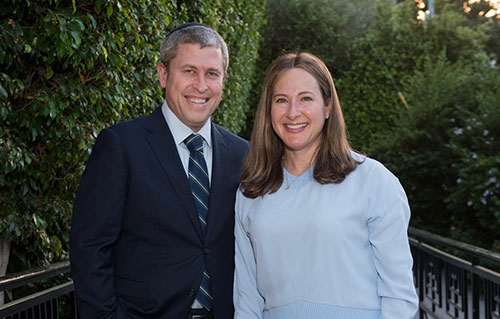
Now, the Topps have been brought on to help build a congregation in Givat HaMatos, a new community under development in Yerushalayim. “Our kehillah will be geared toward Anglos and open to all, offering the connection, inspiration, and sense of belonging that many are familiar with from their Jewish communities in the U.S.,” said Rabbi Topp. “We’re also very excited about the prospect of being involved in building up Yerushalyim and playing a more active and direct role in yishuv ha’aretz.”
Rabbi Topp views his responsibilities “in terms of concentric circles: family, community, the Jewish people, and the wider world,” he said. “Each circle has real importance, and each one should strengthen the next.”
He added, “So in deciding where I can best serve, I’ve looked for a place where those circles can align: where my family can thrive, where I can help build a strong community, and where that community can contribute meaningfully to Am Yisrael.”
Will Congregants Follow?
Rabbi Topp said his decision has “generated lots of conversation” in his shul, with some members potentially thinking more seriously about aliyah – even asking questions about Givat HaMatos in particular – and others “finding other ways to make Israel a more meaningful part of their lives.” For most Modern Orthodox rabbis, including Rabbi Topp, conversations about Israel are a constant feature of leadership, and they start far before any aliyah announcement. And, though the leader of a congregation making aliyah may inspire more members to think about or even make aliyah themselves, it is unusual today for many members of a congregation to actually follow their rabbi to Israel.
There are exceptions, most notably in the case of Rabbi Shlomo Riskin, the founding rabbi of Lincoln Square Synagogue (which Rabbi Robinson now leads). Rabbi Riskin, upon making aliyah in 1983, established the settlement of Efrat, becoming its founding chief rabbi. When he moved, he brought many members of his congregation with him. But most would admit this is an unusual case, and that may explain some of the hesitancy among some shul rabbis in the Diaspora to make aliyah, despite their own personal aspirations.
Rabbi Efrem Goldberg, the senior rabbi of the Boca Raton Synagogue (BRS) and an influential Orthodox voice, expressed something to this effect at a symposium transcribed in Yeshiva University’s Pesach 5786 edition of “Torah To-Go,” a YU Torah publication. The symposium and the larger edition in which it is included share a title: “Diaspora Judaism at a Crossroads,” reflecting what many view as a decisive moment in post-1948 Jewish history, especially amid rising antisemitism.
Rabbi Goldberg was one of several rabbis – both in the Diaspora and in Israel, and including Rabbi Penner of the RCA – invited to discuss “the future of Diaspora Judaism in an age of growing Aliyah” and “to reflect on the meaning of galus, the rise of antisemitism and the challenges and opportunities facing Diaspora communities in the years ahead.”
The symposium transcription quotes Rabbi Goldberg as saying that, despite “a profound yearning” to make aliyah, now his “responsibility, mission, and purpose” are in the Diaspora. “I am often challenged with the premise that if I were to declare my intention to make Aliyah, the community would follow,” he continued. “Unfortunately, experience suggests otherwise, as evidenced by rabbanim who have made that move in the past and in the present without triggering a communal migration.”
Supporting Rabbis Who Make Aliyah
At the symposium and to The Jewish Press, Rabbi Penner emphasized the need to support rabbis and their families who desire to make aliyah as well as promote strong leadership in the Diaspora. “Those goals should not be seen as contradictory,” he said. “A healthy Torah community supports its leaders as people, even while it plans responsibly for its own future.”
To that end, the RCA last year launched the Aliyah Resource Initiative, which Rabbi Penner said reflects increased curiosity about aliyah among rabbinic families. “After years of giving to their communities, they deserve guidance, encouragement, and practical help as they consider their next steps,” he said. “We also want to help set them up for success in Israel, so that their experience, leadership, and Torah can continue to benefit the klal.”
Ultimately, the symposium questions not only how one can “reconcile” an aliyah ideal with Diaspora investment but also how “the Diaspora [can] sustain strong religious practice, communal cohesion and Torah scholarship as many of its most learned families and educators move to Israel.”
“If more experienced rabbis make aliyah, communities and institutions need to invest more seriously in developing the next generation of rabbinic leaders. That means identifying talented young people, encouraging them toward rabbanut and chinuch, mentoring them, and making those careers professionally and financially viable,” Rabbi Penner told The Jewish Press. “We can celebrate rabbis who build their lives in Israel while also taking the need for strong rabbinic leadership in North America seriously.”
At the symposium, Rabbi Larry Rothwachs, the rabbi of Congregation Beth Aaron in Teaneck, N.J., who is making aliyah this summer to build a new community in Ramat Beit Shemesh, suggested that Diaspora communities will need to “expect leadership circulation, invest in cultivating local leadership, and maintain strong relationships with Israeli centers of Torah learning.”
He continued, “The long-term model is likely not separation but integration: shared faculty, shared institutional initiatives, and leadership pipelines that assume movement between Israel and the Diaspora over the course of a career.” This way, he said at the symposium, “leadership movement is not abandonment” but rather “participation in a broader, shared project of building Jewish life across multiple centers of Jewish reality.”
This answer reflects a reality that some leaders of Anglo organizations in Israel think is already unfolding. Among them is Rabbi Avi Berman, executive director of OU Israel, the Orthodox Union’s Israel branch that opened in 1979. When more olim arrive from different Diaspora communities, he said, they will bring with them connections to the communities they left, inviting Diaspora rabbis for Shabbos and hosting the yeshiva and seminary students from their old communities back home. “It’s going to connect more Jews to each other,” said Rabbi Berman. “It’s going to connect Jews in the Diaspora to Jews in Israel, which is absolutely an incredible thing.”
In the meantime, OU Israel is expanding to meet the needs of the increasingly diverse population of Anglo olim, giving them, through its programming and initiatives, a soft place to land in Israeli society (while also serving at-risk Israeli teens). Last year, OU Israel moved into a new headquarters in Yerushalayim’s Har Hotzvim neighborhood. This, they hope, will allow their various initiatives – which include things like NCSY programming, a summer camp, Yachad Israel, and the publishing of the most popular English-language Torah booklet in Israel, Torah Tidbits – to have a further reach.
While rabbis who make aliyah may not always find the same opportunities to lead congregations as they had in the Diaspora, Rabbi Berman said that they, like other kinds of professionals who come to Israel, still have the opportunity to make an impact. “They really come with a tremendous amount of – call it a toolbox, that could really help the communities here,” he said. “And when I say help the communities here, I’m not just talking about the Anglo communities.”
The Call to Live in Israel
For Ariela Davis, leadership in Israel wasn’t part of her family’s decision to move at all. Before making aliyah in 2020, Davis was director of Judaics at Addlestone Hebrew Academy and rebbetzin of Brith Sholom Beth Israel in Charleston, S.C., where her husband was rabbi. “Practically, it was a lot of kiruv, a lot of working with people who were either not religious but wanted to learn about Judaism, a number of gerim, people who went through the process while we were there,” she said. Estimates put the Jewish population of Charleston as less than 10,000.
But she knew from the time she was a child that she wanted to make aliyah, so it was never a question for her family. Though leaving Charleston was “very, very emotional,” she doesn’t see the move as leaving the Jews of Charleston behind. “I think [that for] any Jewish leader, anybody who’s talking about Israel and thinks that Israel is important to them, it’s not enough to just go to Israel all the time,” she said.
She added, “I would say to my students, … ‘Ask me why I’m not living in Israel, don’t be embarrassed to ask me that.’ Every leader should feel that they have to respond to their community, their congregants, their students, whoever it is, and say, ‘Well, if I believe in Israel so much, why am I not there yet?’ And it’s something that everybody should be struggling with.”
Though today Davis serves as principal of Ulpanat Orly, a school for 7-12th graders in Beit Shemesh, and her husband has also found meaningful work in Israel, they didn’t move with any idea of what they were going to do. This uncertainty, she said, may keep a lot of shul rabbis in the Diaspora. “A lot of rabbis really feel a sense of loss of identity,” she said.
While Rabbi Cohen and Rabbi Topp will help build new Anglo communities in Israel – and Rabbi Korobkin said he is “looking into a number of different things” and is “in discussions with a developer” to potentially lead a congregation in Israel as well – all said they plan to maintain the connections they built in their old communities.
“I’ll be coming back a number of times during the year. I’ll be teaching, even in Yerushalayim, and there’ll be virtual opportunities to learn together,” said Rabbi Cohen. “And I’ll be in Stamford, obviously not on a regular basis, but I’ll be here a number of times over the year to maintain those relationships, which my wife and I really cherish, and we still want to be part of people’s journey in life.”
Perhaps, this interconnectedness between Israeli-Diaspora Jewish communities means Jews on both sides of the ocean can ultimately win. But despite acknowledging that strong Diaspora communities are necessary, rabbinic leaders know where the focus of every Jew should ultimately be.
“I think if a person is able to spend time [in Israel], find an anchor there … even if you’re not making aliyah, that will plant memories and sends a message to your family,” said Rabbi Cohen. “That is something that you can’t even quantify, it just says, ‘This is part of who our family is, and rather than going to Florida, or rather than going to some island, our vacations are in Israel.’” For Rabbi Topp, if a Jew does not want to make aliyah, they should at least “want to want to make aliyah.”
Rabbi Korobkin feels similarly. “Everyone should be having a conversation about aliyah, whether or not it turns out that it’s right for you as a personal decision,” he said. “But the fact that it’s a mitzvah to live in Eretz Yisrael means that a person would be derelict as a Jew if they weren’t having a conversation, right?”