 October 16, 2026
 Categories: Headline / Perspectives
Why I Ascended Har HaBayis


“What?! You walked on Har HaBayis?”
I can already hear the critical tone with which friends will ask me this question over Yom Tov.
“Isn’t that forbidden?” they will surely inquire.
In fact, the answer is “No.” No primary halachic source forbids ascending Har HaBayis. What halachaprohibits is walking on the area on which the Beis HaMikdash once stood if one is a temei meis (which we’re all presumed to be nowadays). Walking on any other part of Har HaBayis – which is approximately 90 percent of the mount – is fully permitted for men as long as they aren’t zavim or baalei keri. If they’re the latter (hardly anyone is the former), they must first properly immerse in a mehudar mikveh. That’s it. (The laws for women ascending Har HaBayis are somewhat stricter.)
And in point of fact, Jews have been ascending Har HaBayis for millennia. The Gemara, for example, famously records a conversation between Rabbi Akiva and his colleagues on Har HaBayis after they saw a fox among the ruins of the Beis HaMikdash. When people relate this story, they emphasize the punchline – as they should – but in the process they overlook the fact that several rabbis were standing on what most Jews nowadays think is forbidden ground.
No less a personage than the Rambam ascended Har HaBayis. He writes in a letter: “we left Akko to ascend to Yerushalayim under grave danger. And I entered the great and holy house and prayed there on Thursday, the sixth of Marcheshvan… I made a vow that the days I spent there would be like a festival for me – with prayer, rejoicing with Hashem, eating, and drinking. … Just as I merited praying there in its ruins, so may all of Israel and I see its consolation.”
One of the Baalei Tosafos, Rabbeinu Shmuel ben Shimshon, writes that he ascended Har HaBayis in the 13th century together with the Ri MiLunel:“we went up to the boundaries of the Azarah to prostrate ourselves.” The Meiri (1249-1315) writes, “And the custom is to enter [Har HaBayis] according to what we have heard.”
Two hundred years later, the Radvaz confirms – and endorses – this custom and adds that “there is no doubt that this stone, which is under the Dome [of the Rock], is the even shesiyah upon which the Aron stood in the Kodesh Kadoshim.” This declaration is important because if we know the location of the Kodesh Kadoshim, we can calculate with near exact precision the location of the rest of the Beis HaMikdash based on the detailed measurements Chazal provide in the Mishna.
The Radvaz is just one authority among many who identify the stone in the Dome of the Rock as the even shesiyah. In the 13th century, another one of the Baalei Tosafos, Rabbeinu Yaakov of Paris, writes, “Around the even shesiyah, the Ishmaelite king built an exceedingly splendid edifice and made it a house of prayer, and atop the building they made an exceedingly beautiful dome.” Also in the 13th century, one of the Ramban’s students writes about the Dome of the Rock, “The building stands over the location of the Holy of Holies and the Sanctuary.” The Shelah (c. 1555-1630) declares point blank that “there is no doubt about the location of the Beis HaMikdash.” At least 15 other rabbinic sources state that the Dome of the Rock covers the location of the Kodesh Kodashim – which means we can determine exactly where the rest of the Beis HaMikdash stood and thus where we’re allowed to walk on Har HaBayis and where we’re not allowed to walk.
Why then did the Chief Rabbinate issue a blanket prohibition against ascending Har HaBayis in 1967?
The Rabbinate didn’t really explain its position in any depth, but essentially its calculation was as follows: When the Ottoman Empire conquered the Land of Israel in 1516, it prohibited Jews from ascending Har HaBayis. As a result, the mount soon became unknown territory to Jews. So when the IDF liberated Har HaBayis 450 years later, no one knew precisely which areas were permissible to walk upon. Fearing that non-religious Jews in particular would begin walking on the entire har – including areas near the Dome of the Rock, which is a severe (kares)prohibition – the Chief Rabbinate tried to place Har HaBayis beyond the bounds of all Jews.
It didn’t really work, though. Non-religious Jews today walk wherever they want on the mount. Neither the government nor rabbinic authorities prevent them. The Rabbinate controls religious behavior at the Kotel but not at all on Har HaBayis. In other words – and ironically – by keeping Har HaBayis at arm’s length, the Chief Rabbinate has arguably enabled precisely the kind of violations it originally wished to prevent.
In the meantime, in the 60 years since the Six-Day War, a number of prominent rabbis have researched the location of the Beis HaMikdash in great depth and now know – based on the sources listed above, and others – where the Beis HaMikdash once stood and thus which portions of Har HaBayis are permissible to walk upon. (Incidentally, the police, for political reasons, vigilantly guard every frum group that ascends the mount, so even if a frum Jew wished to enter a forbidden area, he wouldn’t be able to.)
You might be thinking: “This is all very interesting, but I’ve never gone on Har HaBayis before and I’m not going to start now – why should I?”
Respectfully, the answer to this question is the same answer you would give someone who asked, “Why should I go to the Kotel?” You’d say: “It’s the closest you can get to Hashem. How can you not go?” And that’s the reason you should ascend Har HaBayis. The Shechina rests on Har HaBayis to a greater degree than any other place in the world. To not go once one knows that one can go is to spurn kedusha.
Furthermore, revering the makom haMikdash is one of the 613 mitzvos. And, as Rabbi Elisha Wolfson argues in There You Shall Go to Seek His Presence, this mitzvah “is not fulfilled when one overly distances oneself from the site of the Temple any more than one fulfills the mitzvah of revering one’s father by avoiding him.”
Rabbi Wolfson identifies four other mitzvos that one fulfills by ascending Har HaBayis, but anyone who appreciates the holiness of Har HaBayis shouldn’t need these mitzvos for motivation. He should ascend the mount for the same reason the Arabs so jealously guard this site and Hamas fights in its name: Har HaBayis is the spiritual center of Israel.
Yet, so many of us – G-d’s people – ignore it. Hashem’s Shechina rests there, but we express little interest in it. Not only do we not ascend the mount, we permit murderous Arabs to control it, we allow tamei people to visit it, and we do nothing as forbidden trees grow on it.
Seemingly, no one cares. Yet, how dare we not care? Does G-d’s footstool on earth not mean anything to us? And if it does, why does no one demand that the government act? Why doesn’t a single frum politician lobby to uproot those trees, for example?
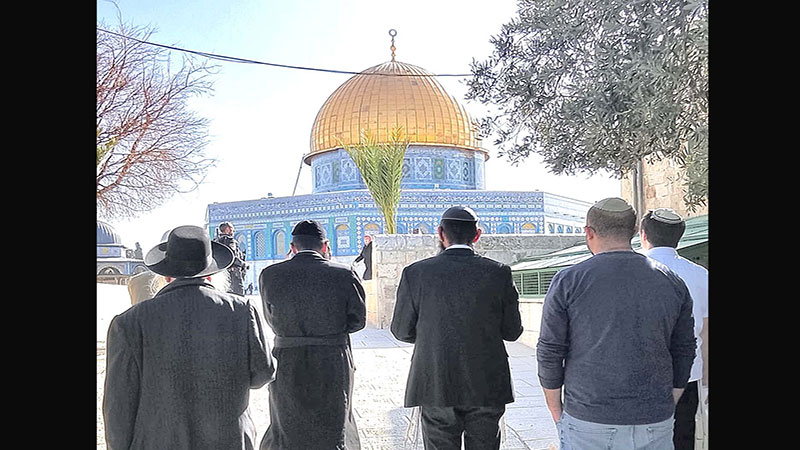
Baruch Hashem, Jewish neglect of Har HaBayis is waning. Whereas a decade ago, only 11,000 ascended the mount, in 2025, over 75,000 did so. And whereas just a few years ago, moving one’s lips in prayer on Har HaBayis was forbidden(!), today, dozens of Jews daven Shachris and Mincha on the mount every single day with a minyan (and full-body prostrations).
Interestingly, these Jews don’t come from any particular “camp.” Both settlers with kippot serugot and chassidim dressed in full regalia ascend Har HaBayis. For while ascending arguably has an ideological component, it goes much deeper than any ideology. It’s about wanting to get closer to Hashem. It’s about showing Hashem that we honor and appreciate His presence. It’s about yearning for the third Beis HaMikdash.