 September 18, 2026
 Categories: Op-Eds
Why the UAE's Unprecedented Annexation Warning to Israel Matters


{Reposted from the MEF website}
Israelis woke up to a potential new era on Friday with an article by the United Arab Emirates ambassador to the US warning that Israel's planned annexation of parts of the West Bank would "upend Israeli aspirations for improved security, economic and cultural ties with the Arab world and with the UAE."
The message was titled "annexation of normalization." This is an unprecedented warning coming from a country that doesn't have relations with Israel but where relations appeared to have unique potential.
The article has several important ramifications, what follows are the top five.
It comes from the US ambassador
The article by Yousef Al Otaiba comes from the UAE's ambassador to the US. It was then tweeted, in Hebrew, by the director of strategic communications for the UAE, Hend al-Otaiba. This is important because Otaiba also attended the "deal of the century" announcement in the East Room of the White House in January. He also gave a statement in January that he appreciated US President Donald Trump's efforts to reach a peace deal and that all concerned parties should reach a deal as part of a way forward.
| The article is much more than a simple comment or warning from Abu Dhabi. |
Overall the comments in the oped or the video were not overly harsh. They appeared more like a warning from a colleague than from an adversary. They were tempered as well, without threats. This is important because it leaves some room for maneuver within this context of annexation and discussions of "normalization." They did not appear to draw a red-line, but rather a warning in the kind of soft chiding terms the Gulf is used to. This means that annexation might not totally derail relations.
In Yediot, not Israel HaYom
The message was delivered via Yedioth Ahronoth, Israel's largest Hebrew daily, to have the maximum affect and to convince the mainstream. While we don't know all the details behind how this article came to be, the choice of venue for something like this would likely be closely followed and studied. Having an article in Hebrew was already a major leap because the ambassador could have chosen to publish in English via a US-based legacy newspaper. The article would have had the same message for Washington and would have been read in Jerusalem.
Going directly to the mainstream Israeli public was a unique choice. What's important also is that while it was in Hebrew, it was not at Israel HaYom or Haaretz. That means it was not seeking to appeal to the left, which is largely harshly critical of Israel's policies and that it wasn't in Israel HaYom, which is widely perceived as very close to Benjamin Netanyahu. That could mean this is an appeal to Benny Gantz, the partner in Netanyahu's current coalition. It can also be seen as a message to Netanyahu to give him a way out of going down the path of annexation because Netanyahu has long championed Israel's foreign relations. What matters is that it appears it was directed at the largest possible Hebrew audience, with knowledge it would be picked up in English as well.
| The article was directed at the largest possible Hebrew audience. |
Two UAE flights have landed in Israel with humanitarian aid
In the last month two UAE flights with humanitarian aid have arrived in Israel. This has been unprecedented and came amid the Covid-19 crisis.

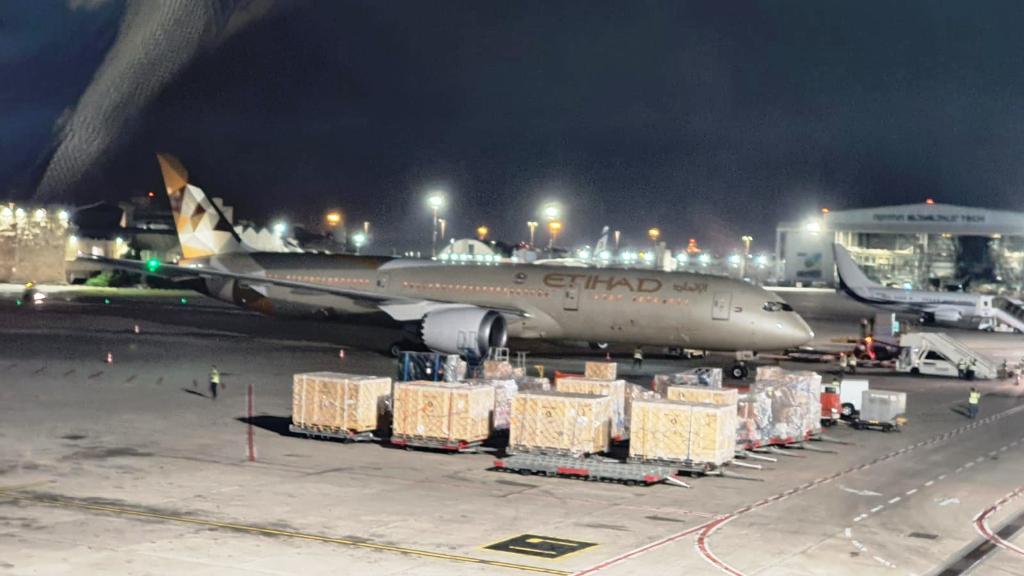
The first flight was on May 20. It was not coordinated with the Palestinian Authority and bypassed Jordanian airspace on its trip, raising questions about controversy it might have caused and Abu Dhabi's attempts to avoid controversy. On June 9 a second flight arrived, this one with the UAE Etihad carrier's markings and a UAE flag. This was an important symbol and judging by reactions to it, there was not very much controversy.
In light of the flights, the new articles and video seem to be suggesting that this progress is in jeopardy. It is important to recall here that overall the steps towards Israel by the UAE have appeared to be incremental and growing. For instance, in December Sheikh Abdullah bin Zayed Al-Nahyan, Minister of Foreign Affairs and International Cooperation for the UAE had tweeted an article by Ed Husain to his 4.6 million followers. It was about "Islam's reformation, an Arab-Israeli alliance is taking shape in the Middle East."
The rest of the Gulf
In June 2019 Bahrain hosted a workshop that was supposed to be part of Trump's "deal of the century." It showcased the economic package available to the Palestinians as part of the plan. Bahrain was slammed by Iran and others for hosting the discussion. However Bahrain has generally been the trial balloon in some comments about Israel over the last years. That the article this week comes from the UAE is a kind of escalation. This is important because Riyadh, Abu Dhabi and Bahrain cooperate closely on policy issues. They have cooperated in a rift with Qatar, for instance. In addition, unlike the monarchy in Kuwait, they have appeared to soften their views of Israel in the last decades. Kuwait is far more critical. Also, unlike Jordan, they have not used as harsh language about Israel's potential annexation.
| The UAE, Saudi Arabia, and Bahrain cooperate closely on policy issues. |
The regional implications
There is a growing crescendo of warnings to Israel about annexation. This has come particularly from Jordan and also from Egypt and Russia in recent weeks. Most countries feel the need to say something, but the question is which are serious in their opposition and which are paying more lip service to the issue?
There are already enough crises in the Middle East, so annexation could either add fuel or could be seen as yet another problem. For instance Lebanon and Syria are in the middle of an economic disaster. ISIS is rising again in Iraq as the US contemplates withdrawing some forces. Iran is stoking tensions in Yemen, Iraq and Lebanon and Syria with weapons trafficking. Turkey is sending drones and forces to Libya. The unseen opposition to annexation may come from Turkey, for instance, has been distracted by Idlib conflicts in Syria and by Libya, but it is possible it will ramp up opposition to inflame the region. Turkey supports Hamas in Gaza and is one of the largest implacable foes of Israel's policies. When Trump moved the embassy to Jerusalem, Turkey became the main opponent to the move in the region.
| Annexation might put the Israel-Palestinian issue back in the center of regional politics. |