 September 25, 2026
 Wisdom Unfettered by Divine Inspiration


For Shabbat Chanukah, in this week’s column we will complete our survey of Ner Mitzvah by the Maharal. We’ve got dreams in the parsha and dreams in our book. Pharaoh – who, as we saw last week, is left out of the count of empires in the dreams of Nebuchadnezzar – has prophetic dreams that require Yosef’s interpretation, while Nebuchadnezzar has prophetic dreams that require Daniel’s explanation.
Daniel has his own prophetic dream: He sees four beasts, the third being a leopard which is the most cunning of all the animals, as it says in Pirkei Avot (5:23), “Be cunning as a leopard.”
In Nebuchadnezzar’s dream, the metal that corresponds to the third empire is copper. Or bronze – bronze is an alloy of copper, and in Aramaic, they’re essentially the same word. When humans learned to make weapons and tools out of bronze, that was the first major technological leap forward since the Stone Age. It marked the dawn of the Golden (bronze?) Age of Greece. In our time as well, copper is fundamental to our progress. Without it, there would be no electrical cables, electronics, or any of our other high-tech tools.
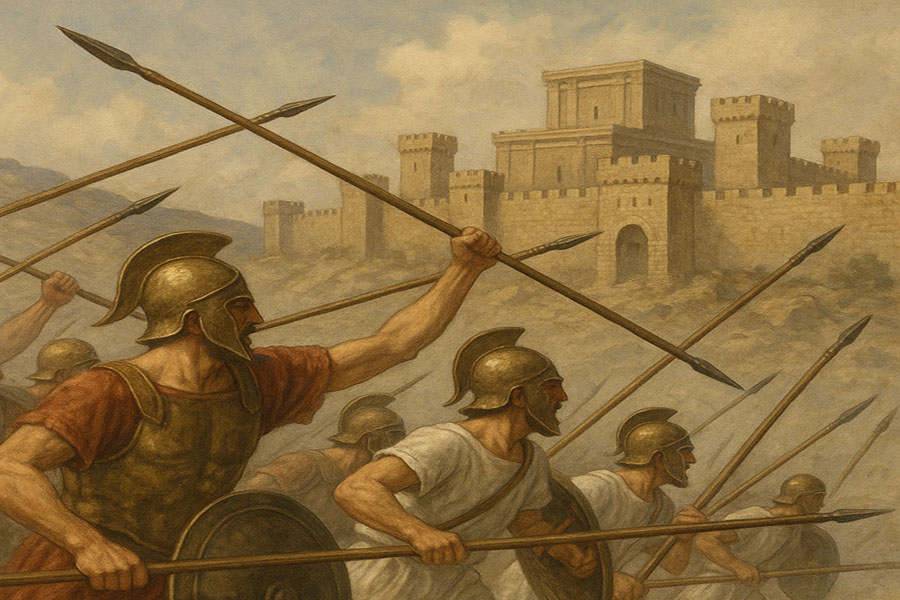
Appropriately, the third empire represented in Nebuchadnezzar’s dream is Greece, the civilization of Socrates and Aristotle – the apex of human wisdom. That is the might of Greece – its unique contribution to human history and also the great danger it represents when it opposes Israel, as occurred in the story of Chanukah. The Greeks (as the Seleucids) represent human wisdom unfettered by Divine inspiration or prophecy – the triumph of the intellect in opposition, where necessary, to the soul. Certainly, this purely human wisdom negates the commandments and the very notion of a “Commander” as being outside the framework of what can be known by reason and philosophy.
The Greeks resent the mitzvot as not rational and because they don’t understand them. In particular, it was very important to those Greeks who opposed Israel (it bears mentioning there were many who admired our wisdom, and whose wisdom was admired by the Sages of Israel) to debase and profane the Beit HaMikdash. The very notion of a special place, unique for the service of the Creator and to the exclusion of those (such as the Greeks) who were not called to this service, was deeply offensive to them. They devoted great effort to compelling Israel to deny our Divine selection, to occupying the Temple complex and desecrating it, and ultimately to hunting and exterminating the Kohanim (such as the Hasmoneans) who insisted on preserving the Torah and its dicta.
It is not insignificant that in those days, as in ours, the rationalists who opposed normative Torah and mitzvot and who advocated for a universalist secular lifestyle were known as Hellenists or Hellenizers. This is the dark side of the Greeks and their wisdom – the opposition to sanctity and to prophecy in the name of reason and humanism.
The Menorah itself, in Jewish tradition, represents the wisdom of Torah illuminating the material world as its light emanates out of the physical space of the Beit HaMikdash via windows that uniquely open outward. Although the miracle of Chanukah was really several miracles (and in the Al HaNissim that we recite all eight days, we list several of these), the basis for our ritual observance of the holiday is the miracle of the light of the menorah that lasted for eight days.
The number eight is important in and of itself because in Jewish numerology, it stands for everything that is beyond and outside of the order of nature. That is to say, there are seven days of Creation, seven cardinal directions (including the central point), seventy elders, and seventy years in a standard human lifetime (although it can continue until a hundred and twenty), and of course, seven lights on the Menorah in the Beit HaMikdash. The number eight is always the supernatural that can’t be measured or perceived with our earthly faculties. Thus, the preeminent miracle of Chanukah is the usurpation of the human wisdom of the Greeks by the miraculous amplification of the Divine light that is unique to the Torah and those who uphold it.
May we merit redemption in our time and victory over the enemies who seek our destruction, as we witnessed in those days at this time.